AI Aesthetic Renaissance: Why It Shouldn't Be Just a Neoclassical Revival
AI's aesthetic renaissance should unlock diverse global craft traditions, not just replicate neoclassical clichés.
When AI slashes creative costs, the resulting aesthetic renaissance shouldn't default to neoclassical revival. Non-Western craft traditions — from Islamic geometric patterns to Japanese kumiko — are far more labor-intensive and complex. AI's true potential lies in making these intricate traditions affordable, not mass-producing Roman columns. However, training data biases risk homogenizing output toward Western classical styles, creating tension between AI's theoretical diversity and practical monoculture.
Introduction: A Debate About Aesthetics
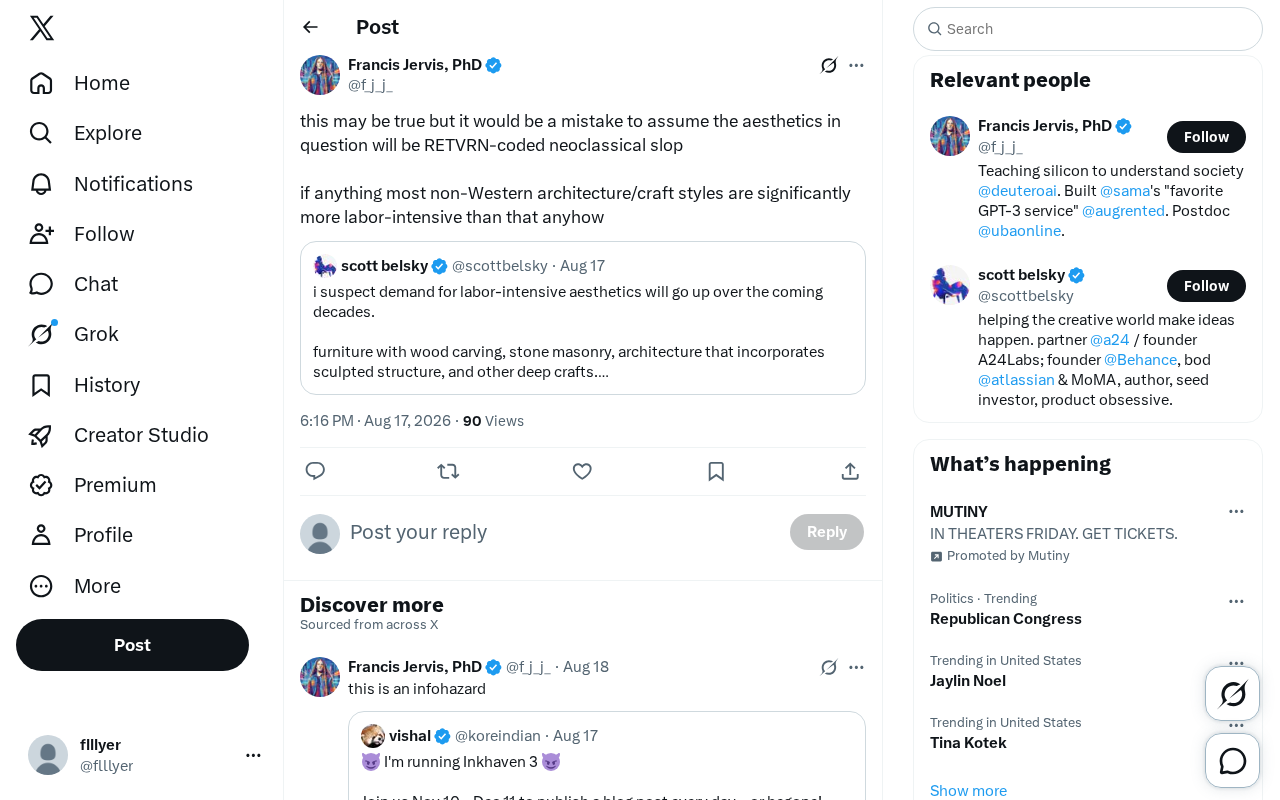
Recently, a Twitter post sparked a discussion about the future direction of AI and aesthetics. The original post responded to a popular hypothesis — that when technology (especially AI and automation) dramatically reduces the cost of creation, human society might witness an "aesthetic renaissance."
The poster argued: "This is probably true, but it would be a mistake to assume that this aesthetic renaissance will be some kind of 'RETVRN' neoclassical slop."
This seemingly brief comment actually touches on a profound question: when AI makes exquisite visuals and craftsmanship readily accessible, what kind of aesthetics will we actually return to?
"RETVRN" Culture and the Neoclassical Myth
What Is "RETVRN" Aesthetics
In internet subculture, "RETVRN" (a stylized variant of "return") is a nostalgia-tinged cultural slogan often associated with calls to "return to tradition" and "return to classical beauty." It typically points toward Greco-Roman sculptures, symmetrical architectural facades, marble colonnades, and other neoclassical symbols.
This aesthetic is highly shareable on social media — it's clean, grand, and easily recognizable, which also makes it easy to replicate en masse. The original poster's use of the word "slop" is a pointed critique: once this aesthetic is industrialized and mass-produced by AI, it degenerates into hollow visual fast food.
Why This Is a Misjudgment
The poster's core argument is this: equating "aesthetic renaissance" with "neoclassical revival" is fundamentally a Western-centric bias in viewing world culture. Aesthetic diversity extends far beyond the Greco-Roman framework, and narrowing the renaissance to a single style actually undermines the imagination of the entire discussion.
The Overlooked Non-Western Craft Traditions
Craft Aesthetics with Greater Labor Intensity
The most insightful point in the original post is: "In fact, most non-Western architectural and craft styles are inherently far more labor-intensive than neoclassicism."
This observation deserves serious consideration. Take the geometric tessellations (girih) in Islamic architecture, traditional Chinese mortise-and-tenon joinery and dougong bracket systems, Japanese kumiko woodwork, Indian pierced stone carving, and Persian miniature painting as examples. These crafts typically require extremely high manual precision, complex repeating pattern design, and years of artisan training. By comparison, while neoclassicism's system of proportions is rigorous, it doesn't necessarily surpass these non-Western traditions in pattern complexity and craft layering.
A Natural Fit Between Complexity and AI Capability
This implies a technological proposition: if AI can truly reduce creation costs, then what it should most liberate are precisely those high-complexity craft aesthetics that were previously difficult to popularize because they were "too labor-intensive" — not the classical symbols that were already relatively easy to standardize.
In other words, the real potential of an AI aesthetic renaissance may lie in making intricate, elaborate handcraft traditions "affordable" again, rather than producing more cookie-cutter Roman columns.
AI and the Deeper Transformation of Aesthetic Production
From Scarcity to Abundance: A Shift in Production Logic
Throughout human history, exquisite ornamentation and craftsmanship were long symbols of wealth and power, because they implied massive human labor investment. Industrialization once drove aesthetics toward minimalism — modernism's "less is more" was, to some extent, a compromise with machine production.
What generative AI brings is yet another restructuring of production logic. When the marginal cost of pattern design, rendering, and iteration approaches zero, "complexity" is no longer a luxury. In theory, we could witness a resurgence of ornamentalism — but this time, the medium is algorithms.
The Risk: Aesthetic Homogenization Driven by Training Data
However, the original poster's caution is equally important. While AI reduces costs, it also naturally tends to generate styles that are "most common in the training data." If the training corpus is dominated by Western classical aesthetics, then the so-called renaissance may indeed devolve into "neoclassical slop" — not because it's the most beautiful, but because it's the easiest for models to imitate and output.
This creates a real tension: technically, AI can support infinite aesthetic diversity, but in practice, it may actually intensify cultural homogenization.
Conclusion: The Open-Endedness of Aesthetic Futures
Though brief, this Twitter comment raises a question worthy of consideration across the entire AI creative field: do we want the aesthetic renaissance brought by AI to be a return to some romanticized past, or an expansion into a truly diverse future that embraces craft traditions from around the world?
The answer largely depends on how we build training datasets, how we design tools, and what cultural vision creators themselves hold. If we merely use AI to mass-produce Roman columns and marble statues, we're just replicating old biases with new technology. But if we can leverage AI to bring the world's labor-intensive, endangered craft aesthetics back into circulation — that is where this technological transformation becomes truly exciting.
The future of aesthetics should not be predetermined. Like human civilization itself, it should be rich and unpredictable.
Related articles

Cursor AI Programming in Practice: Build a Student Management System from Scratch in 30 Minutes
A Bilibili creator demonstrates Cursor AI programming: generating a student management system in 30 minutes with natural language. Details on Agent mode, Claude selection, prompt techniques, and thresholds.

Top 20 AI Coding Tools Ranking: From Rock-Solid to Lackluster, a Scored Matrix
Bilibili creator releases top 20 AI coding tools ranking, tiered T0–T4 from rock-solid to lackluster, with Claude Code and Codex tied at T0. This article details the scoring dimensions (capability, reliability, robustness, durability, cost, domestic availability) and tool performances to help developers choose the right AI coding assistant.

Vibe Coding Systematic Tutorial: Master AI-Assisted Programming from Zero
A three-month Vibe Coding tutorial from a Bilibili creator covering Codex, ClaudeCode, and Cursor, from core logic to commercial project practice for beginners.