AI Agent Approval Gates: Where to Put Human Review in the Loop

Approval gates belong at the tool layer, blocking writes, with external signals and engineering-grade resume to avoid fatigue and misfires.
The article argues that most AI agents put human confirmation at the end of the conversation, after side effects have already happened—too late. Effective gates belong at the tool layer, pausing before write operations that change the outside world, not intercepting every action. Reviewers need precise action diffs, motivation and source, and a timeout policy, plus the ability to edit parameters directly. The author stresses using externally verifiable signals instead of the model's self-reported confidence, and after approval, persisting the pending call, rechecking world state, and using idempotency keys and audit logs to prevent duplicate or stale execution. Finally, high-pass-rate low-risk approvals should be automated so human attention goes to requests that actually get modified or rejected—avoiding approval fatigue that is more dangerous than no gate at all.
Most AI agent demos turn "human confirmation" into a button that pops up at the very end. The problem is—by the time you click it, the email has already been sent and the database row has already been written.
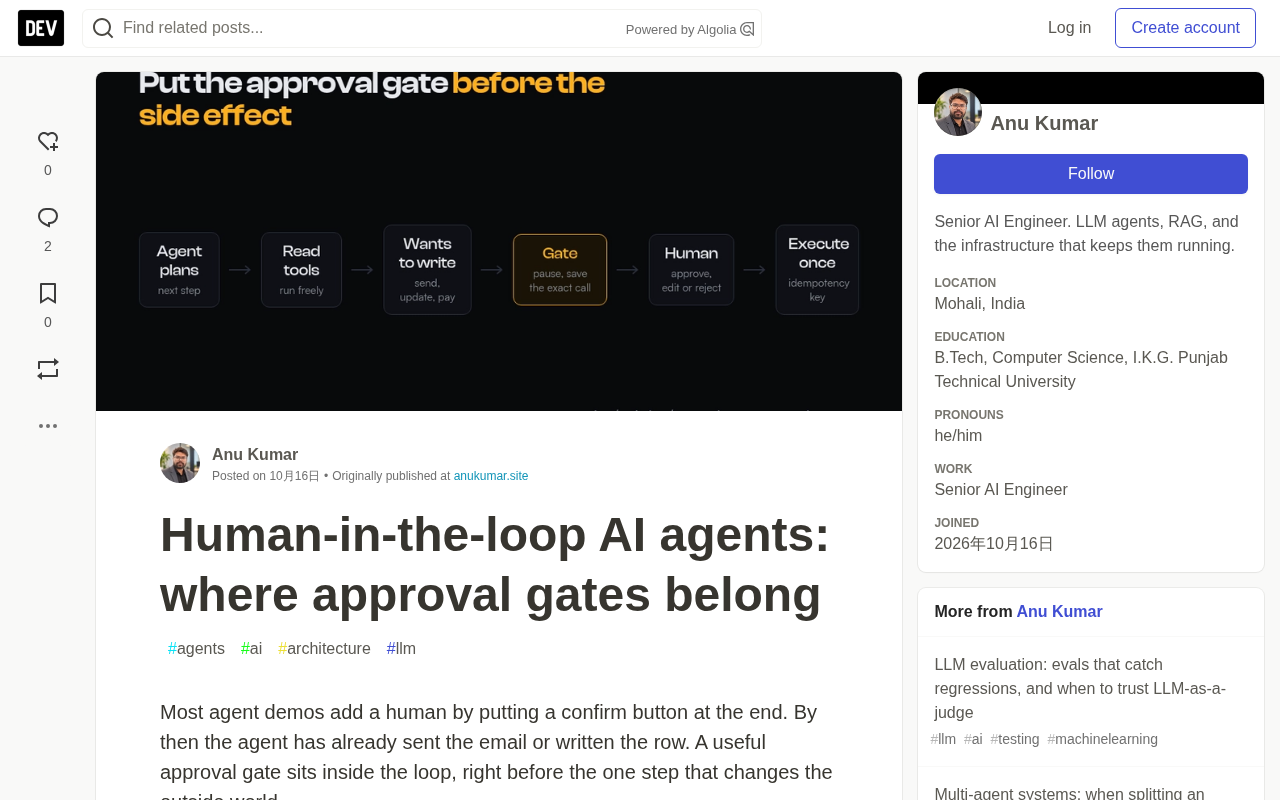
A genuinely useful approval gate doesn't sit at the end of the conversation. It sits inside the loop, blocking the single action that changes the outside world.
Why gates should target "side effects," not "answers"
Agents do two kinds of things: reads and writes.
Reads include searches, document retrieval, and calls to APIs that only return data. Writes include sending messages, modifying records, transferring money, deleting things. A wrong read costs little—you just throw the result away and try again. A wrong write is often irreversible.
So approval gates belong at the tool layer, not the conversation layer. Let the agent plan freely and read freely; the moment it decides to call a tool that writes, stop it, persist the exact call it intends to make, and wait.
def call_tool(run, tool, args):
    if tool.writes and needs_approval(tool, args):
        request = save_pending(run.id, tool.name, args)
        run.pause(waiting_on=request.id)
        return  # resumes later from the saved request
    return tool.execute(args)
The author's rule isn't "review every write" but a combination of two dimensions: reversible vs. irreversible, and internal vs. customer-visible. Irreversible, customer-facing actions always wait; reversible internal actions usually don't need to be blocked. For example, "create a draft" and "send the draft" are two separate things—the former can go through, the latter must be intercepted.
What reviewers actually need to see
"The agent wants to update a record—approve?" That kind of prompt gets rubber-stamped every single time, which means there's no real review happening.
The key is giving the reviewer grounds to say no. The article lays out three minimum requirements:
- The precise action and parameters, shown as a diff against the current state wherever possible. "Change the due date from Nov 12 to Nov 3" is far more useful than a blob of JSON.
- Motivation and source. One sentence explaining why the agent is doing this, plus the material it consulted; if a retrieved document drove the decision, surface the link.
- What happens if no one responds. An approval request with no expiration turns into a stale operation that fires weeks later out of nowhere.
There's another design point that's often overlooked: let reviewers edit parameters directly rather than forcing a binary approve/reject choice. Most corrections are tiny—a wrong date, a wrong recipient. Rejecting the whole action just to fix one field, then making the agent rerun everything, wastes everyone's time.
Don't trust the model's self-reported confidence
It's tempting to skip approval whenever the model says it's confident.
But the author cautions that when you ask a model to assess its own confidence, it frequently gives high scores to wrong answers. A more reliable approach is to use externally verifiable signals:
- Did retrieval actually find relevant content, or did the answer come from the model's memory?
- Do the parameters pass validation—does the record exist, is the amount within a normal range?
- Has this type of action been approved as-is many times before?
- Would repeating this step cause harm?
These signals can be combined into a score. The point is that none of them require asking the model—each can be independently verified from the outside.
This brings up an often-confused concept: calibration. For a model's "confidence" to be genuinely usable, it must satisfy the calibration condition—that when it says "I'm 90% sure," across a large number of similar questions it really is right about 90% of the time. Research shows language models are broadly overconfident on generative tasks, especially in domains uncommon in their training data, where they tend to give high scores while answering incorrectly.
Worse, there's no stable mapping between a model's self-assessed score and its actual accuracy: reword the same prompt and the score can drift substantially. This is why the article argues for external signals—retrieval hit rate, parameter validation, historical approval records—metrics that don't depend on the model's self-report but are derived from observable facts, and are naturally closer to true confidence. Once these signals are combined into a score, the threshold can be adjusted to match business risk instead of being held hostage by the model's "gut feeling."
How to resume execution after a "yes"
Approval might arrive minutes later, or it might drag on for days. By then, the process that issued the request may be gone, the record may have changed, and the reviewer may have double-clicked by accident.
The author's solution leans engineering-heavy:
- Persist the pending call, not the agent's memory. On resume, execute the saved call directly rather than having the model re-derive it and hoping it produces the same answer.
- Look at the world again before executing. If the record changed after the request was generated, ask again.
- Give every approved action an idempotency key so repeated clicks or retries only execute once.
- Write an audit row recording who approved what, when, and what actually ran. When something goes wrong, this is the first place everyone looks.
Human-in-the-loop (HITL) and human-on-the-loop (HOTL) are two distinct supervision paradigms, and the article implicitly favors the latter. HITL requires a person to synchronously block and confirm at every critical decision point; HOTL has people step in only at anomalies or high-risk nodes, with the system running autonomously the rest of the time and humans handling after-the-fact auditing and exception handling.
Choosing between these two modes directly affects the degree of approval fatigue. HITL looks safer, but if it's applied to every write operation it inevitably degrades into "mindless clicking." The cost of HOTL is that the system needs stronger automatic discrimination—which is exactly why the external signals, idempotency keys, and audit logs described above exist. Together they turn "should a human intervene?" into a configurable, quantifiable, optimizable engineering problem rather than a black-and-white switch.
Approval fatigue: more dangerous than no gate at all
A gate that pops up fifty times a day gets clicked through mindlessly. That's worse than having no gate, because it looks like there's supervision.
The monitoring metric the article suggests is concrete: track the proportion of each request type that gets approved as-is. When a low-risk action's pass rate stays stubbornly high over time, it should be automated, redirecting human attention to the requests that actually get edited or rejected.
Ultimately, the goal isn't to have a person standing inside every loop, but to have people at the few steps where errors are costly, with enough information in front of them to genuinely catch mistakes.
Idempotency keys are the most underrated piece of this engineering design. The core idea: assign every "approved action" a globally unique identifier, and before actually committing to the database or calling an external API, the execution side checks whether that key has already been processed; if so, it returns the previous result instead of executing again. This way, even if the approver double-clicks, a network retry resends the request, or the resume process gets woken multiple times, the side effect happens only once.
In naive implementations without idempotency keys, duplicate execution often doesn't surface immediately. For instance, resending an email just means one extra copy, which looks harmless; but transferring $100 or deleting that row a second time is an incident. Idempotency keys aren't an optional optimization—they're the infrastructure that must accompany decoupling "approval" from "execution." They're typically written to the same table as the audit row, with the key itself included as part of the audit trail, making it easy to trace afterward which click triggered this execution.
One-line Summary
Approval gates should sit at the tool layer to intercept write operations, using external signals and engineering-grade resume mechanisms to avoid fatigue and erroneous execution.
Paragraph Summary
The article points out that most AI agents put human confirmation at the end of the conversation, by which time side effects have already occurred—too late. A genuinely effective gate belongs at the tool layer, pausing before calls that change the outside world, rather than intercepting every action. The review interface must present a precise action diff, motivation and source, and a timeout policy, and let reviewers edit parameters directly instead of forcing a binary approve/reject choice. The author stresses not relying on a model's self-reported confidence, but instead combining externally verifiable signals like retrieval hits, parameter validation, and historical approval rates into a score. After approval, the pending call must be persisted, the world state rechecked, and idempotency keys and audit logs used to prevent duplicate or stale execution. Finally, low-risk approvals with high pass rates should be automated, reserving human attention for requests that genuinely get modified or rejected—because approval fatigue is more dangerous than having no gate at all.
Related articles

Free Unlimited Claude Code Solution: Agnes AI + CC Switch Setup Guide
No paid subscription needed — pair the free AI platform Agnes AI with the open-source tool CC Switch to provide a backend for Claude Code, enabling unlimited free calls to text, image, and video models. This guide covers the full setup, test results, and usage boundaries.

A Complete Zero-Cost Guide to Getting Started with Claude Code for Beginners in China
A beginner's guide to Claude Code for users in China: two installation methods (command line and IDE plugin), full configuration steps for replacing the official API with the free domestic LongCat model, and a hands-on demo of building a small tool with natural language, plus tips.

When the NSA Gets Involved: The AI Supply Chain Crisis Behind Open-Source CVEs and API Key Hijacking
Multiple open-source projects disclosed severe CVEs in one day, PHP flaws alarmed the FBI, and Railway and OpenCode were breached with API keys stolen. This article breaks down the vulnerability window, AI-accelerated exploitation, and the AI supply chain crisis behind the API key black market, with a developer defense checklist.