AI Agent Beginner's Guide: A Learning Path from Concepts to Real Projects

Learn AI Agent development systematically: fundamentals, advanced architecture, and hands-on projects.
This article addresses the fragmented learning experience many AI Agent beginners face, proposing a three-module framework: Fundamentals (prompt engineering, tool calling, memory, planning), Advanced (ReAct, RAG, multi-agent coordination), and Hands-On Practice (personal assistants, office automation, data analysis). It notes that over 85% of online tutorials lack structure, and recommends building a cognitive framework with a structured course before reinforcing it through official docs and real projects.
Why AI Agent Learning Requires a Systematic Path
As large model capabilities continue to evolve, AI Agents are moving from lab concepts into real production environments. Whether it's task-oriented agents that run autonomously, analytical agents that process information with precision, or fully automated office workflows — all of them point to the same trend: knowing how to use a model is just the starting point. The real barrier is being able to orchestrate and deploy them.
For beginners, however, the quality of online tutorials varies wildly. One Bilibili content creator admitted to combing through nearly every relevant course on Chinese platforms — even heading to YouTube to study overseas instructors' Agent content — only to conclude that over 85% of videos suffer from cobbled-together content and a lack of structure. Very few tutorials genuinely walk learners through hands-on practice while thoroughly explaining a given concept or feature. This explains why so many people study for a long time yet remain stuck at the stage of "understanding demos but unable to build projects."

Three Core Modules: Fundamentals, Advanced Concepts, and Hands-On Practice
The AI Agent knowledge landscape is broad, but it can be cleanly divided into three progressive levels. Understanding this framework is far more valuable than randomly watching scattered tutorials.
Fundamentals: Building Your First Agent
The core goal of the fundamentals module is to help learners clear two early hurdles: environment setup and conceptual grounding. This stage typically covers setting up Agent development platforms and tools, along with four essential concepts you can't skip:
- Prompt Engineering: How to use structured instructions to guide models toward consistent outputs
- Tool Calling: Enabling an Agent to go beyond conversation — calling external APIs and executing actions
- Memory: Allowing an Agent to retain context and interaction history
- Planning: Breaking down complex goals into executable sub-steps
These four pillars form the skeleton of any Agent. Understanding how they work together is the critical leap from "calling a large model" to "building an intelligent agent."
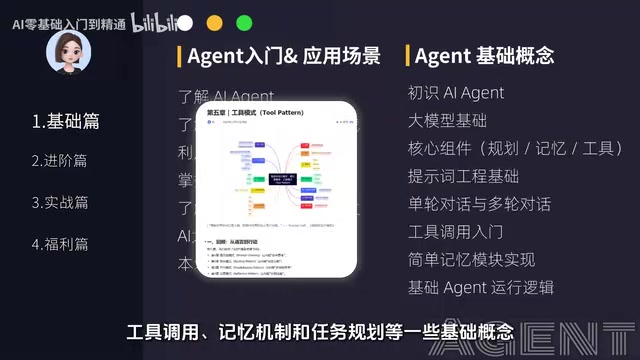
Tool Calling is the key mechanism that upgrades modern large models from "conversational systems" to "action-taking agents." The technical principle works like this: developers describe available tools — their names, parameters, and functions — to the model in a structured format (typically JSON Schema). When the model determines during inference that a tool needs to be called, it outputs a structured instruction containing the tool name and parameters; external code then handles the actual execution and returns the result to the model. OpenAI formally standardized this capability as the Function Calling interface in 2023, and it has since become the de facto industry standard. Common tools include web search, code executors, database queries, and email sending. Understanding the three-stage flow of "model outputs instruction → code executes → result returned" helps developers more clearly define an Agent's capability boundaries and safety constraints.
Advanced: Architectural Patterns and Multi-Agent Collaboration
The advanced module is where genuine engineering capability comes into play. The focus here is on Agent architecture design and multi-agent coordination.
Among the classic Agent-building paradigms, ReAct (Reasoning + Acting) is unavoidable — it lets a model iteratively cycle between "thinking" and "acting," significantly improving task completion reliability. This module also covers RAG (Retrieval-Augmented Generation) integration with knowledge libraries, Agent fine-tuning, and building more complex applications using visual development frameworks.
Multi-Agent coordination represents the current frontier: rather than having a single agent shoulder all responsibilities, multiple specialized agents divide tasks, collaborate, and communicate with each other to handle more complex real-world challenges. This section is especially important for developers who want to build deployable products.
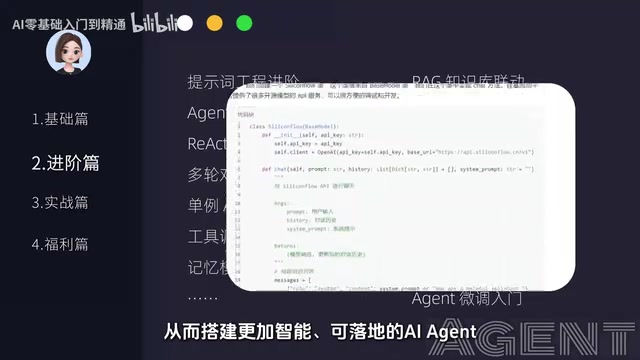
ReAct (Reasoning + Acting) was proposed by a Google Research team in 2022. Its core idea is to interweave a large model's reasoning (Chain-of-Thought) with tool calls in a continuous loop: the model first "thinks" about the current state and its next intention, then "acts" by calling a tool to get feedback, and then continues thinking based on that feedback — until the task is complete. This iterative "think → act → observe" structure dramatically reduces hallucination risk compared to single-pass generation, and allows the model to dynamically adjust strategies when unexpected situations arise. In mainstream frameworks like LangChain and LlamaIndex, ReAct has been packaged as a directly callable Agent type, so beginners don't need to implement it from scratch. That said, understanding the internal loop logic is crucial for debugging and optimizing Agent behavior.
RAG (Retrieval-Augmented Generation) addresses two major pain points of large models: knowledge cutoff dates and access to private data. The workflow goes like this: external documents are vectorized and stored in a vector database; when a user asks a question, relevant passages are retrieved first, then passed along with the question to the model to generate an answer. In Agent contexts, RAG often serves as a "memory tool," allowing agents to consult internal knowledge bases, live documents, or conversation history — effectively breaking through the constraints of the context window.
Hands-On Practice: Turning Knowledge into Deployable Projects
The ultimate goal of learning is to produce results. The practical module typically centers on several high-frequency real-world use cases:
- Personal intelligent assistant: Integrating scheduling, information retrieval, and task execution
- Automated office workflows: Having an Agent handle repetitive document, email, and data processing tasks
- Multi-agent collaborative development: Multiple agents dividing labor to complete an end-to-end task
- Data analysis and decision support: Using an Agent to extract insights from data
What these projects share is that they all point toward tangible value — converting what you've learned into reusable, and potentially monetizable, skills. That's the practical edge you need to stay competitive in the AI era.
Learning Tips: Make the Most of Supplementary Resources
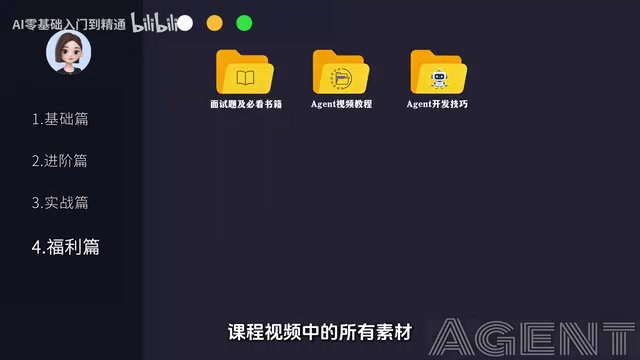
For beginners starting from zero, the completeness of supplementary materials often determines learning efficiency. According to the tutorial described here, accompanying resources include mind maps, development environment setup packages, study schedule templates, and slide materials. These structured aids effectively lower the two most common barriers: "can't take notes fast enough" and "can't get the environment working."
A word of caution: the content described in this article is drawn from a single Bilibili course introduction, and claims like "most comprehensive on the entire internet" are marketing language — take them with a grain of salt. The genuinely effective approach is to use a structured course like this to build your mental framework, then deepen your understanding through official documentation (such as LangChain and other mainstream Agent frameworks) and hands-on projects of your own.
Conclusion
AI Agent is not a short-lived trend — it's a necessary path for large models to reach practical applications. For beginners, rather than jumping between fragmented tutorials, the better move is to establish a clear progression: fundamentals → advanced → hands-on practice. Start by thoroughly mastering the four core building blocks — prompt engineering, tool calling, memory, and planning — then go deeper into ReAct, RAG, and multi-agent architectures, and finally validate what you've learned through real projects. This path doesn't guarantee shortcuts, but it will save you from taking a lot of unnecessary detours.
Related articles

Random Pruning of the DPO Computation Graph: 1.4x Training Speedup and Lower Peak Memory
DPO training too slow and memory-hungry? This paper proposes a random pruning framework for the DPO computation graph, sampling independently across position, sequence, and branch dimensions; branch pruning achieves a 1.426x step-time speedup and cuts training time by about 30%, with in-depth attribution of memory and time gains.

Why Does JEPA Underperform MLM in Longitudinal EHR Representation Learning?
New study compares JEPA and MLM for longitudinal EHR representation learning on MIMIC-IV: three JEPA variants train stably without collapse but underperform MLM; target size, not heterogeneity, drives prediction error.

Transfer Learning + Visible Light Communication: A New Approach to Energy-Efficient Indoor Positioning
A study proposes a transfer learning-based visible light communication indoor positioning method, achieving 47% accuracy improvement on the BOSCH factory dataset, 67.5% model efficiency under high noise, and introducing the ME composite metric for energy-efficient positioning in energy-constrained industrial IoT scenarios.