AI Agent Beginner's Guide: Why It's the Next Big Thing in Tech

AI Agents evolve software from answering questions to autonomously completing tasks — the next computing revolution.
AI Agents go far beyond chatbots like ChatGPT — they make autonomous decisions and execute tasks across applications, moving AI from 'saying' to 'doing.' Projects like Stanford Town and ChatDev showcase multi-agent collaboration potential, while market reports show the space growing at over 40% CAGR. Beginners face four key barriers: scarce resources, fragmented knowledge, surface-level courses, and limited hands-on practice. The article introduces a LangChain-based course that uses a 'feng shui fortune teller' as a through-line project, covering industry foundations, framework deep dives, and hands-on development — ideal for app developers, PMs, and engineers transitioning into AI.
AI Agent: The Next Form of Software
When people think about AI, they usually picture chatbots like ChatGPT — systems that understand and generate natural language, provide information, and assist with entertainment. But is this the final form AI will take?
Bill Gates offered his take on this in a personal blog post: existing software is still quite clunky, and the future of software lies in intelligent agents — AI Agents. He predicted that within five years, everyone will have their own personal AI assistant, and every piece of software today is worth rebuilding with an Agent-first approach. In his view, this will represent the biggest computing revolution since the shift from typing commands to clicking icons — no more switching between different apps to draft a document, build a spreadsheet, or send an email. You simply tell your device what you want in plain language.
An Agent refers to an intelligent system that can execute specific tasks and perform actions on behalf of a user. It can take the form of a chatbot, a smart assistant, or automated software. This article draws on a course by Bilibili creator Tommy to outline the value, market outlook, and beginner's path into Agent development.
From "Saying" to "Doing"
In practice, general-purpose tools like ChatGPT have limited utility in enterprise B2B scenarios. Many business owners who follow AI are puzzled by the question "What can AI actually do for me?" — and that's precisely where Agents shine.
Imagine a business consulting firm that handles large volumes of data every day: pulling raw data from a database, cleaning it, running statistical analysis, and ultimately extracting business insights. A general-purpose chat tool simply can't handle this kind of workflow. A better approach is to build an Agent tailored to your own business — connect your database, input the insight question you want answered, and the report is generated quickly. You could even connect it to an email system to send it out automatically.
This is the core distinction between Agents and traditional AI tools: they move AI from "saying what" to "doing what."
Autonomous Decision-Making and Multi-Agent Collaboration
Agents are evolving toward greater intelligence and more human-like behavior. They can not only understand complex natural language instructions, but also make autonomous decisions in response to changing environments.
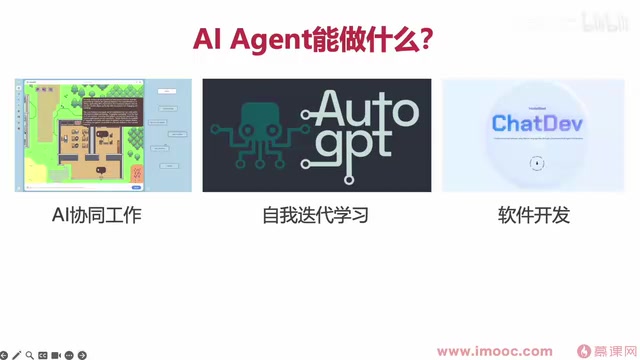
- Stanford Town: A multi-agent project developed by Stanford University, where virtual town characters are assigned different personality traits and allowed to develop freely in a shared environment, achieving group-level collaboration.
- ChatDev: A Chinese team applied a similar concept to virtualize the entire software development process and its roles, using multi-agent collaboration to achieve results more powerful than any single agent.
Unlike traditional tools that only respond to specific commands, Agents operate with far greater initiative — they can proactively offer suggestions before a user even makes a request, execute tasks across applications, and continuously refine their interactions over time. They remember user activity, recognize behavioral intent and patterns, and surface what they believe the user needs — while keeping final decision-making in the user's hands.
Travel planning is a perfect example: an Agent doesn't just know your schedule — it can recommend destinations based on your preferences, arrange activities, and book restaurants. That level of deep personalization used to require paying a travel agency to handle.
LangChain is one of the most widely used open-source frameworks for Agent development today, launched by Harrison Chase in 2022. Its core value lies in connecting large language models (LLMs) with external tools, data sources, and memory systems to form an orchestrable "chain" workflow. Developers can use it to define the reasoning logic of an Agent: the Agent first determines what steps are needed to complete a task, then calls tools like search engines, databases, or code executors as needed, and finally integrates the results to return to the user. This "perceive–decide–act" loop is known as the ReAct (Reasoning + Acting) pattern, and it forms the theoretical foundation of mainstream Agent architectures today. LangChain also has built-in support for vector databases, prompt templates, and conversation memory, significantly reducing the engineering complexity of building an Agent from scratch — making it the go-to starting point for anyone entering Agent development.
Market Data: A Rapidly Expanding Space
Multiple industry reports confirm the strong growth momentum in the Agent market.
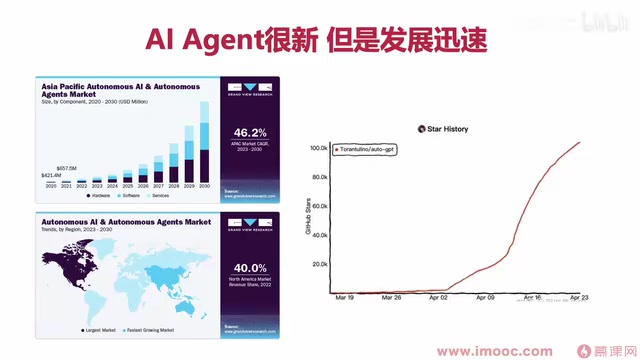
According to Grand View Research, the autonomous AI and agent market has already reached $3.9 billion and is projected to expand at a compound annual growth rate (CAGR) of approximately 42.8% over the coming years. Another report indicates the autonomous AI agent market will grow from $5 billion to $29 billion by 2028, at a CAGR of roughly 43%. Some forecasts put the total global AI market at $190.8 billion, with Agents accounting for a significant share.
The explosive growth of open-source projects tells the same story. After AutoGPT, LangChain, and other Agent ecosystem projects went open-source, interest surged dramatically — AutoGPT's GitHub stars skyrocketed, turning it into a star project and reflecting intense developer and community enthusiasm.
From a career perspective, Indeed reports that AI-related positions offer average salaries 20–30% higher than traditional tech roles. The course author compares mastering Agent technology to mastering web development during the PC era, or app development during the mobile era — a position at the entrance to a major paradigm shift.
The Real Barriers to Getting Started with Agents
For beginners trying to jump directly into Agent development, there are several practical obstacles.
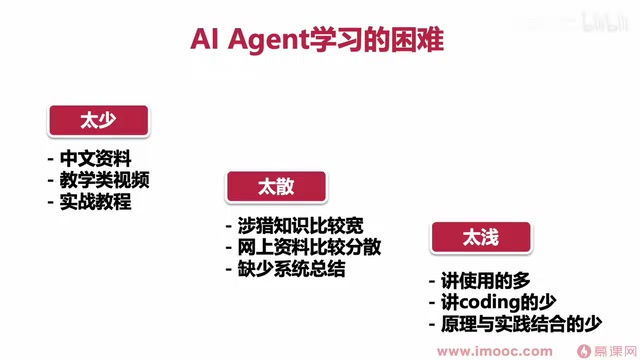
Scarce and fast-changing resources. Agent development is a new field. Chinese-language resources are very limited, and English resources update so rapidly that keeping up is a challenge. Surveys show that over 60% of beginners cite finding high-quality, up-to-date learning materials as their top difficulty.
Fragmented knowledge. Topics spanning LLMs, tool use, vector databases, and AI engineering are scattered across different domains with no systematic overview, making it especially hard to build a coherent knowledge base.
Surface-level courses. Most available courses focus on how to use tools, or how to implement certain business models with AI — useful for beginners or those seeking productivity gains, but limited for anyone who wants to actually build AI application products. They often lack content tied to real coding.
Limited hands-on opportunities. The field is new, practical projects are scarce, and validating theoretical knowledge in real-world applications is significantly harder.
A Hands-On Agent Project: The "Feng Shui Master"
The course uses LangChain as its primary framework, with all teaching code strictly following the official documentation, and ties theory to practice through a fictional project that runs throughout the entire curriculum.
This project is designed as a "feng shui fortune teller" Agent, inspired by the character Chen Xiazi from the novel Ghost Blows Out the Light. Unlike simply chatting with ChatGPT or making raw API calls, this Agent has several capabilities:
- A distinct personality that allows it to converse consistently and in character with users
- The ability to call appropriate tools to extend its capabilities — such as real-time search for current events, or integration with email and SMS
- Continuous learning from feng shui-related knowledge to build an external knowledge base
- Real-time text-to-speech (TTS), with the ability to detect user emotion from input and respond accordingly
- Flexible integration with a variety of platforms
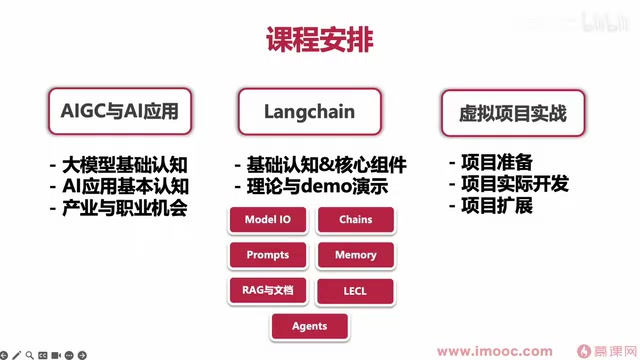
The curriculum is divided into three parts covering roughly ten to eleven chapters:
- Industry Overview: Starting from the development history of large language models, introducing mainstream LLMs and their limitations via Hugging Face, introducing fine-tuning and LangChain approaches, and breaking down the pipeline from research papers to production applications.
- Framework Deep Dive: Covering LangChain's seven core modules, including running in a local environment, understanding ModelIO, applying prompt templates, building an external knowledge base ("the LLM's external brain"), retrieval augmentation, text splitting, and vector databases.
- Hands-On Practice: Using a complete project to cover requirements analysis, architecture design, and development, with extensions into digital human and intelligent voice scenarios.
The course primarily uses Python. Some background is helpful, but it's designed so that even complete beginners can follow along step by step. It's suited for application developers, AI-focused product managers, entrepreneurs looking to innovate with AI, and front-end or back-end developers looking to transition into the AI space.
Vector databases are the key infrastructure for building an Agent's external knowledge base — the "LLM's external brain." The idea is to convert unstructured content like text and documents into high-dimensional numerical vectors using an embedding model, then store those vectors in a specialized database. When a user asks a question, the system converts the question into a vector as well, uses similarity search to find the most semantically relevant content chunks, and injects them as context into the LLM — enabling the model to answer questions about private knowledge that wasn't in its original training data. This approach is known as RAG (Retrieval-Augmented Generation) and is the dominant method enterprises use today when deploying Agents to handle internal documents and domain knowledge. Common vector databases include Pinecone, Chroma, and Weaviate — all of which LangChain provides wrapped interfaces for.
Closing Thoughts
As the course author puts it, AI won't replace people — it will replace people who don't know how to use AI. Agents move software from "telling you information" to "completing tasks for you." This isn't just a technical upgrade; it opens new possibilities for individuals and businesses that have accumulated domain knowledge and proprietary data. For anyone looking to enter AI application development, now is exactly the right time to step into this space.
Related articles

How Big Can Stars Really Get? The Physical Limits of the Largest Stars
Red supergiants are the largest stars by volume, with radii up to 2,000 times the Sun, engulfing the inner solar system. But there is no precise upper limit on stellar size—models predict up to 15,000 solar radii. The most massive blue stars are far smaller than red supergiants—biggest and heaviest are two different things.

Apple HomeView Smart Display Full Feature Breakdown: Wall-Mount or Desktop, $299
Apple launches HomeView, a $299 smart display with wall-mount and desktop options, 12MP camera for facial recognition, smart home control, music playback, and recipe step-by-step cooking. Full breakdown of watch faces, apps, privacy, and cooking integration.

Where Did the Promised New Studio Go? Craft Computing Answers After Five Years
Craft Computing's host responds to viewer questions: the new studio promised five years ago was shelved as construction costs soared from $30,000 to $75,000, and was replaced by a 168-square-foot garage conversion.