AI Agent Deployment Pain Points: How Serverless MicroVM Runtimes Solve the Backend Problem

Breaking down AI Agent backend infrastructure bottlenecks and the MicroVM runtime solution.
As AI Agent capabilities mature, the infrastructure challenges of embedding them into real product backends are becoming the primary deployment barrier. This article focuses on two core problems: hard timeout limits on Serverless platforms that can't support agent tasks running tens of minutes, and the high cost of Docker container management for secure code execution. It introduces a Serverless Agent runtime built on MicroVM and snapshot technology — treating each agent session as an independent managed backend worker, with HTTP requests returning in milliseconds while tasks run in isolated sandboxes. Through session-request decoupling, tiered resource reclamation, instant snapshot restore, async Human-in-the-Loop, and BYOK hardware isolation, the solution seeks a balance between cost, security, and developer experience.
When AI Agents Meet Backend Deployment: An Unavoidable Infrastructure Challenge
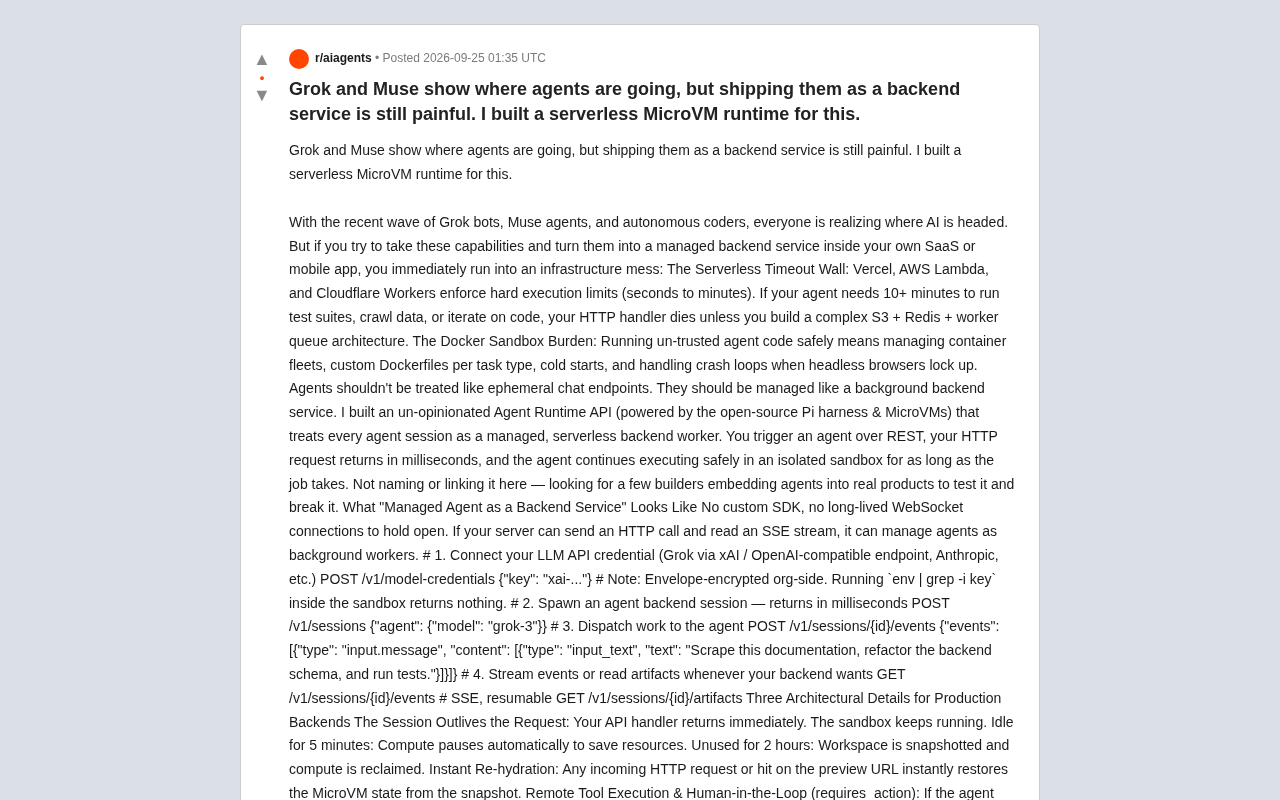
With the rise of Grok bots, Muse agents, and various autonomous coding assistants, the industry has reached a clear consensus on where AI Agents are headed. But one Reddit developer pointed out a widely underestimated reality: actually embedding these capabilities into your own SaaS or mobile app backend turns into an infrastructure nightmare.
The core issue isn't the intelligence of the agents themselves — it's that the execution environment required to run them is fundamentally at odds with traditional web service architecture. This developer built a MicroVM-based Serverless Agent runtime to address the problem at the architectural level.
Two Walls Standing in Developers' Way
The Serverless Timeout Wall
The first obstacle is execution time limits. Mainstream Serverless platforms like Vercel, AWS Lambda, and Cloudflare Workers all enforce hard execution caps, ranging from a few seconds to a few minutes.
But real Agent workloads are often completely different — an agent that needs to run a full test suite, scrape data, or iteratively refine code can easily need 10+ minutes. In these scenarios, your HTTP handler simply times out and dies. Unless you're willing to build a complex S3 + Redis + worker queue architecture to manually manage async tasks, there's no way to handle the load.
The Docker Sandbox Burden
The second wall is the cost of securely executing untrusted code. Safely running agent-generated code means managing container clusters, maintaining custom Dockerfiles for different task types, dealing with cold starts, and handling crash loops when headless browsers freeze.
The author's position is clear: agents shouldn't be treated as ephemeral chat endpoints — they should be managed like background backend services. This shift in perspective is the foundation of the architectural design.
MicroVMs (micro virtual machines) are lightweight isolation technology sitting between traditional VMs and containers, best exemplified by AWS Firecracker. By trimming the Linux kernel and removing unnecessary device drivers, MicroVMs compress VM startup time to under 100 milliseconds while providing hardware-level memory isolation — a security boundary that Docker containers cannot guarantee. The snapshot mechanism allows the in-memory state of a running MicroVM to be persisted to disk, so on the next restore there's no need to go through a full OS boot sequence — execution resumes from exactly where it left off in milliseconds. These two capabilities combined allow MicroVMs to respond to burst requests at near-container startup speeds while providing near-VM-level strong isolation, making them a natural fit for the multi-tenant agent runtime requirement that "each session must not interfere with others."
Treating Each Agent Session as a Managed Backend Worker
The author's solution is an un-opinionated Agent Runtime API, powered under the hood by the open-source Pi harness and MicroVMs. The core idea: every agent session is a managed, Serverless backend worker.
The workflow is designed to be extremely lightweight — no custom SDK required, no persistent WebSocket connections. As long as your server can make HTTP requests and read SSE streams, you can schedule agents as background workers:
# 1. Plug in your LLM credentials (Grok via xAI / OpenAI-compatible endpoints / Anthropic, etc.)
POST /v1/model-credentials {"key": "xai-..."}
# Credentials are envelope-encrypted — running env | grep -i key inside the sandbox returns nothing

# 2. Start an Agent backend session — returns in milliseconds
POST /v1/sessions {"agent": {"model": "grok-3"}}

# 3. Dispatch tasks to the Agent
POST /v1/sessions/{id}/events

# 4. Stream events or fetch artifacts at any time
GET /v1/sessions/{id}/events   # SSE, resumable
GET /v1/sessions/{id}/artifacts
The key is step two: once you trigger the agent, the HTTP request returns in milliseconds, while the agent continues running safely inside an isolated sandbox — no matter how long the task takes.
Three Production-Ready Architectural Details
Session Lifecycle Independent of Requests
This is the soul of the entire design. The API handler returns immediately; the sandbox keeps running. Resource scheduling uses a tiered strategy:
- Idle for 5 minutes: compute resources are automatically paused to save costs;
- Idle for 2 hours: the workspace is snapshotted and compute resources are reclaimed;
- Instant rebuild: any new HTTP request or access to a preview URL instantly restores MicroVM state from the snapshot.
This mechanism lets long-running agents avoid wasting resources while remaining instantly resumable, balancing cost and responsiveness.
Remote Tool Execution and Human-in-the-Loop
When an agent needs the main backend to perform privileged operations (like database writes) or requests human approval, the session transitions to a requires_action state and pauses — without needing to maintain a synchronous long-lived HTTP connection. You can respond minutes or even hours later, and the session resumes seamlessly. This is especially useful for production workflows that require human intervention or permission checks.
Human-in-the-Loop (HITL) refers to inserting checkpoints in an automated process where a human reviews or intervenes at specific decision nodes before the process continues. In agent scenarios, these checkpoints are especially critical — when an agent needs to perform irreversible actions (like sending emails, writing to a production database, or calling a paid API) or has low confidence, pausing for human confirmation can effectively prevent automation from going off the rails. Implementing HITL under traditional synchronous HTTP architectures is prohibitively expensive, typically requiring long-polling or WebSocket connections that break the entire flow if they time out. A session-request decoupled design naturally supports async HITL: the agent suspends and releases all compute resources, approval can be delayed by hours, and on resume execution continues from the exact point of interruption — a perfect match for the unpredictable latency of human approval workflows.
Strict BYOK and Hardware Isolation
The solution emphasizes zero model markup and zero vendor lock-in. You bring your own Grok, Anthropic, or OpenAI credentials (BYOK — Bring Your Own Key), encrypted with envelope encryption on the organization side. Each agent runs in its own hardware-isolated MicroVM — one agent crashing will never affect other sessions.
BYOK (Bring Your Own Key) is a security architecture pattern where users bring their own API keys or encryption keys into a third-party service, rather than using shared credentials managed by the service provider. Envelope Encryption is a common implementation: a data encryption key (DEK) encrypts the actual credentials, and a key encryption key (KEK) encrypts the DEK, with the KEK managed by the user or an independent KMS. In the agent runtime context, BYOK means that even if the infrastructure provider is compromised, attackers cannot obtain your LLM API keys. It also means that usage billing happens directly between you and the model vendor — the runtime provider cannot mark up model calls or hijack traffic, architecturally eliminating vendor lock-in risk.
Honest Acknowledgment of Current Limitations
Notably, the author honestly lists the current shortcomings rather than overselling:
- API only: no official Web UI, CLI, or IDE extension — purely designed for backend developers;
- Snapshot constraints: snapshots skip
node_modulesand.git(300MB limit), so on cold restore dependencies must be reinstalled from the lockfile; - BYOK only: no global model catalog or default keys provided.
These limitations clearly define the scope — this isn't a product for end users, but an infrastructure layer for engineering teams embedding agents into real products.
A Signal Worth Watching
Setting aside the specific project itself (the author is currently in the alpha-tester recruitment phase, offering free execution credits, higher concurrency, and one-on-one integration support), it reflects a broader trend: the bottleneck for AI Agent deployment is shifting from model capability to execution infrastructure.
When models are already smart enough to run for 10 or 20 minutes completing complex multi-step tasks, the traditional Serverless paradigm — designed for stateless short requests — simply falls short. Design patterns like MicroVM snapshots, session-request decoupling, and async Human-in-the-Loop are likely to become standard components of the next generation of agent backend infrastructure. For developers productizing agent capabilities, the maturity of these runtimes may directly determine whether a product can be delivered at scale.
Related articles

Qwen 4 First Test Leaks: Performance Rivals Opus 5.5, DeepSeek V4 Series Surfaces
Early Qwen 4 test outputs leak, with front-end generation said to rival Opus 5.5; DeepSeek V4 Mini, Flash, and Pro names appear in a code repo; Ant Group's Ling-3.1-flash surfaces too. Here's the latest on model tiering and on-device lightweight models.

OpenCode Makes DeepSeek V4.1 Flash Free, AI Daily Roundup
AI daily roundup: OpenCode makes DeepSeek V4.1 Flash free, StepFun Step5 Preview and Ling 3.1 Flash open-sourced, Grok Voice 3.0 tops speech leaderboard, Matrix Game 4.0 open-sourced, and the EU opens its first AI Act enforcement probe into OpenAI and Anthropic.

DeepSeek V4.1 Flash 1017 Released: Reasoning and Coding Upgrades, Search and Fetch API Now Available
DeepSeek releases V4.1 Flash 1017 with major gains in reasoning, coding, and agentic tasks, plus web search and fetch APIs at 5 yuan per 1,000 requests. Tencent Hunyuan open-sources High Memory 2.0, Perplexity open-sources multimodal decision models, and MOFCOM seeks comments on AI export catalog.