DeepSeek V4.1 Flash 1017 Released: Reasoning and Coding Upgrades, Search and Fetch API Now Available

DeepSeek releases V4.1 Flash 1017 and launches search and fetch APIs as AI competition shifts to infrastructure integration.
DeepSeek released V4.1 Flash 1017 on October 17, improving reasoning, coding, and agentic tasks with some benchmarks surpassing Opus 5; weights are on Hugging Face. Its new search and fetch APIs bill 5 yuan per 1,000 successful requests with no charge for failures and a 5 QPS limit. Also: Perplexity open-sourced multimodal decision models, Tencent Hunyuan launched High Memory 2.0, OpenAI optimized Codex and GPT-6 Pro, and China's MOFCOM sought comments on adding 40 technologies to the export catalog.
DeepSeek V4.1 Flash 1017 Released: Improvements in Reasoning and Coding, Search and Fetch Services Launch
On October 17, DeepSeekAd released the 1017 version of V4.1 Flash. The company characterized it as a minor update, but the actual capability improvements cover three core dimensions: reasoning, coding, and agentic tasks, with vision capabilities also further enhanced. On the same day, DeepSeek's web search and web fetch API services officially went live, providing real-time web content for agents and RAG applications.
According to a roundup from Bilibili's AI Daily Report Episode 551, the new model leads the previous version across multiple benchmarks, surpasses Opus 5 on some scores, and competes directly with Kimi K3 and GLM 5.3. The company emphasized that the new model reduces task execution time and output length, meaning users get faster responses and lower costs on equivalent tasks. The model has been updated simultaneously across the web, App, and API, and the weights are open-sourced on Hugging Face.
Search and Fetch APIs: Completing the RAG Infrastructure
The two services launched alongside the model update deserve separate attention. The Search interface returns structured web results, while the Fetch service retrieves a single web page and returns the body content in Markdown format. Both use DeepSeek's self-developed search engine and are billed per successful request at 5 yuan per 1,000 requests. Failed requests and empty results are not charged, and the account rate limit is 5 queries per second.
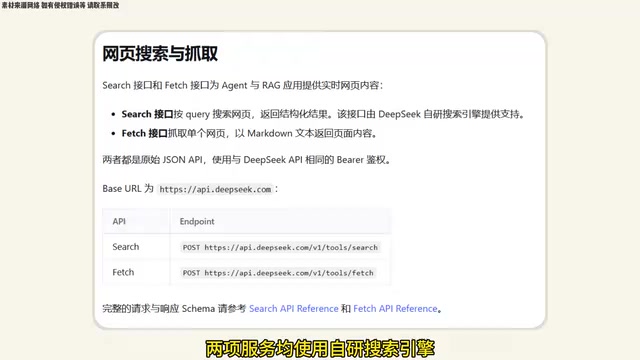
This pricing strategy is quite friendly to small and medium-sized developers, especially since the no-charge-for-failures rule lowers the cost of trial and error. From a product logic perspective, DeepSeek is packaging model capabilities and data acquisition capabilities into a complete pipeline, so developers no longer need to separately integrate third-party search services, reducing engineering complexity. For teams building agent applications, an integrated solution of search plus fetch plus reasoning can significantly shorten the cycle from prototype to launch.
RAG (Retrieval-Augmented Generation) is a technical architecture that combines external knowledge retrieval with language model generation. Its basic workflow is: after a user asks a question, the system first retrieves relevant snippets from external data sources (such as web pages, document libraries, or databases), then feeds those snippets as context into the large model, which generates an answer based on this real-time, trustworthy material. Compared with purely parametric memory, RAG can significantly reduce model hallucinations and make answers traceable to sources.
RAG's engineering quality depends heavily on the freshness and coverage of data in the retrieval stage. The traditional approach requires developers to build their own crawlers, clean body text, split snippets, and maintain vector indexes—a long pipeline with high maintenance costs. By offering Search (returning structured result lists) and Fetch (retrieving a single page and converting it to Markdown) as independent APIs, DeepSeek essentially outsources the "retrieval layer" to the search engine provider. Developers only need to split and vectorize the Markdown body text after receiving it. Markdown format is especially well suited to RAG because it preserves structural information such as heading levels, lists, and code blocks, making it easier to chunk by semantic units and easier for large models to parse correctly.
Synchronized Evolution of Multimodal and Memory Frameworks
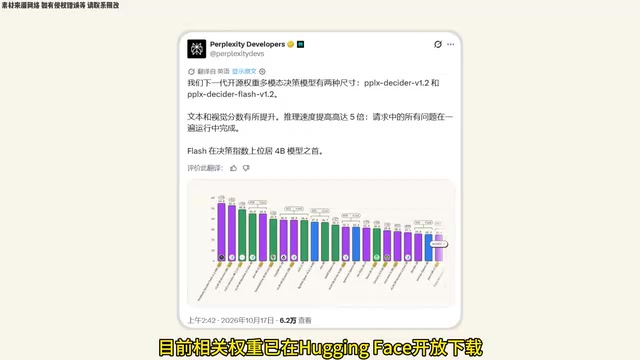
Perplexity open-sourced its next-generation multimodal decision models in two specifications, PPLX Decider V1.2 and Flash V2. Both show improvements in text and vision scores, with inference speed up to 5 times faster, and all questions in a single request can be completed in one run. The weights are available for download on Hugging Face. This speed improvement is clearly significant for high-concurrency scenarios, and throughput for batch decision tasks will benefit directly.
Tencent Hunyuan, meanwhile, launched the agent memory framework High Memory 2.0 and open-sourced a dedicated model memory framework and the MemHub application. Tencent claims this is the industry's first memory framework to propose working memory and code memory, and that it replaces open-source frameworks as the top performer on four benchmarks across chat, work, and coding scenarios.
Memory capability has long been one of the bottlenecks in deploying agents. Working memory is responsible for maintaining context for the current task, while code memory retains structured knowledge for programming scenarios. This separation design is closer to real engineering needs than a single context window. The weights have been released on Hugging Face, so developers can directly test its performance in real projects.
An agent's "memory" is usually divided into short-term and long-term types. Short-term memory corresponds to the context window, maintaining the state of the current conversation or task, but it is limited by window length and costs increase as the conversation grows. Long-term memory persists historical information through external storage (vector databases, structured databases, knowledge graphs) and retrieves it back when needed. The engineering challenge lies in deciding which information should be written to long-term memory, how to organize it for efficient recall, and how to resolve conflicts between old and new memories.
The separation of "working memory" and "code memory" proposed by Tencent Hunyuan High Memory 2.0 is precisely a scenario-based split addressing these challenges. Working memory targets general tasks, recording task goals, intermediate steps, and tool call results, emphasizing timeliness and contextual coherence. Code memory targets programming scenarios, preserving structured knowledge such as function signatures, dependencies, and project conventions, emphasizing precise retrieval and cross-file consistency. Modeling the two separately prevents general conversation history from drowning out key code-related constraints, and makes it easier to design separate recall strategies and eviction mechanisms for different scenarios. MemHub, as a companion application, provides an interface for writing, retrieving, and visually managing memories.
Regulatory Developments: Refinement of AI Technology Export Management
The Ministry of Commerce and the Ministry of Science and Technology issued Announcement No. 48 of 2026, soliciting public comments on the revision of China's Catalog of Technologies Prohibited and Restricted from Export, and implementing temporary management measures requiring pre-export registration for relevant technologies. This round of comments involves adding 40 key technologies across three fields—artificial intelligence, biomedicine, and photovoltaics—including 14 prohibited from export, such as AI-driven malicious code generation and mutation technology, and 26 restricted from export, including AI-assisted vulnerability discovery technology.

The Ministry of Commerce stated that the purpose of adding 23 key technologies related to AI large models, agents, and computing cluster information processing to the catalog is to ensure technology security and controllability while encouraging open source, openness, and cooperative sharing. For open-source enterprises establishing and operating their own computing centers overseas, tape-out of chips overseas, and joint research and development, facilitated measures such as automatic licensing apply to technology exports. Scenarios in which enterprises use restricted large models to provide API calls, web interaction, SaaS applications, and on-device deployment to overseas parties are included within the scope of large model technology export management. This set of rules attempts to draw a boundary between security and openness, and open-source enterprises need to pay attention to the conditions for automatic licensing.
China's Catalog of Technologies Prohibited and Restricted from Export is jointly issued by the Ministry of Commerce and the Ministry of Science and Technology and is the core basis for technology export management. Technologies in the catalog are divided into two categories: "prohibited from export" and "restricted from export." The former generally may not be provided externally, while the latter may be exported only after licensing or registration. The catalog is revised periodically as technology develops, and this round of comments represents a new round of additions.
"Pre-export registration" is a relatively lightweight management approach: enterprises only need to file with the competent authorities before providing relevant technologies externally, without necessarily undergoing substantive approval, and its regulatory intensity is lower than the licensing system. "Automatic licensing" means that qualifying applications can automatically obtain a license, essentially providing a facilitated channel for specific circumstances (such as open-source enterprises building computing centers overseas, overseas tape-out, and joint research and development). It should be noted that the rules include "using restricted large models to provide API calls, web interaction, SaaS applications, and on-device deployment to overseas parties" within the scope of large model technology export management. This means that even without transferring model weights, merely exporting model capabilities in service form to overseas parties may trigger management obligations. For AI companies whose main forms are open source and API services, compliance assessment of deployment architecture and service regions will become more important.
OpenAI and Google Product Cadence
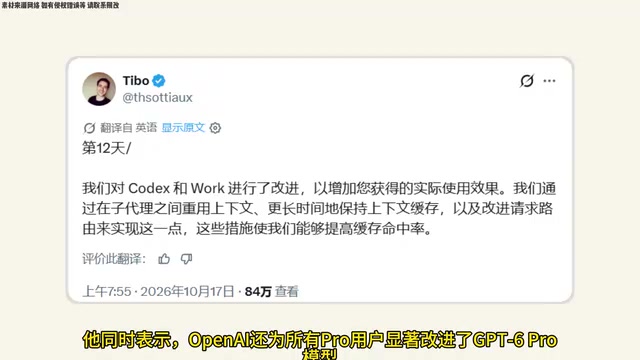
On the OpenAI side, Codex Rework has been improved, increasing users' actual usable quota by reusing context across sub-agents, extending context cache duration, and optimizing request routing to improve cache hit rates. At the same time, the GPT-6 Pro model for all Pro users has also received significant improvements.
ChatGPT launched a widget for the iOS home screen; after adding it, users can tap once to enter a conversation or directly start a call. GPT-6 Astra Pro has been upgraded with faster response speeds and improved ability to use plugins and tools. The new version supports multiple agents working in parallel on different parts of the same task, and users can track each agent's progress and open completed tasks to view results. This feature is available to Pro users on the Chat tab.
Google AI Studio announced that Google AI Pro subscribers can now use Gemini 4 Argon to build in AI Studio's Build and Playground, and the official website already provides a build entry point.
Context Caching is a key mechanism for reducing large model inference costs. In multi-turn conversations or agent loops, system prompts, tool definitions, and conversation history are often highly repetitive across requests. Caching temporarily stores the computation results for this prefix (usually the KV state of the attention layers), and subsequent requests that hit the cache reuse them directly, avoiding redundant computation and thereby reducing both latency and billing costs. The cache hit rate depends on the stability of the request prefix, so optimizing request routing and placing variable content as late as possible are common ways to improve hit rates.
"Reusing context" across sub-agents is a cost optimization approach in multi-agent architectures: when the main agent splits a task among multiple sub-agents, if each sub-agent builds its context from scratch, it causes a large number of duplicate cache writes. Having sub-agents share the same stable prefix can significantly improve the overall cache hit rate and thus increase users' actual usable quota. This echoes the multi-agent parallel processing of different parts of the same task mentioned in the article—parallelism improves throughput, but only when context is organized properly will costs not inflate in tandem.
Observation: Infrastructure Competition Becomes the Main Theme
Looking at this batch of updates, the parameter race among models themselves is giving way to integration at the infrastructure level. DeepSeek packages search, fetch, and reasoning together; Tencent Hunyuan open-sources its memory framework independently; OpenAI optimizes caching and context reuse. These moves all point in the same direction: making agents run more reliably and cheaply in real tasks. For developers, choosing a technology stack now requires more consideration of whether the service pipeline is complete, rather than just looking at single-point benchmark scores.
The refinement at the regulatory level is also worth noting. The way export management rules cover open source and API services may affect enterprises' future deployment architecture choices. The balance between technology security and controllability and open-source cooperative sharing will be tested in specific implementation.
One-line Summary
DeepSeek releases V4.1 Flash 1017 and launches search and fetch APIs as AI competition shifts toward infrastructure integration.
Paragraph Summary
On October 17, DeepSeek released V4.1 Flash 1017. Although officially described as a minor update, it comprehensively improves three core capabilities—reasoning, coding, and agentic tasks—with enhanced vision, surpassing Opus 5 on some benchmarks and competing directly with Kimi K3 and GLM 5.3. The weights are open-sourced on Hugging Face. The web search and fetch APIs launched the same day are billed per successful request at 5 yuan per thousand, with failures not charged and a rate limit of 5 requests per second, completing the data acquisition pipeline for agents and RAG applications. In addition, Perplexity open-sourced multimodal decision models, Tencent Hunyuan launched High Memory 2.0 with separate working memory and code memory, OpenAI optimized Codex quota and GPT-6 Pro, and Google AI Studio opened Gemini 4 Argon to Pro users. The Ministry of Commerce and the Ministry of Science and Technology are soliciting comments on adding 40 technologies across AI, biomedicine, and photovoltaics to the export catalog.
Related articles

Uber Deploys ChatGPT Work Company-Wide: AI in the Workplace Enters the Scaled Implementation Phase
Uber deploys ChatGPT Work to 30,000+ employees, extending it from engineering to all roles. We analyze its expert-engineer pairing, end-to-end automation, and questions of AI control and power concentration—insights for scaling AI in the workplace.

Shift at Midnight Hands-On: When "ID Verification" Becomes Alien Hunting
Shift at Midnight blends ID verification with horror survival in a four-player co-op game. We break down its inspection mechanics and chaotic humor.

Zelensky Recounts the Outbreak of War: I Need Ammunition, Not a Ride
Zelensky recalls the first day of war in a YouTube interview: farewell to family, rejecting Biden's evacuation offer with "I need ammunition, not a ride," and how Bucha shaped his stance on compromise and peace talks.