AI Agent Developer Job Hunt Guide: 4 Standards to Land Your Offer This Recruiting Season
Hit these 4 standards and apply now — waiting until you 'know everything' means missing fall recruiting.
This article breaks down a Bilibili creator's core methodology for landing AI Agent developer roles in fall recruiting. The key insight: you don't need to know everything — you need to hit four standards and apply. Those standards are: your project runs with real business logic, you can debug issues, you can explain your technical decisions, and you can handle tough follow-up questions. The article also warns that the original video's second half contains training program recruitment pitches, so apply the methodology critically.
For students aiming to land an AI Agent developer role in fall recruiting, the biggest trap isn't lack of ability — it's endless second-guessing and self-doubt. Many people keep asking: how good do I need to be at Agent development before I start applying? One Bilibili creator gave a blunt answer: by the time you feel like you "know everything," fall recruiting may already be over, leaving only spring recruiting as a backup. People who land offers are never the ones who know everything — they're the ones who apply as soon as they hit the bar.
This article compiles and organizes the core methodology that creator shared for Agent job hunting, structured around four standards: the project runs, you can debug issues, you can explain your approach, and you can handle follow-up interview questions.
Good Enough Basics — No Need to Go Deep
Many people fall into "fundamentals anxiety," feeling like they need to master Python and Linux before they dare submit a résumé. That's exactly how you go in circles.
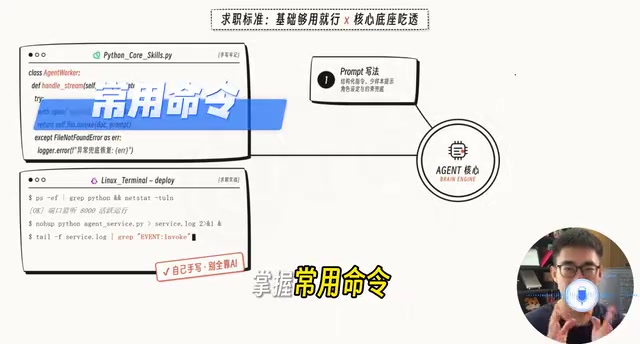
The creator emphasizes that Python is essential for Agent development, but the bar is "good enough": core basics like functions, classes, file operations, and exception handling must be something you can write yourself — don't rely entirely on AI to do it for you. This is a common pitfall for beginners — they can't code without AI assistance, and the moment a whiteboard question comes up in an interview, it shows.
The same applies to Linux: know the common commands, be able to deploy a project, and know how to read logs to troubleshoot. There's no need to study the underlying internals.
On the Agent core knowledge side, you must have a solid grasp of Prompt writing, Function Calling, the role of Agents, and Memory mechanisms. These are the key concepts interviewers use to judge whether you truly understand how Agents work — and the dividing line between "wrapper players" and "real developers."
Ditch the Toy Demo — Your Project Needs Real Business Value
This is the most valuable point in the entire guide. The creator says it plainly: a résumé project that just calls a single LLM API wrapped in a chat interface won't impress any interviewer.
What companies actually want is real-world deployment capability. Take a customer service Agent as an example — you need to be able to walk through the full decision logic in an interview:
- When to query the knowledge base vs. when to call a tool API
- How to fall back when an API call fails
- How to correct the model when it gives a wrong answer
- How to escalate to a human agent when the issue can't be resolved
This complete set of exception handling and business closure logic is the real differentiator for résumé projects. It doesn't just show whether you can "make it run" — it shows whether it can reliably serve users in production — which is exactly what companies are hiring for.
Function Calling is the core mechanism for "calling tool APIs" in Agent projects and deserves dedicated study. It allows LLMs to decide, while generating a response, whether to call an external function (such as querying a database or hitting a third-party API). The developer then executes that function locally and returns the result to the model, completing a full "perceive → decide → execute → feedback" loop. In a customer service Agent, for example, when the model determines the user's question requires an order lookup, it triggers a query_order(order_id) Function Call rather than guessing an answer. Being able to clearly describe this interaction chain in an interview is exactly what separates "wrapper" projects from real development. Mainstream frameworks like LangChain and the OpenAI API both natively support Function Calling. It's recommended to implement at least one complete tool-calling scenario in your project, including handling edge cases like API timeouts and unexpected return values.
Fill in the Engineering Gaps — Hold Up Under Detail Questions
Many people study for months and still can't pass interviews. The root cause is that they can only make the code run — the moment they get asked about details, everything falls apart.
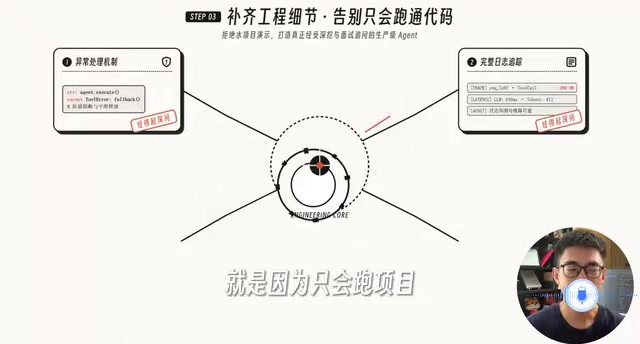
The creator recommends focusing on a few key engineering skills: exception handling, logging, retry mechanisms, and performance evaluation. These don't need to be overly complex, but you must understand them thoroughly and be able to explain them clearly.
An interview is fundamentally a stress test. When an interviewer asks "why did you design it this way?" or "what happens if it fails?", only candidates who have genuinely internalized engineering details can answer confidently. Engineering depth is often what separates candidates with similar project backgrounds.
Retry mechanisms and performance evaluation are two dimensions of Agent engineering that are easy to overlook. Retry mechanisms typically use an exponential backoff strategy: wait 1 second before the first retry after failure, then 2 seconds, then 4 seconds, and so on — with a maximum retry limit to avoid infinite blocking. When calling LLM APIs or third-party tool APIs, this mechanism significantly improves system stability under network instability. Performance evaluation refers to quantitatively measuring Agent output quality. Common approaches include: recording user satisfaction feedback, tracking tool call success rates, and comparing model responses to reference answers using metrics like ROUGE or BLEU. Even if your evaluation approach is simple, being able to say in an interview "here's how we measure whether the Agent is performing well" already puts you ahead of the majority of candidates who only focus on making features work.
Be Ready to Answer the Three Core Questions for Every Technical Point
The creator summarized a validation standard that runs through your entire résumé: for every technical point listed, be ready to answer three questions:
- Why did you choose this approach instead of alternatives?
- How would you debug it if something goes wrong?
- How did you ultimately solve the problem you encountered?
Once you've internalized all three, interviews become much less intimidating. This is really about developing a "technical decision-making mindset" rather than just stacking up technical knowledge. Interviewers use these three questions to figure out whether you're a passive executor or an active thinker.

Don't Neglect Your Fundamentals: Databases, APIs, and Algorithms
While focusing on Agent development, don't let your core CS fundamentals slip. Databases and API design are commonly tested in Agent roles. For algorithms, you don't need to grind hard problems — but you must maintain your feel for writing basic problems by hand.
On the career path side, the creator mentioned that Agent-related roles generally branch in two directions: CV (Computer Vision) and NLP (Natural Language Processing). Both require a corresponding foundation in algorithms and models. For career changers and those coming from non-CS backgrounds, planning a clear learning roadmap early is especially important.

CV (Computer Vision) and NLP (Natural Language Processing) represent the two main paths for technical depth in Agent roles. CV-oriented Agent applications include visual question answering (VQA), image content moderation, and multimodal instruction understanding — requiring a foundation in CNN basics and recent vision-language models like CLIP and LLaVA. NLP is closer to the mainstream text-based Agent stack, requiring knowledge of Transformer architecture principles, embedding-based vector retrieval (the underlying mechanism behind RAG), and the appropriate use cases for fine-tuning vs. prompt engineering. For fall recruiting candidates, there's no need to go deep on both tracks simultaneously — but you should clearly communicate your direction preference in your résumé and interviews. This helps interviewers assess your growth potential, not just your current skill inventory.
The Bottom Line: Hit the Bar and Apply — Iterate While You Interview
The entire guide can be distilled into one sentence: solid basics, real project deployment, strong engineering fundamentals, and the ability to handle follow-up questions. Once you meet this standard, apply to fall recruiting right away — no need to lock yourself away chasing perfection.
The creator specifically emphasizes that fall recruiting won't wait. The strategy of iterating while interviewing is far more effective at landing offers than "practicing in isolation until you're perfect." Interviews themselves are the best review tool — every follow-up question exposes a weak spot and helps you fix it precisely.
One caveat worth noting: the second half of the video includes a fair amount of recruitment pitches from a training organization (downloadable roadmaps, team coaching, etc.). While the methodology is worth referencing, stay rational. Learning resources are not scarce — what matters is coming back to these four standards and training yourself against them.
Related articles
$20/Month vs. $5M/Year: The Fundamental Difference Between Cursor and Blitzy
Cursor at $20/month vs. Blitzy at up to $5M/year: a Grafana 3M-line codebase test reveals how these AI coding tools differ in context, work unit, and production readiness.
Factoriax: A GPU-Parallelized Factory-Building Reinforcement Learning Research Environment
Factoriax is a GPU-parallelized RL research environment inspired by Factorio, focused on long-horizon planning and high-throughput sampling for complex factory-building simulations.
Matt Pocock Skills Deep Dive: Turning AI Coding from Chat into Engineering
Matt Pocock Skills transforms AI coding into an engineering workflow: requirements discussion, SPEC generation, task breakdown, TDD implementation, and code review — solving vague requirements and repeated bugs.