AI Agent Developer Roadmap: A 4-Stage Learning Path from Zero to Project-Ready

A project-driven, 4-stage AI Agent learning roadmap designed for developers starting from zero.
This article outlines a 4-stage AI Agent learning roadmap for beginners: Stage 1 builds conceptual foundations around Prompt engineering, Chain of Thought, and tool calling; Stage 2 covers model deployment with Docker and FastAPI, delivering a working AI chatbot; Stage 3 dives into core Agent development with RAG, LangChain, and task orchestration; Stage 4 focuses on polishing projects and preparing for technical interviews. The roadmap's defining feature is its project-first approach, with a tangible deliverable at every stage.
Many people want to learn AI Agent development but get stuck in the same trap: no idea where to start or what comes next. Two months of scattered learning later, they still can't get an API call to work. This roadmap — put together by a Bilibili content creator — breaks AI Agent learning into four progressive stages, with each stage targeting a concrete deliverable you can actually put on your résumé. If you're looking to break into this space, it's worth using as a reference.
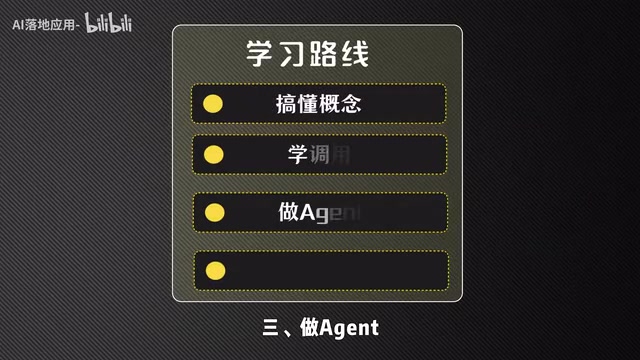
Stage 1: Get the Core Concepts Right
Before diving into AI Agent development, you need to fill in the gaps on large language models and the fundamentals of intelligent agents. This stage isn't about writing code — it's about building the right mental model.
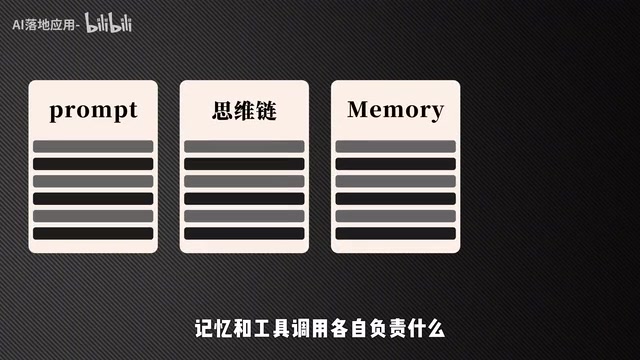
Specifically, you need to understand: how to write effective prompts, what Chain of Thought (CoT) is and why it improves reasoning, and what roles memory mechanisms and tool calling each play. These concepts may seem basic, but they're the foundation for everything that comes after.
As the creator puts it, once you get through this stage, "you'll actually understand what an agent is doing." In other words, nail down the what and why before tackling the how — it'll save you a lot of confusion when you start working with APIs.
Chain of Thought (CoT) is a prompting technique introduced by Google researchers in 2022. The core idea is to have the model output intermediate reasoning steps before arriving at a final answer — similar to how a person might "show their work" when solving a problem. Experiments have shown that CoT significantly improves model accuracy on complex tasks like math reasoning and logical inference. The technique is simple to apply: include a phrase like "think step by step" in your prompt, or provide a few examples that include reasoning (Few-shot CoT), and the model will mimic that structure. Understanding CoT is especially important for Agent development, because modern Agent frameworks like ReAct explicitly formalize this "Think → Act → Observe" loop, enabling models to autonomously plan and execute multi-step tasks.
Stage 2: Learn to Call and Deploy Models
Once the concepts are clear, it's time to get hands-on. This stage focuses on mastering how to call large language models and handle basic engineering for deployment.
Topics include advanced prompt engineering techniques, chaining multiple steps together, and the trade-offs between local vs. cloud deployment. On the tooling side, you'll work with Docker for containerization, choosing the right deployment strategy, building APIs with FastAPI, and putting together a frontend.
The deliverable for this stage is your own AI conversational assistant. Unlike the theory-heavy first stage, you now have something runnable and demonstrable. For many learners, this is the first moment they genuinely feel: I actually got a model running myself.
Stage 3: Actually Build an Agent
The first two stages are groundwork. This is where the real Agent development begins.
The technical content here gets denser: building a RAG (Retrieval-Augmented Generation) knowledge base, orchestrating task planning and tool calls, and implementing memory management. Fine-tuning (e.g., LoRA) is also introduced as a bonus skill.
For tooling, you'll get hands-on with mainstream Agent development frameworks like LangChain. Deliverable projects include a personal assistant, a document analysis tool, and a web-search-enabled agent — among the most common and practical Agent applications today. By this point, you'll have the skills to independently build a fully functional intelligent agent.
RAG (Retrieval-Augmented Generation) addresses two major pain points of large language models: the knowledge cutoff date and hallucination. It works in three steps: first, external documents are chunked and converted into vectors stored in a vector database (like FAISS or Chroma); when a user asks a question, that question is also vectorized and used to retrieve the most similar text chunks from the database; finally, those retrieved context passages are passed along with the question to the model to generate a grounded answer. This way, the model's response is backed by real documents rather than generated from nothing. Frameworks like LangChain include a full RAG pipeline out of the box, dramatically lowering the barrier to entry. For developers building enterprise knowledge base Q&A systems or private document assistants, RAG is one of the most critical foundational techniques.
LoRA (Low-Rank Adaptation) is a parameter-efficient fine-tuning method that avoids updating all of a model's weights. Instead, it inserts two low-rank matrices alongside the original weight matrices and trains only those new parameters — typically less than 1% of the original model's parameter count — allowing the model to adapt to a specific domain or style at a fraction of the usual compute cost. For individual developers, LoRA makes it feasible to fine-tune 7B or even 13B parameter models on consumer-grade GPUs, making it an important entry point for learning how to customize model behavior.
Stage 4: Polish Your Project and Prep for Interviews
The goal of the final stage is to turn all the pieces you've built into one cohesive project you can explain end-to-end — and to get ready for job hunting.
The creator's observation here is refreshingly direct: in interviews for Agent roles, "it all comes down to projects." Interviewers want to know why you designed it that way and how you optimized it — that's what determines the outcome. Rattling off a list of tech buzzwords won't cut it. What matters is being able to clearly articulate the design trade-offs and optimization thinking behind a real project.

So this stage isn't about learning new things — it's about going back and deepening your existing work, shaping it into a complete technical narrative, and getting ready for internship applications or campus recruitment.
What This Roadmap Gets Right — and Where It Falls Short
The biggest strength of this roadmap is its project-driven approach — every stage emphasizes producing something résumé-worthy, avoiding the common trap of tutorial content that's all theory and leaves learners unsure what they can actually build. The four-stage progression also follows a natural learning arc: concepts → calling → development → integration.
A fair caveat: as a promotional overview for a learning course, the original content doesn't go deep on the technical specifics of each stage. Your actual learning outcomes will still depend heavily on the quality of the accompanying tutorials and how much hands-on practice you put in. For someone starting from scratch who wants to move into AI Agent development, this roadmap is best treated as a learning map to orient yourself — not a guaranteed path to follow verbatim.
If you've ever found yourself going in circles trying to learn AI Agent development, this four-step framework — concepts, calling, development, integration — can at least help you get your bearings and avoid some of the wrong turns.
Related articles

AI New Grad Resume Diagnosis: How to Stand Out for ML/CV Roles?
How can AI/ML new grads optimize their resumes to get interviews? Based on a real Reddit case, this article analyzes project selection, depth display, and structure for ML/CV roles, with actionable revision advice.

OpenAI Opens Up Decision Models as Competition with Jev Heats Up
OpenAI makes its decision model widely available, directly challenging first mover Jev. We analyze the impact on the decision model competitive landscape and key considerations for developers and enterprises.

Startup Growth Secrets: Early Sales Are Not the Key
At Disrupt, experts from Lovable, Polska, and Theory Ventures said early startup growth depends not on early sales but on a repeatable sales process, a clear ICP, team development, and data-driven iteration.