AI Agent Development: A 4-Stage Learning Roadmap from Beginner to Enterprise-Level Practice
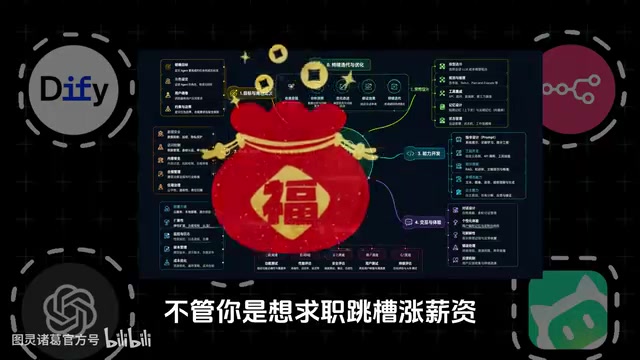
A 4-stage roadmap to master AI Agent development, from core concepts to enterprise-level real-world projects.
This article outlines a four-stage AI Agent learning roadmap progressing from zero to enterprise-level practice: Stage 1 builds foundational understanding of planning, memory, and tool use; Stage 2 dives into paradigms like ReAct and Code Agent; Stage 3 strengthens multi-agent collaboration and Prompt tuning; Stage 4 delivers results through complete real-world projects. As basic API skills become commoditized, the ability to independently build autonomous, tool-calling Agents is now the key differentiator for AI practitioners. RAG and MCP are also covered as critical technologies for extending Agent capabilities.
Why AI Agent Development Has Become a Core Skill for AI Practitioners
The skill requirements for AI roles are undergoing a fundamental shift. Not long ago, knowing how to call a large language model API and set up a basic RAG knowledge base retrieval system was enough to consider yourself proficient. That's no longer the case — the bar for basic retrieval and API calls keeps getting lower, and what truly separates skill levels now is whether you can independently build an intelligent agent (Agent) capable of autonomous reasoning, task planning, and tool-calling to solve complex problems end-to-end.
In other words, Agent development has gone from a "nice-to-have" to a "table stakes" requirement. Whether your goal is landing a job, switching roles, getting a raise, or building your own AI-powered product, this skill is unavoidable. It's no longer about memorizing a few API interfaces — it demands a systematic understanding of how large language models operate, how tasks are planned, how memory is managed, and how tools are called.
This article is based on a zero-to-advanced AI Agent tutorial series on Bilibili. It maps out a clear progression from complete beginner to enterprise-level practice, helping aspiring practitioners avoid common pitfalls.
Stage 1: Foundations — Mastering the Core Concepts
The height of a building is determined by the strength of its foundation. The goal of Stage 1 isn't to rush into writing code — it's to thoroughly internalize the theoretical framework of Agents: what components they're made of, and what role each component plays.
At this stage, you need to familiarize yourself with the basic principles of large language models and focus on understanding three core modules:
- Planning Module: Responsible for breaking down a complex goal into a sequence of executable subtasks — essentially deciding what the Agent does first and what comes next.
- Memory Module: Enables the Agent to retain context and interaction history. Distinguishing between short-term and long-term memory is key to avoiding repetitive, "goldfish-memory" behavior.
- Tool Use: Gives the Agent the ability to call external tools (search engines, code executors, APIs, etc.), extending its capabilities beyond the model's built-in knowledge.
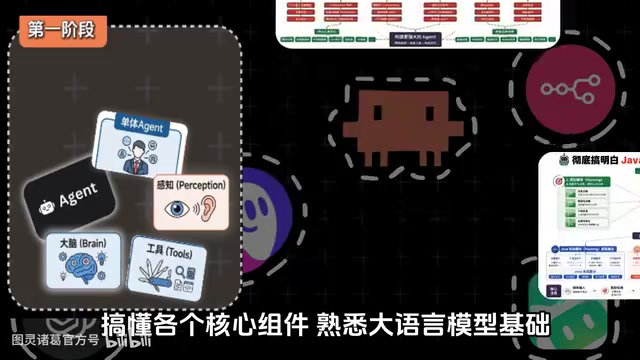
Fully grasping these foundational concepts is a prerequisite for all advanced work that follows. Many people skip this stage and jump straight into frameworks, then find themselves stuck relying purely on trial and error when problems arise — an extremely inefficient approach.
Stage 2: Core Advancement — Internalizing Principles and Paradigms
Once you understand "what the components are," Stage 2 addresses "how they work together." The focus here is understanding how Agents actually operate, and mastering several classic Agent paradigms.
The most representative is the ReAct (Reasoning + Acting) paradigm — where the model alternates between "reasoning" and "acting": first thinking through what to do next, then executing the corresponding action, then reasoning again based on the feedback received. Another key paradigm is the Code Agent, which centers on generating and executing code as its primary mode of action.
The value of deeply understanding these paradigms is that you'll truly grasp the logic behind every decision an Agent makes, rather than treating frameworks as black boxes. When you hit blind spots during development — for example, an Agent getting stuck in a loop, a tool call failing, or reasoning going off the rails — you can diagnose the problem at the principle level instead of randomly tweaking parameters. This is the critical leap from "understanding concepts" to "understanding how things actually work."
The ReAct paradigm was proposed by Yao et al. in 2022. Its core idea is to have large language models interweave "chain-of-thought reasoning" with "action execution" when handling tasks, rather than generating a one-shot answer. The process works like this: the model first generates a reasoning passage (Thought) describing the current state and intended next step; it then outputs an action command (Action), such as calling a search tool; upon receiving the tool's result (Observation), the model reasons further based on the new information — and so on until the task is complete. This design makes the model's decision-making process traceable and debuggable, and makes it easier to identify where reasoning goes astray. The Code Agent is another mainstream paradigm, where the model generates and executes code (typically Python) as its primary "action" mechanism — well-suited for data processing and computation-intensive tasks. Its advantage is that code is more deterministic than natural language instructions, making execution results more reliable.
Stage 3: Skill Enhancement — Refining Real-World Output Quality
Getting a single Agent to run is just the starting point. Real-world engineering deployment typically demands much finer-grained capabilities. Stage 3 focuses on two directions.
The first is Multi-Agent collaboration. Complex business tasks usually can't be handled by a single Agent working alone. Multiple Agents need to divide and coordinate responsibilities — some handling planning, others execution, others review and verification. Understanding how they communicate, how tasks are allocated, and how conflicts are avoided is an essential skill for building complex systems.
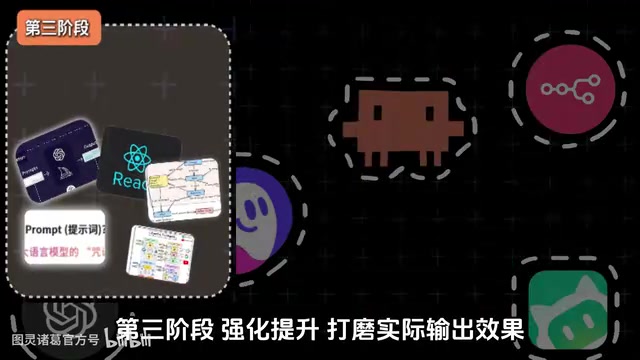
The second is Prompt tuning. Given the same model and framework, the quality of your prompts directly determines output precision and controllability. Through systematic prompt engineering, you can make an Agent's behavior more stable and its results more predictable — the difference between something that works in a demo and something that actually holds up in production.
Stage 4: Real-World Practice — Solving Actual Business Problems
Ultimately, technical skills are proven through projects. Stage 4 requires you to connect everything learned so far and complete two or three end-to-end practical projects. Suggested directions include:
- Intelligent Decision Assistant: Combines planning and tool-calling to help users with data analysis or decision-making.
- Office Automation Agent: Automatically handles repetitive tasks such as emails, scheduling, and document processing.
- Multi-Agent Collaborative System: Multiple Agents working together to complete a complex, end-to-end business workflow.
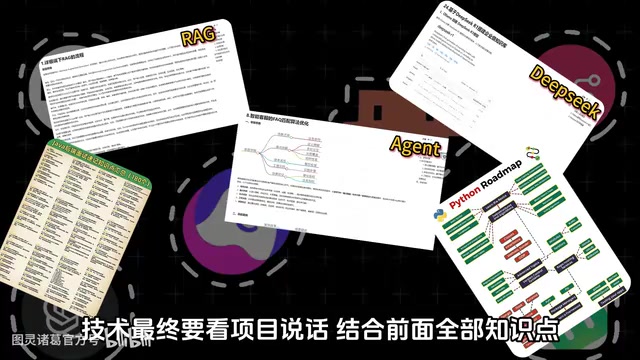
These projects matter not just as practice exercises, but as portfolio pieces. In a job interview, a complete, working Agent project that you can explain clearly is far more persuasive than a list of technical buzzwords on a resume.
Supplementary: Where RAG and MCP Fit In
The original curriculum also covers RAG and MCP — two technologies that play important roles in the Agent ecosystem. RAG (Retrieval-Augmented Generation) gives Agents the ability to access external knowledge, making it a key implementation approach for memory and knowledge management. MCP (Model Context Protocol) is a recently prominent standardized tool integration protocol that makes it easier and more consistent for Agents to connect with external tools and data sources. Mastering both technologies significantly extends the capability boundary of any Agent system.
RAG works by chunking external documents, vectorizing them into a vector database, and — when a user asks a question — retrieving the most semantically relevant text segments and injecting them into the prompt before the model generates a response. This allows the model to leverage continuously updated private knowledge without retraining. In the Agent ecosystem, RAG typically serves as "long-term memory," compensating for the limited context window of large models. MCP (Model Context Protocol) was released by Anthropic in late 2024. It is an open standard protocol that defines the communication interface format between AI models and external tools and data sources. Conceptually, it's like establishing a "USB standard" for the Agent ecosystem — tool developers implement the interface once according to the protocol, and their tools can be called by any Agent framework that supports MCP, eliminating repetitive custom integration work and significantly reducing ecosystem fragmentation.
Final Thoughts
The logic of this four-stage roadmap is straightforward: Build the foundation (concepts) → Understand the principles (paradigms) → Strengthen capabilities (collaboration and tuning) → Deliver results (real-world projects). Follow it seriously and you'll see a genuine improvement in your technical competitiveness.
It's worth noting that this roadmap originates from a learning series shared by a Bilibili creator — the quality of the specific courses and accompanying materials is something you'll need to evaluate for yourself. But as a roadmap, it captures the key milestones of Agent development from beginner to production-ready, and serves as a solid reference for anyone looking to enter the field systematically. The real core always comes down to the same thing: understand the principles, build things hands-on, and validate your learning through projects.
Related articles
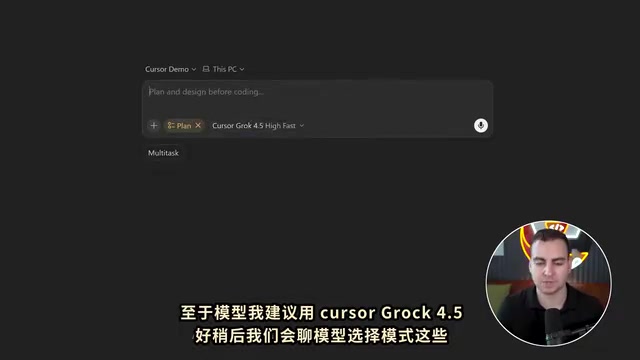
Cursor 3.0 Complete Beginner's Guide: Getting Started with AI-Powered IDE Development
Cursor 3.0 beginner's guide: from download and setup to parallel sub-agents, cloud development, skills, and automations. Master model selection, design mode, and Git with this complete AI IDE walkthrough.
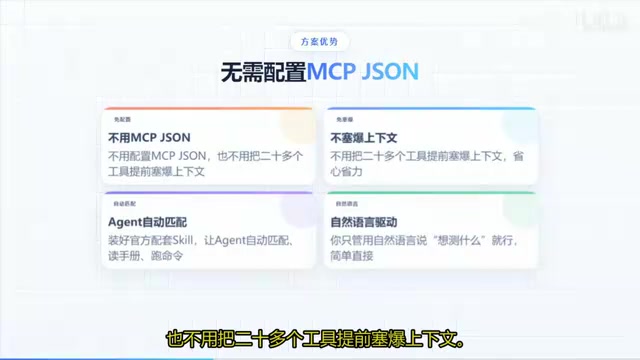
Codex + Playwright as a Skill: UI Automation Without Manual Commands
Wrap Playwright as a Codex Skill so AI agents run UI automation tests via natural language. Covers install, Sauce Demo walkthrough, PO pattern, and MCP vs CLI+Skill tradeoffs.

Replicate the $400/Year 'Dedao Brain' With Obsidian + AI Agents — For Free
How to replicate Dedao Brain Expert Edition (¥2,999/year) using free Obsidian + AI agents. A breakdown of Germinate, Polish, Challenge, Style Coach, and more as reusable prompt skills.