AI Agent Development: A Beginner's Guide from Concepts to Hands-On Practice
A beginner's roadmap for AI Agent development—from core concepts to LangChain and hands-on projects.
This article breaks down AI Agents based on analysis by an experienced tech creator, covering why Bill Gates calls them the biggest computing revolution since GUIs, how they differ from passive AI tools through proactivity and memory, and what multi-agent projects like Stanford Smallville and ChatDev reveal about their potential. It honestly addresses learning barriers—scarce resources, fragmented knowledge, few hands-on projects—then outlines a three-stage path: industry awareness, LangChain fundamentals (including RAG and vector databases), and a full project build.
Why AI Agent Represents the Next Form of Software
When most people think of artificial intelligence, they still picture chatbots like ChatGPT — understanding natural language, returning information, occasionally entertaining. But is that really AI's ultimate form? Bill Gates answered with a definitive "no" on his personal blog. He argued that existing software is still quite clunky, and that the future of software lies in intelligent agents (AI Agents). He predicted that within five years, everyone will have their own personal AI assistant, and that every piece of existing software is worth rebuilding through the lens of Agent-based design.
Gates described this shift as the biggest computing revolution since the transition from command lines to graphical user interfaces. At its core, it's a fundamental change in how we interact with technology: instead of opening separate apps to draft a document, build a spreadsheet, or send an email, you simply tell your device what you want in plain language. These intelligent systems that can execute specific tasks and act on behalf of users — that's the essence of an Agent.
According to analysis by Bilibili creator Tommy (who holds a software degree from Beihang University and claims 16 years of product development experience at major tech companies), Agents represent AI evolving from "what can it say" to "what can it do for us" — a generational leap and a major window of innovation.
The Fundamental Difference Between Agents and Traditional AI Tools
Many business owners who follow AI are puzzled: beyond chat, what can AI actually do in B2B scenarios? This is precisely where Agents shine.
Imagine a business consulting firm that processes large volumes of data every day — cleaning raw database records, extracting tables, running statistical analysis, and generating business insights. Generic ChatGPT can't handle this kind of workflow. The ideal solution is to build a business-specific Agent using AI capabilities: connect it to the database, input the insight questions you want answered, and a report is generated quickly — with the option to integrate an email system for direct delivery.
The key difference between Agents and traditional AI tools lies in proactivity and memory. Traditional tools are confined to specific applications and only respond when given explicit instructions. Agents, on the other hand, can proactively offer suggestions before a user even makes a request, execute tasks across applications, and continuously improve their interactions over time. They remember user activity, recognize behavioral patterns and intent, and surface content they believe the user needs — while always leaving the final decision to the user.
Take travel planning as an example: a sufficiently intelligent Agent doesn't just know your itinerary dates — it recommends destinations based on your preferences (do you like exploring new places or revisiting old favorites?), schedules activities based on your interests, and books restaurants. This kind of deep personalization once required paying a travel agency to achieve.
Multi-Agent Collaboration: From Stanford Smallville to ChatDev
Agents are evolving toward greater intelligence and human-like behavior — not only understanding complex instructions but making autonomous decisions based on changing environments. Several research projects have validated this direction.
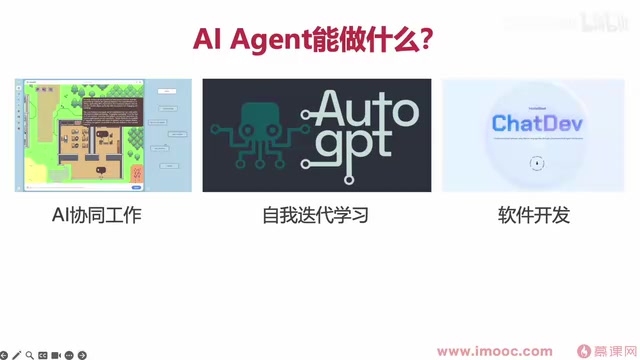
Stanford University's "Smallville" project assigned distinct personality attributes to virtual characters, then let these Agents develop freely within a shared environment, enabling collaborative behavior across the group. ChatDev, developed by a team in China, took a similar approach by virtualizing the entire software development lifecycle, with all roles played by AI agents collaborating as a group — achieving results that single agents simply couldn't match. It has since been widely applied in software development, making it possible to write code from verbal instructions.
In customer service, LLM-based Agents can handle inquiries and deliver personalized support, improving interaction quality and efficiency in banking, e-commerce, and other industries. In data visualization, Agents can transform raw data into interactive charts, offering new ways to understand complex information in use cases like market analysis and health tracking.
Stanford Smallville is a joint research project from Stanford University and Google, formally published as "Generative Agents: Interactive Simulacra of Human Behavior." Researchers equipped 25 virtual characters with a three-layer architecture of Memory Stream, Reflection, and Planning, enabling each Agent to record experiences, summarize patterns, and formulate action plans accordingly. During the experiment, the characters spontaneously organized a Valentine's Day party — spreading the word, inviting friends, and coordinating time and location — all without any human intervention. This demonstrated remarkable emergent social behavior. The significance of the research lies in showing that when Agents are equipped with persistent memory and autonomous planning, group interactions can produce complex behaviors that no single model could have predicted — laying both the theoretical and engineering groundwork for practical multi-agent systems.
ChatDev is an open-source project from Tsinghua University's Natural Language Processing Lab. Its core idea is to map the organizational structure of a software company onto a multi-Agent collaboration framework, with roles including CEO, CTO, programmer, and tester, who work sequentially through a "Chat Chain" to complete the full pipeline from requirements analysis to code testing. This division of labor not only improves code quality but also provides a reproducible technical path for "describing requirements in natural language and generating runnable software."
Market Potential and Learning Value
On market scale, the video cited two sets of figures. According to Grand View Research, the autonomous AI and Agent market was already worth $3.9 billion in 2022, with a projected compound annual growth rate (CAGR) of approximately 42.8% through 2030. Another report indicated the market would grow from $5 billion to $29 billion at a similar ~43% CAGR. These numbers reflect both strong market demand and the potential for Agents to be applied across industries.
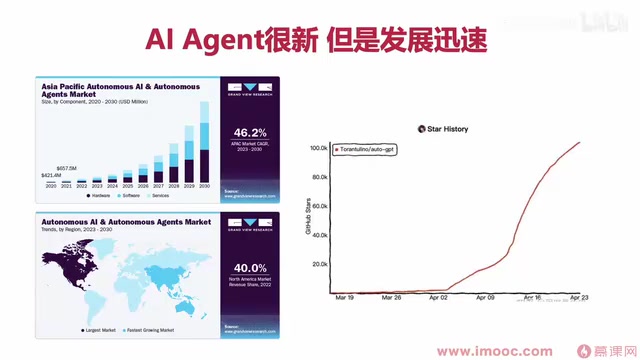
From a learning value perspective, mastering Agent technology is compared to learning web development during the PC era or app development during the mobile era — a defining skill of the moment. AutoGPT, LangChain, and other ecosystem projects saw explosive growth after going open source, with GitHub stars surging, signaling strong developer community interest. According to an Indeed report, AI-related positions pay 20–30% more on average than traditional tech roles, and Agent development skills are seen as a gateway to high-paying employment.
A caveat worth noting: these market figures were cited from a single video, and readers should cross-reference multiple sources before drawing conclusions.
The Real Challenges of Getting Started with Agent Development
The video was also candid about the key barriers to learning Agent development — a section that offers genuine value for beginners:
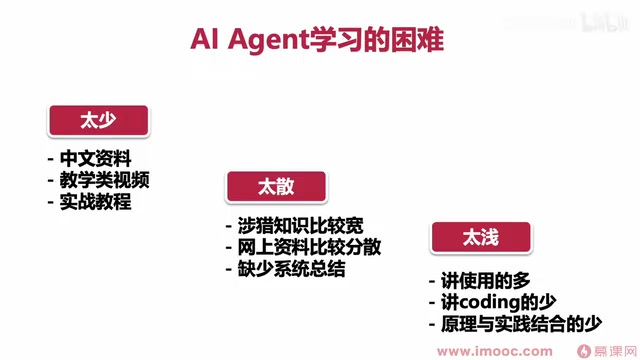
- Scarce resources: Agent development is relatively new, with very few quality Chinese-language materials and rapidly outdating English-language content. It's reported that over 60% of beginners cite finding high-quality, up-to-date resources as their top challenge.
- Fragmented knowledge: Content is scattered across domains — from large language models and tool use to vector databases and AI engineering — with little in the way of systematic synthesis.
- Surface-level courses: Most available courses only cover how to use tools, without connecting them to actual coding workflows, leaving those who want to build real AI products underserved.
- Limited hands-on opportunities: The technology is new, practical projects to work on are scarce, and it's difficult to validate theory through real-world application.
A Practical Systematic Learning Path
In response to these challenges, the course framework outlined in the video also sketches a reasonably complete learning path for self-learners. It's divided into three main sections:
Part 1: Understanding the AIGC Industry and Technology Selection
Starting from the history of large language models, this section uses platforms like Hugging Face to introduce mainstream models and their limitations, then introduces fine-tuning and LangChain as solutions, and decodes the industry jargon between research papers and real applications. The goal at this stage is to build industry awareness and complete requirements analysis and technology selection for a virtual project.
Part 2: The LangChain Framework and Foundational Theory
This section systematically covers the fundamentals of Agent development through LangChain's core components: running a local environment, the Model I/O concept, prompt template usage, building an external knowledge base for LLMs, Retrieval-Augmented Generation (RAG), text chunking, and vector databases.
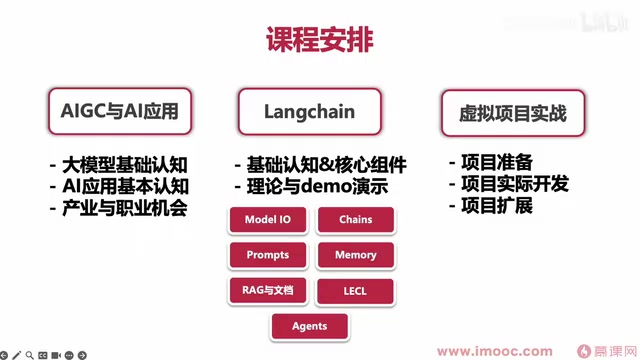
LangChain is currently one of the most widely used open-source frameworks for Agent development. Released by Harrison Chase in late 2022, its core idea is to "chain" large language models together with external tools and data sources through standardized interfaces. The framework provides key abstractions including Chain (sequential calls), Agent (dynamic decisions about which tool to invoke), Memory (cross-conversation memory), and Tool (external API wrappers) — so developers don't have to handle the tedious work of stitching prompts, parsing tool call return values, and so on from scratch. RAG (Retrieval-Augmented Generation) is one of its key technologies: it splits private documents into text chunks, converts them into vector embeddings stored in a vector database (such as Chroma or Pinecone), and at query time retrieves the most relevant chunks to inject into the prompt — enabling the model to answer based on real documents. This addresses two major pain points of LLMs: knowledge cutoff dates and hallucinations. It's the most common way enterprises integrate internal data with AI capabilities, and the underlying technical foundation that makes the business consulting scenario described earlier possible.
Part 3: Hands-On Practice and Engineering
This section grounds all the knowledge in a complete virtual project. The example project in the video is quite creative — it's designed as a "feng shui fortune teller" (modeled after the character Chen Xiazi from the Chinese novel Ghost Blows Out the Light): with its own distinct personality, ability to hold casual conversation, tool-calling capabilities (real-time search, email and SMS integration), continuous knowledge learning, real-time text-to-speech synthesis (TTS), and even emotional inference based on user input with corresponding feedback. The project covers the full pipeline from product requirements analysis and architecture design to coding and engineering.
For developers looking to get started, the video's advice is: primarily use Python — prior experience helps, but beginners can follow along too. The emphasis isn't just on learning to use tools, but on learning to think about how to embed business scenarios into AI. This "theory + practice + complete project" approach offers genuine value for application developers, AI product managers, and front-end or back-end engineers looking to transition.
Closing Thoughts
At its core, this content is a course introduction — but its framing of Agent's role, its contrast with traditional tools, its overview of market trends, and its outline of a learning path still offer a valuable conceptual framework for anyone approaching Agent development for the first time. As the video concludes: AI doesn't make people obsolete — it makes people who don't know how to use AI obsolete. For companies and individuals who already possess industry data and domain expertise, learning to rethink their business through an Agent lens may be exactly the right entry point for embracing this transformation.
Related articles
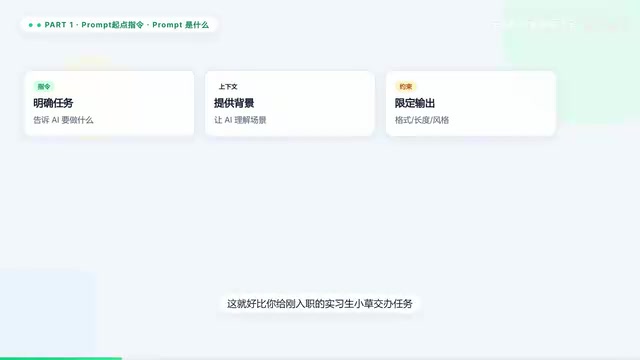
Prompt → MCP → Agent → Skill: The AI Terminology Evolution Chain Explained in 5 Minutes
A clear guide to five core AI concepts — Prompt, MCP, Agent, Skill, and Cowork — and how they connect in a layered evolution chain from simple instructions to multi-agent teamwork.
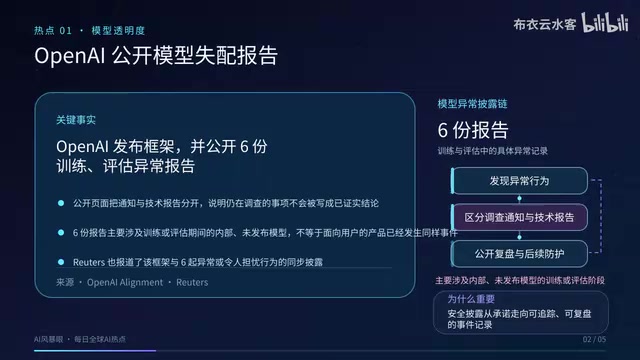
OpenAI Discloses Model Anomalies, DeepMind Launches AGI Forum, NVIDIA Partners on Grid Power Management
Sept 17 AI roundup: OpenAI publishes model anomaly disclosure framework with 6 reports, Google DeepMind launches AGI public forum, NVIDIA leads AI energy management alliance with 18 partners.
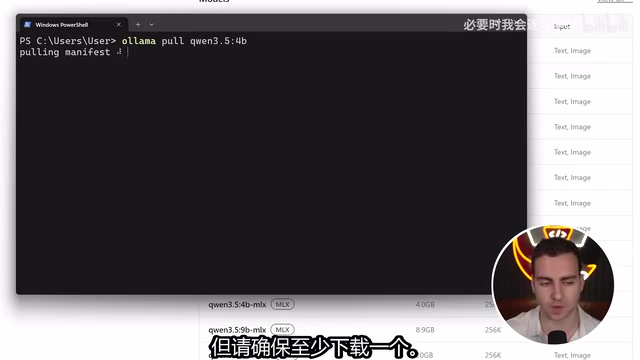
Build a Local AI Agent with Python in 10 Minutes: Ollama + PydanticAI in Action
A hands-on guide to building a fully local AI agent with Python, Ollama, and PydanticAI in 10 minutes — covering model selection, tool functions, and conversation loops.