AI Agent Development from Zero: A Four-Week Progressive Learning Guide

A four-week AI Agent learning roadmap deconstructed — solid framework, but ignore the fast-track hype.
This article systematically breaks down and evaluates a popular four-week AI Agent learning roadmap. The plan progresses from LLM fundamentals → Agent principles → multi-agent collaboration → real-world projects, covering core components like planning, memory, and tool use, as well as the ReAct paradigm and prompt engineering. The framework's logic is sound and progressive, making it a useful reference for beginners — but claims like "become an AI engineer in one month" or "job-ready after the course" are pure marketing. A month is enough to build a conceptual foundation and run a demo; true engineering competence requires sustained work on real projects.
A Learning Roadmap That Keeps Getting Recommended
I recently came across a beginner's learning plan for AI Agent development on Bilibili. The core claim is straightforward: as long as you're not just chasing trends, anyone can work through the core concepts and practical workflows of AI Agents in about a month by following a structured path. Content like this tends to carry strong marketing overtones — but setting aside the hype, the underlying learning framework is worth examining.
This article breaks down the roadmap from the original material, cross-references it against established knowledge in the AI Agent field, and helps genuine beginners separate the substance from the sales pitch.
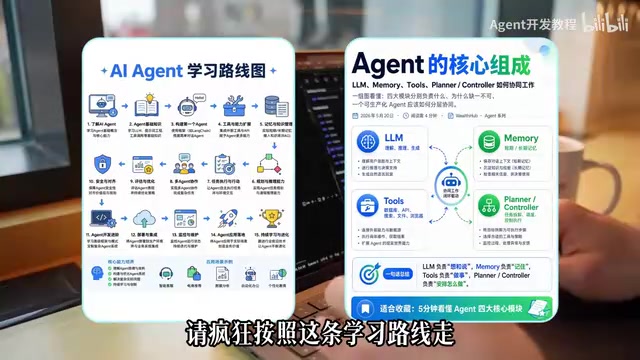
Let's start with a reality check: claims like "go from zero to expert in seven days" or "job-ready after finishing the course" are clear exaggerations. AI Agent engineering spans multiple disciplines — LLM fundamentals, software engineering, and system design, to name a few. A month is enough to build a conceptual framework and get a demo running, but reaching production-level engineering competence still requires sustained work on real-world projects.
Week One: Laying the Foundation — LLMs and Core Agent Concepts
The focus of the first week is understanding Agent theory and key components. The modules listed in the source material — LLM fundamentals, Planning, Memory, and Tool Use — happen to be the four pillars of mainstream Agent architectures today.
- LLM Fundamentals: Understanding how LLMs handle inputs and outputs, context windows, and token-based pricing. This is the prerequisite for everything built on top.
- Planning: How an Agent breaks a complex goal into executable subtasks.
- Memory: The interplay between short-term memory (conversational context) and long-term memory (vector database retrieval).
- Tool Use: Enabling models to call external APIs, execute code, and retrieve information — this is what sets an Agent apart from a standard chatbot.
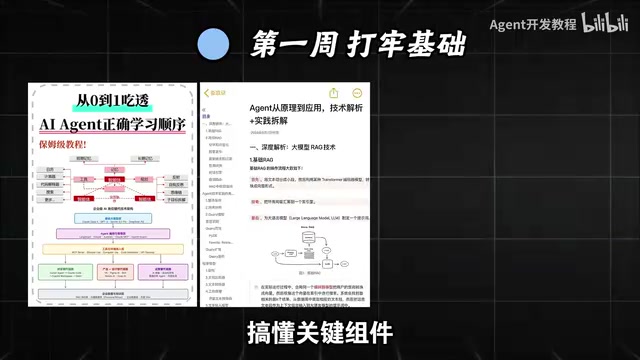
Truly internalizing these four concepts matters more than rushing to write code. Many beginners skip the theory and jump straight to copying demos, only to find themselves completely lost when something breaks.
Vector databases are the core infrastructure for long-term memory in the memory module and deserve focused attention. They work by converting text, documents, and other content into high-dimensional numerical vectors (embeddings). These vectors are stored and later retrieved by computing similarity scores, enabling semantic search. Unlike traditional keyword search, vector retrieval understands semantic relevance — even when the query and the document use different words, it can still find a match if the meaning is close. Popular vector databases include Pinecone, Chroma, Weaviate, and Milvus. In Agent systems, long-term memory is typically implemented by storing historical conversations or external knowledge in a vector database and injecting relevant retrieved snippets into the context when needed — which is also the foundational logic behind RAG (Retrieval-Augmented Generation).
Week Two: Mastering Agent Internals and Classic Architecture Patterns
The goal of the second week is to understand the complete Agent workflow and study classic architectural paradigms. The source material references something that sounds like "ReactCut," which appears to be a mispronunciation — it almost certainly refers to the ReAct architecture: the classic pattern of alternating Reasoning and Acting.
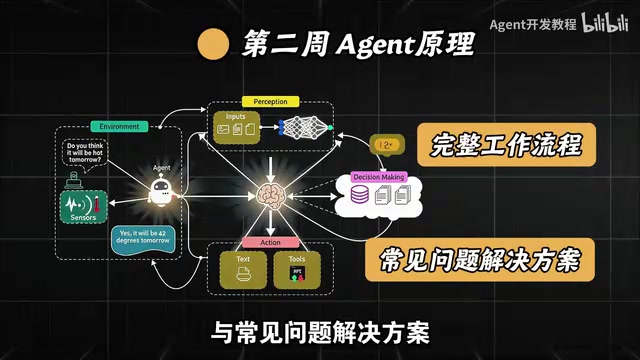
The core idea behind ReAct is to have the model iteratively approach an answer through a "Think → Act → Observe" loop, rather than attempting to produce the final result in one shot. This paradigm addresses the tendency of LLMs to make mistakes when trying to solve complex problems all at once, and it forms the conceptual foundation for understanding subsequent Agent frameworks like LangChain and AutoGPT.
This phase should also cover solutions to common failure modes, such as:
- Retry and fallback strategies when tool calls fail
- Information loss caused by excessively long contexts
- Interruption mechanisms when a model gets stuck in an infinite loop
Understanding these pitfalls in advance is far more valuable than only learning how things work in the happy path.
ReAct was first introduced by Yao et al. in the 2022 paper "ReAct: Synergizing Reasoning and Acting in Language Models." Its key innovation was combining Chain-of-Thought reasoning with external tool calls, forming an alternating cycle of Thought → Action → Observation. Concretely, the model first writes out its current reasoning step in natural language, then invokes a tool (such as a search engine or calculator), and uses the returned result as a new observation to feed into the next round of reasoning — continuing until a final answer is reached. This structure makes the model's reasoning process interpretable and debuggable, and gives developers clear intervention points. Mainstream Agent frameworks like LangChain are heavily influenced by the ReAct paradigm in their design.
Week Three: Multi-Agent Collaboration and Prompt Tuning
By week three, the content advances to multi-agent coordination logic and Prompt engineering optimization techniques.
Multi-agent collaboration has become a hot area recently. The idea is to distribute a complex task across multiple specialized Agents, using their division of labor and communication to accomplish work that a single Agent would struggle with — for example, one Agent handles retrieval, another handles writing, and a third handles review. The challenge here lies in designing the coordination mechanism, not in the capability of any individual Agent.
Prompt engineering is a critical lever for improving Agent output quality. Tuning here goes far beyond "writing a good instruction" — it encompasses role definition, few-shot examples, output format constraints, chain-of-thought prompting, and more. With the same underlying model, the difference between a well-crafted and a poorly-crafted prompt can be dramatic.
In multi-agent systems, coordination mechanisms generally fall into two main patterns: centralized orchestration (Orchestrator-Agent) and decentralized peer-to-peer collaboration. In the former, a primary orchestrator Agent handles task decomposition, delegation, and result aggregation, while sub-Agents each focus on their designated role — similar to a "project manager + execution team" structure. Frameworks like AutoGen and CrewAI primarily adopt this model. In the latter, multiple Agents communicate and negotiate as equals, which suits scenarios requiring multi-perspective debate or mutual verification. Both patterns have their place, but centralized orchestration is easier to debug and control in practice, making it the more recommended starting point for beginners. Multi-agent systems also need to address message format conventions between Agents, how shared state is managed, and how to prevent multiple Agents from creating race conditions or redundant operations on the same resource.
Week Four: Real-World Projects — Putting Technology to Work
The final week emphasizes hands-on project work using the knowledge accumulated over the previous three weeks, with the goal of applying the technology to real business scenarios.
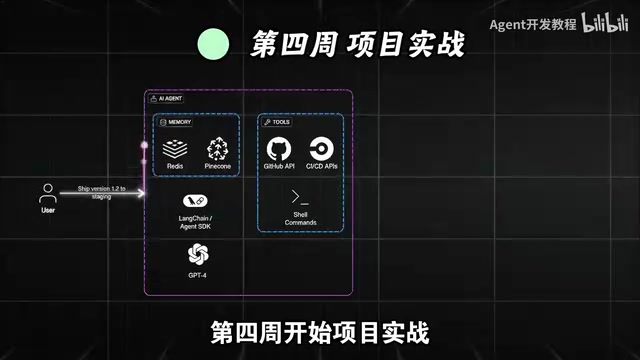
This step is critical. AI Agent development is a highly practice-dependent field — watching videos and reading documentation alone is unlikely to build real capability. The recommendation is to start with a clearly scoped small use case: for instance, an Agent that automatically retrieves information and generates a report, or an assistant that calls multiple tools to handle customer service tasks. Working on a real project will expose you to problems that classroom learning can't fully address: cost control, response latency, error handling, and output evaluation.
A Realistic Take on "Fast-Track" Learning Claims
Overall, the framework of this four-week roadmap is sound: moving from concepts to principles, from single-Agent to multi-agent systems, and then to real-world projects follows a sensible progressive learning logic.
But keep a clear head about the marketing language:
- "Become an AI engineer in one month" is closer to "build a solid conceptual framework in one month" — there's still a significant gap between that and the practical threshold for engineering work.
- "Job-ready after the course" is a classic marketing hook. Employment depends on a demonstrable project portfolio and sustained deep learning, not a fast-track tutorial.
- The source material uses a free roadmap as a lead-generation tool — a common pattern for this type of content. The learning resources may be worth referencing, but don't treat them as gospel.
For those who genuinely want to get started, rather than worrying about "how long it will take to learn," treat this roadmap as a map: follow the sequence of LLM fundamentals → Agent principles → multi-agent systems → real-world projects, and verify every step by building something yourself. That's the most solid path forward.
Related articles

Random Pruning of the DPO Computation Graph: 1.4x Training Speedup and Lower Peak Memory
DPO training too slow and memory-hungry? This paper proposes a random pruning framework for the DPO computation graph, sampling independently across position, sequence, and branch dimensions; branch pruning achieves a 1.426x step-time speedup and cuts training time by about 30%, with in-depth attribution of memory and time gains.

Why Does JEPA Underperform MLM in Longitudinal EHR Representation Learning?
New study compares JEPA and MLM for longitudinal EHR representation learning on MIMIC-IV: three JEPA variants train stably without collapse but underperform MLM; target size, not heterogeneity, drives prediction error.

Transfer Learning + Visible Light Communication: A New Approach to Energy-Efficient Indoor Positioning
A study proposes a transfer learning-based visible light communication indoor positioning method, achieving 47% accuracy improvement on the BOSCH factory dataset, 67.5% model efficiency under high noise, and introducing the ME composite metric for energy-efficient positioning in energy-constrained industrial IoT scenarios.