AI Agent Development Landscape: From Architecture Design to Production Deployment

A complete architectural guide to modern AI Agent development, from RAG and planning to MCP, gateways, and production observability.
This article maps the full technology stack of modern AI Agents — covering RAG knowledge retrieval, Agent task planning via the ReAct pattern, the MCP tool protocol, AI Gateways, and LLM observability platforms. It emphasizes starting with a macro architectural view before drilling into details, helping developers avoid fragmented learning and build production-grade AI systems with confidence.
Over the past two years, AI Agents have moved from concept to reality, becoming the core focus of enterprise-grade AI systems. Yet many developers fall into the trap of scattered, fragmented learning — studying RAG here, experimenting with Agents there, trying out Coze and Dify along the way — only to find they can't actually build anything end-to-end.
The root cause is simple: a lack of high-level architectural understanding of AI systems as a whole.
This article is based on a technical talk by a senior AI engineer, and systematically maps out the complete technology stack of modern AI agents — helping developers build a clear learning path from fundamentals to production.
The Overall Architecture of a Modern AI System
No matter how complex an AI system appears, its core pipeline follows a common pattern. Everything starts with a user request — essentially a Prompt. The system calls a large model API to perform semantic understanding and reasoning on that input.
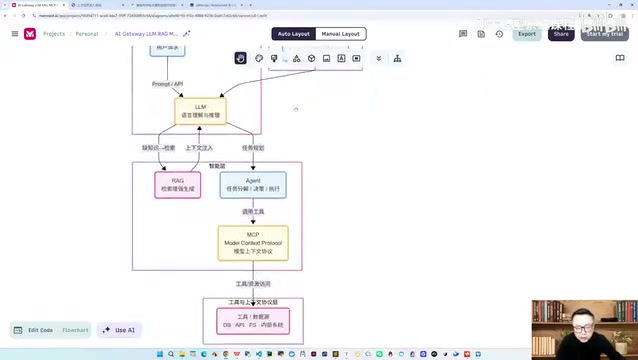
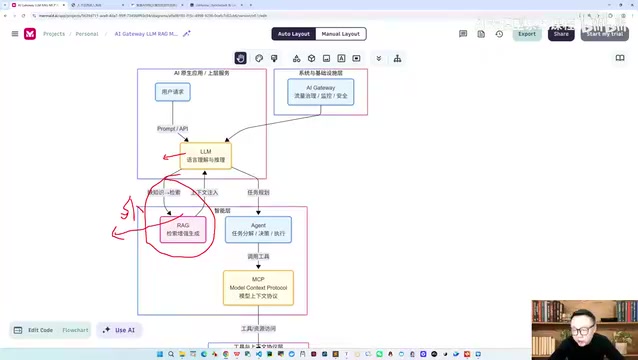
When the model's built-in knowledge is insufficient to answer directly, that's where RAG (Retrieval-Augmented Generation) comes in. In enterprise settings, RAG is often called a "local knowledge base" or "enterprise knowledge base."
RAG was formally introduced by Meta AI Research in the 2020 paper Retrieval-Augmented Generation for Knowledge-Intensive NLP Tasks. Its core idea is to combine parametric memory (knowledge stored in model weights) with non-parametric memory (externally retrievable documents). In practice, RAG typically has two phases: an offline indexing phase (document parsing, chunking, vectorization, and storage) and an online retrieval phase (query vectorization, similarity search, context assembly, and answer generation). Each phase involves substantial engineering detail that requires careful tuning.
Here's a critical insight: a large model's knowledge is essentially "frozen" — its pre-training data has a hard cutoff date, and the model has no access to your organization's proprietary data. Ask it to "analyze our company's financial profit this year" and it will confidently fabricate an answer — a phenomenon commonly known as hallucination. RAG addresses this gap by augmenting the model with an external knowledge source.
Three Core Forms of Knowledge Retrieval
A common misconception is that "knowledge base = vector database." That's not quite right. There are three mainstream retrieval approaches:
- Vector Store (Vector DB): The most common approach. Retrieval is based on semantic similarity, using vector data structures. Popular options include Pinecone, Milvus, and Qdrant. Under the hood, algorithms like HNSW and IVF efficiently locate semantically similar document chunks in high-dimensional space.
- Knowledge Graph: A graph-based structured data model that stores knowledge as "entity–relation–entity" triples. Neo4j is the go-to implementation. Construction is significantly more complex than vector-based approaches, but it excels at representing multi-hop relationships between entities — making it especially well-suited for enterprise knowledge management scenarios requiring complex reasoning.
- Full-Text Search (e.g., BM25): A probabilistic keyword-matching approach and an improvement over TF-IDF. It delivers excellent results for exact keyword matches and remains a classic full-scan retrieval method.
In practice, Hybrid Search — combining vector retrieval with BM25 and merging results using algorithms like RRF (Reciprocal Rank Fusion) — consistently outperforms either method alone, capturing the benefits of both semantic understanding and precise keyword matching.
Understanding these three retrieval modalities is the foundation for building high-quality RAG systems. Many developers jump straight to dumping PDFs into a pipeline without cleaning the data — and then wonder why retrieval fails or only returns partial fragments. This is a textbook symptom of lacking a systematic methodology.
From ChatBot to Agent: Giving the LLM "Hands and Feet"
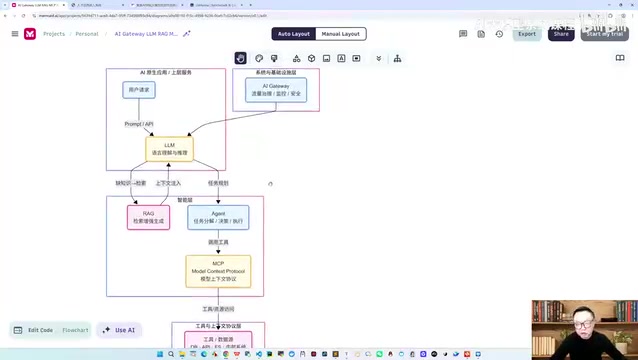
A large model combined with RAG alone doesn't constitute a true AI system — at best, it's a more powerful search tool or question-answering chatbot. It can provide suggestions, but it can't autonomously take action or complete goals. This is the defining characteristic of the first generation of AI applications.
A true AI Agent is a different matter entirely. Take "order me a coffee" as an example. An Agent's execution flow looks like this:
- Perception: Receive and understand the user's intent;
- Task Planning: Decompose the goal into a sequence of actions — find a nearby store, place an order, process payment, arrange delivery;
- Tool Invocation: Execute each step through the appropriate Tools.
This complete loop of "perceive → plan → act" is the essence of an Agent. It gives the LLM "hands and feet," enabling AI to evolve from "offering advice" to "autonomously completing tasks."
MCP Protocol: Standardizing Agent-Tool Interaction
For an Agent to call external tools, it needs MCP (Model Context Protocol). MCP is an open protocol released by Anthropic in November 2024. Its design draws inspiration from LSP (Language Server Protocol) — the same standardization that allows editors like VS Code to support dozens of programming languages through a unified interface. MCP aims to achieve the same effect in the AI tooling ecosystem.
MCP defines a clear three-layer architecture: Host (e.g., Claude Desktop — the runtime environment hosting the agent), Client (the protocol client, responsible for communicating with servers), and Server (the tool service provider, which can expose three types of capabilities: Tools, Resources, and Prompts). Consider this scenario: an agent needs to simultaneously access a file system, a database, and GitHub. The traditional approach requires building a separate adapter for each service — high effort and hard to maintain. MCP solves this by defining a unified protocol, so all services can be accessed in the same way, dramatically reducing integration overhead. Today, a large ecosystem of third-party MCP Servers covers common scenarios including file systems, databases, web browsing, and code execution.
MCP's design philosophy centers on context sharing and unified access — it's not just a remote procedure call protocol; it also allows rich context to be shared between agents and tools.
In practice, LangChain integration via the langchain-mcp-adapters package and its MultiServerMCPClient allows developers to connect to multiple MCP services at once, significantly simplifying tool integration complexity.
The ReAct Pattern and the Limits of Single Agents
ReAct Agent is the dominant single-agent paradigm today, jointly proposed by Princeton University and Google Research in 2022 (paper: ReAct: Synergizing Reasoning and Acting in Language Models). Its core is a three-step loop:
- Reason: Analyze the current state and decide on the next action
- Act: Invoke a tool or issue an instruction
- Observe: Capture the result and feed it into the next reasoning cycle
The real value of ReAct is that it makes the LLM's reasoning process interpretable and auditable — every thought in the chain is explicitly recorded. This is critical for debugging, root cause analysis, and performance optimization in production. The agent iterates through this loop until the task is complete.
However, the traditional ReAct pattern hits clear bottlenecks in complex scenarios. For high-complexity, multi-step tasks, a single agent struggles to maintain reliably high planning and execution success rates. Error accumulation over long reasoning chains can cause task failure rates to rise significantly. This is precisely why the industry is actively exploring multi-agent collaboration architectures.
Infrastructure for Production-Grade AI Systems
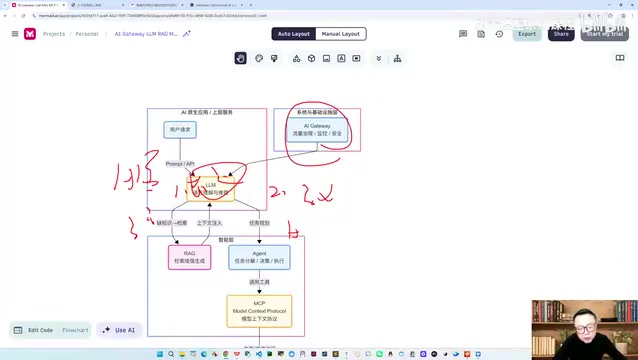
Once the full pipeline — LLM + RAG + Agent + MCP — is wired together, the system might run smoothly in a demo environment. But to run reliably in production over the long term, a solid infrastructure layer is essential.
AI Gateway
Production systems need an AI Gateway to handle access control, rate limiting, monitoring, security interception, and authentication. Compared to a traditional API gateway, an AI Gateway must also address LLM-specific engineering challenges: real-time forwarding of streaming responses, token-level billing and quota management, dynamic load balancing across multiple models (e.g., intelligent routing between GPT-4o and Claude), and security features like prompt injection detection. Stability above all else — this is the first principle of production-grade AI systems.
Observability
Continuous improvement requires a robust observability stack. LangSmith, LangFuse, and Helicone are leading LLM observability platforms that can trace complete Agent call chains, visualize each reasoning step, record token consumption and latency distributions, and provide quantitative data for diagnosing hallucinations and optimizing system performance. Observability solutions collect data from real user interactions and long-running call histories, providing the empirical basis for model iteration and improvement. As a side note: the content transmitted during routine API calls is often collected by service providers and used as training data for future model versions.
The Value of the AI Systems Engineer
When an engineer can fully wire together every component — LLM inference, RAG retrieval, Agent planning, MCP tool calls, AI Gateway, and observability — and actually ship it to production, they possess a skillset that is exceptionally sought-after in today's market. Based on the presenter's observations, AI application systems engineers with this breadth of capability command starting salaries of 30K+ (CNY/month).
More important than the destination, though, is the learning methodology: start with the macro architecture, then drill down into the details layer by layer. How do you make LLM capabilities more domain-specific? How do you improve RAG retrieval quality? How do you push Agent task execution success rates above 95%? You can only answer these questions — and know where to focus your effort — once you've established a holistic architectural understanding first.
Conclusion
AI Agent development is not about piling up isolated technical components. It's a systems engineering discipline. From user Prompt to RAG-augmented knowledge retrieval, from Agent task planning to MCP tool invocation, and through to production-ready gateway governance and observability — understanding this complete pipeline is what it takes to ship agents to production.
For developers, the right path is clear: establish the macro architectural view first, then refine the details through hands-on practice. That's the correct approach to mastering AI Agent development.
Related articles
Understanding GitHub's Availability Report: Platform Stability and Developer Response Strategies
Deep dive into GitHub's monthly availability report: analyzing service degradation impacts, CI/CD fault tolerance, and platform dependency risk strategies for resilient development.
OpenAI's Claim of Solving a Millennium Prize Problem Sparks Academic Controversy
OpenAI claims its AI solved a Millennium Prize Problem, sparking debates over attribution, verification, and AI's role in reshaping mathematical research.
Ledoit-Wolf Covariance Shrinkage in Practice: 57% Lower Turnover + 10x GPU Acceleration
Learn how Ledoit-Wolf covariance shrinkage reduces portfolio turnover by up to 57% and how cuML GPU acceleration cuts backtest time from 1.5 hours to 9 minutes.