AI Agent Frameworks: A Whiteboard Guide to Whether and When to Use Them

An Agent framework essentially runs the tool-call loop for you; whether to adopt one depends on task complexity and observability needs.
Using a whiteboard explanation video, the article breaks down four mainstream Agent frameworks: LangGraph, OpenAI Agents SDK, Claude Agent SDK, and Google ADK. The essence of a framework is running the "call the model—execute tools—feed back results—call again" loop for you, along with supporting capabilities such as tools, memory and state, handoffs, guardrails, and tracing. These capabilities are not hard to implement individually, but their combination is where the appeal lies. The four frameworks form a spectrum from minimal abstraction (OpenAI) to low-level stateful orchestration (LangGraph) to production-ready out-of-the-box solutions (Claude, Google). On whether a framework is needed, Anthropic recommends starting by calling the model API directly, because the extra layers of a framework can hide prompts and responses and increase debugging difficulty; OpenAI presents "owning the loop yourself" and "letting the SDK runtime handle it" as a trade-off. The conclusion is that you do not have to choose one globally; switch flexibly based on task complexity and control needs, and the pragmatic path is to write the loop by hand once before evaluating a framework.
AI Agents are moving from demos to production, but many developers still feel confused when facing LangGraph, OpenAI Agents SDK, Claude Agent SDK, and Google ADK: What problems do these frameworks actually solve? Do I really need another layer of abstraction? A recent video that explains AI Agent frameworks on a whiteboard breaks this question down quite clearly, and it is worth discussing alongside its points.
The Essence of a Framework: Running That Loop for You
The video gives a straightforward definition: An Agent framework is a code library that runs the Agent loop for you. The so-called loop means calling the model, executing the tools the model requests, feeding the results back to the model, and repeating until the task is complete. LangChain's documentation also describes the value of a framework as providing "abstractions"—reusable building blocks that make it easier to get started.
Take the OpenAI Agents SDK as an example. You create an Agent with instructions, hand it to a Runner along with a task, and the Runner then runs the loop: call the model; if the model requests a tool, execute the tool, add the result back, and loop again until the output is the final answer. This loop is the core of the framework.
The Agent Loop is the starting point for understanding every Agent framework. Its minimal form is a while loop: send the conversation history to the model → check whether the model returns plain text or a tool-call request → if it is a tool call, execute the corresponding function and append the return value to the history as a tool-result message → call the model again. The loop terminates when the model no longer requests tools and directly gives the final answer (or when hard limits such as the maximum number of turns or a token budget are reached). Writing this loop from scratch usually takes only a few dozen lines of code; the real complexity comes from edge cases: parallel tool calls, retries and error propagation when tool execution fails, interleaving of streaming output and tool calls, and truncation strategies when the context grows too long. The value of a framework lies not mainly in writing the loop itself, but in handling these edge cases properly and making the loop observable. Understanding this lets you judge whether a framework is solving real pain points for you or merely adding a layer of indirection you are not familiar with.
What Else Is in the Box
Besides the loop, frameworks usually package these capabilities:
- Tools: The Claude Agent SDK includes built-in tools for reading and editing files, running commands, and searching the web.
- Memory and state: LangGraph provides short-term working memory and long-term memory across sessions.
- Handoffs: One Agent delegates a task to another Agent.
- Guardrails: Validate inputs and outputs.
- Tracing: Visualize and debug a run.
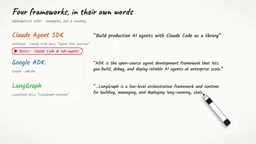
None of these capabilities is hard to implement individually, but their combination is the real appeal of a framework. The video shows screenshots of how two frameworks position themselves:
Handoffs deserve a separate explanation because it is the most easily misunderstood mechanism in multi-Agent systems. A handoff is not essentially "starting a new process"; it is transferring control, together with the conversation context, to another Agent within a single session—usually implemented as a special tool call: the current Agent calls a transfer_to_xxx tool, and the runtime switches the system prompt and available toolset used for subsequent turns accordingly. This differs from "sub-Agent calls," where the main Agent calls out a subtask as a tool, gets the result, and continues to control the flow itself, with the context potentially isolated. Handoffs are suitable for dividing responsibilities by domain (e.g., a triage Agent handing off to a refund Agent), while sub-calls are suitable for heavy work that needs parallelism or context isolation. When designing a multi-Agent system, thinking clearly about which one to use often affects the final architecture more than which framework you choose.
Four Frameworks, Four Descriptions
The video lists the self-descriptions of four frameworks in alphabetical order (not a ranking): Claude Agent SDK from Anthropic is positioned as "building production-grade AI Agents by treating Claude Code as a library"; Google describes ADK as an open-source framework for building, debugging, and deploying AI Agents; LangGraph describes itself as a low-level orchestration framework and runtime for stateful Agents; and OpenAI Agents SDK emphasizes being lightweight, easy to use, and having very few abstractions.
These positions reveal a spectrum: OpenAI's SDK has the fewest abstractions, LangGraph emphasizes low-level orchestration but provides a stateful runtime, and Claude and Google's offerings lean more toward out-of-the-box production capabilities.
Do You Need a Framework? Cross-Validating Two Positions
This is the most valuable part of the whole explanation. An Anthropic article cited in the video (published in December 2024; the article also acknowledges that the tool ecosystem has changed) recommends: start by calling the model API directly. Many patterns require only a few lines of code, and the extra layers of a framework can hide prompts and responses, making debugging harder. If you use a framework, understand the underlying code.
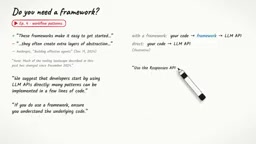
OpenAI's documentation presents the same choice: using the API directly means you own control of the loop; using the SDK means letting its runtime manage the loop. The two sides say it differently, but they point in the same direction—this is a trade-off, not a question of right or wrong.
A more important reminder is: You do not need to choose one globally. You can call the API directly for simple tasks and introduce a framework when you need complex capabilities such as memory, multi-Agent handoffs, and tracing; you can also mix them within one project. The criterion should be task complexity and your need for control over underlying behavior, not the popularity of a framework.
For developers building Agents, a pragmatic path is: first write the loop by hand once, understand the mechanics of tool calls and result feedback, and then evaluate whether what a framework saves you is tedium or observability.
The Anthropic article cited usually refers to "Building effective agents" on its engineering blog. Its core argument is to prioritize composable workflow patterns over general-purpose frameworks: break tasks into several fixed topologies such as prompt chaining, routing, parallelization, orchestrator-executor, and evaluation-optimization, each of which can be implemented with a few dozen lines of code that call the API directly, with fully transparent behavior and easy debugging. The article also distinguishes "workflows" (where the path is predetermined by code) from "Agents" (where the model autonomously decides steps and tool usage), and recommends introducing an autonomous loop only when dynamic decision-making by the model is truly needed. The practical significance of this distinction is that many requirements treated as Agents can actually be completed more stably and cheaply with a deterministic workflow; in that case, introducing an Agent framework is over-engineering.
One-line Summary
An Agent framework essentially runs the tool-call loop for you; whether to introduce one depends on task complexity and observability needs.
Paragraph Summary
Using a whiteboard explanation video, the article breaks down four mainstream Agent frameworks: LangGraph, OpenAI Agents SDK, Claude Agent SDK, and Google ADK. The essence of a framework is running the "call the model—execute tools—feed back results—call again" loop for you, along with supporting capabilities such as tools, memory and state, handoffs, guardrails, and tracing. These capabilities are not hard to implement individually, but their combination is where the appeal lies. The four frameworks form a spectrum from minimal abstraction (OpenAI) to low-level stateful orchestration (LangGraph) to production-ready out-of-the-box solutions (Claude, Google). On whether a framework is needed, Anthropic recommends starting by calling the model API directly, because the extra layers of a framework can hide prompts and responses and increase debugging difficulty; OpenAI presents "owning the loop yourself" and "letting the SDK runtime handle it" as a trade-off. The conclusion is that you do not have to choose one globally; switch flexibly based on task complexity and control needs, and the pragmatic path is to write the loop by hand once before evaluating a framework.
Related articles

Codex in Practice: A Complete Guide to Enterprise-Grade Agent Skills Development
An in-depth analysis of a Bilibili Codex practical course covering core capabilities, agents.md configuration, MCP protocol, multi-agent collaboration, and enterprise plugin development—building a complete framework for enterprise AI coding tool adoption.

A Beginner's Guide to LLM Fine-Tuning: From Principles to Industry Implementation
Starting from the layered structure of general LLMs, this guide systematically covers the motivations, cost comparisons, and applicable scenarios of LLM fine-tuning, with three open-source cases: Bencao, LawGPT, and FinGPT, illustrating implementation paths in healthcare, law, and finance.

Claude Code in Practice: From Installation to MCP, Skills, and SubAgents
Claude Code tutorial: NPM install with Node.js prerequisites, using CC Switch to bypass account login and avoid bans, permission modes, built-in commands, MCP, Skills, SubAgents, and CLAUDE.md project files—helping developers move from natural language chat to structured AI coding workflows.