AI Agent Human Handoff: Not a Fallback, but an Architectural Core
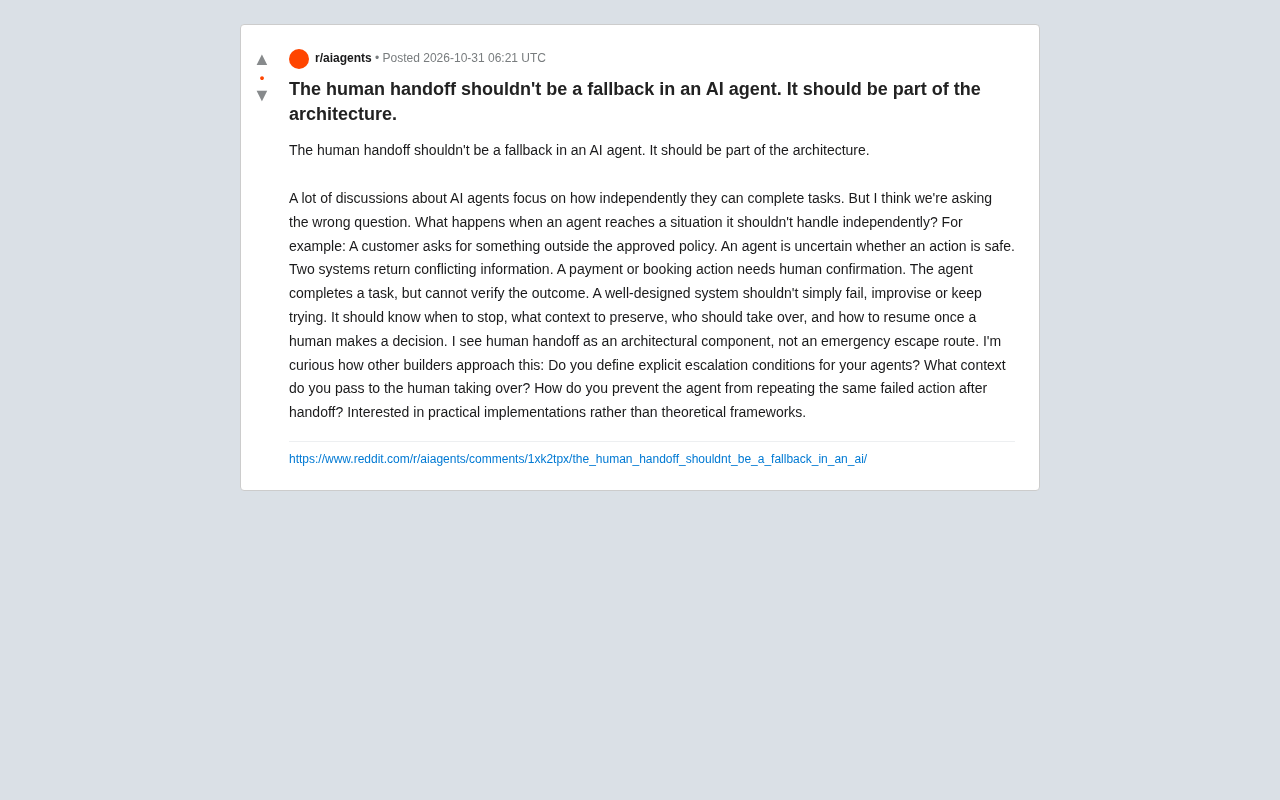
Human handoff should be an explicit component of AI Agent architecture, not a failure fallback.
Starting from a Reddit discussion, the article points out that human handoff is often mistakenly designed as an exception fallback after an Agent completely fails, rather than an organic part of the system architecture. The author argues that an Agent's capability boundaries are fuzzy and dynamic, and after-the-fact remediation alone leads to lost context, repeated failures, and a plummeting user experience. Therefore, handoff should be treated as an architectural component on par with databases and message queues, including explicit escalation conditions, structured context transfer, and anti-repetition failure mechanisms. In practice, teams explore approaches such as confidence thresholds, human takeover queues, and state machines, but standardized patterns are lacking. The article concludes by suggesting that development teams shift from pursuing full automation to designing resilient collaborative systems, defining escalation strategies early and building infrastructure for context and state management.
In discussions about AI Agents, we often focus on how independently they can complete tasks. But a more critical question is overlooked: what happens when an Agent encounters a situation it shouldn't handle on its own?
Recently on Reddit, a developer's viewpoint struck a chord: human handoff should not be a failure fallback for AI Agents, but an indispensable part of the system architecture. He listed typical scenarios where an Agent needs to stop: a customer makes a request beyond approved policy, the Agent is unsure whether an action is safe, two systems return conflicting information, a payment or booking operation requires human confirmation, or a task is completed but the result cannot be verified. These scenarios are not anomalies—they are the norm during Agent operation.
Why is human handoff often treated as a "fallback"?
When building Agents, many teams prioritize automation rate and task completion. Human handoff is often designed as an exception-handling process—triggered only when the Agent completely fails. This approach implies an assumption: the Agent should be as independent as possible, and human intervention is a last-resort compromise.
But the reality is that an Agent's capability boundaries are fuzzy and dynamic. It may excel at some tasks but get stuck in other seemingly simple scenarios. If handoff is merely after-the-fact remediation, the system will lack preparation: humans take over without context, the Agent may repeat already-failed actions, and user experience plummets.
Treating human handoff as an architectural component
The developer argues that a well-designed system should not just fail, improvise, or keep retrying. It should know: when to stop, what context to preserve, who takes over, and how to resume after a human decision. This means human handoff needs to be explicitly designed, just like a database or a message queue.
Specifically, the architecture needs to include several key parts:
- Explicit escalation conditions: Clearly define which situations must be handed off to humans, such as out-of-policy requests, safety uncertainty, conflicting information, operations requiring human confirmation, and unverifiable results. These conditions should be configuration items, not hardcoded in logic.
- Context transfer mechanism: When a handoff occurs, the system should automatically package relevant conversation history, the Agent's reasoning process, attempted actions and results, current state, and pending questions, so humans can quickly understand the situation.
- Anti-repetition failure mechanism: After handoff, the Agent should enter a waiting state to avoid repeating the same actions before a human decision. Upon resumption, the system should update its strategy based on the human decision rather than mechanically retrying.
State Machine is a computational model that models system behavior as a finite set of states and transitions between them. In human handoff scenarios, a state machine can be used to explicitly manage the Agent's lifecycle: for example, states such as "autonomous execution," "waiting for human," "human takeover in progress," and "execution resumed," along with events that trigger state transitions (e.g., confidence below threshold, human decision submitted). The benefit of using a state machine is that handoff logic is no longer scattered throughout the code but centrally defined, observable, and testable. When a human makes a decision, the system determines the next transition based on the current state and the decision content, rather than mechanically retrying the original action. This directly addresses the needs emphasized in the original post: "how to resume after a human decision" and "preventing the Agent from returning to the old path."
Practical challenges and explorations
In the Reddit discussion, many builders shared their approaches. Some defined a "confidence threshold" for the Agent, triggering handoff when the Agent's confidence in the next action falls below the threshold; some designed a "human takeover queue" where all handoff requests come with structured context; others mentioned using a state machine to record human decisions after handoff, preventing the Agent from returning to the old path.
But the consensus is: there is currently a lack of standardized implementation patterns. Every team is exploring based on their own business scenarios, and theoretical frameworks are often hard to implement. The developer emphasized that he is more concerned with practical implementation than theory.
Confidence Threshold refers to the estimated score of an Agent's confidence in the correctness of its next action or output. Models can typically output probabilities or calibrated confidence scores. Teams set a threshold, and if the value falls below it, human handoff is triggered. The challenge of this mechanism lies in confidence calibration: the model's self-reported confidence may not be reliable—too high and it won't hand off when it should, too low and it frequently disturbs humans. Common practices include calibrating the threshold on a validation set, combining rule constraints (e.g., payments must be handed off) as hard conditions, and setting differentiated thresholds for different task types. The confidence threshold should be a configurable policy item rather than hardcoded in prompts or code, so it can be continuously adjusted based on business feedback.
Implications for AI application development
For teams building AI Agents, this discussion points to a key shift: from pursuing full automation to designing resilient collaborative systems. Human handoff is not a denial of the Agent's capabilities but an honest acknowledgment of its limitations. Incorporating handoff into the architecture means considering the boundaries of human-AI collaboration, state management, and recovery processes early in system design.
This requires product managers and engineers to jointly define escalation strategies and invest resources in building infrastructure for context transfer and state management. Although it increases initial complexity, it can significantly improve system reliability and user experience. After all, users don't want an Agent that never fails—they want a system that can reliably hand off at critical moments.
In the future, as Agents handle increasingly complex tasks, the design quality of human handoff may become a key differentiator between excellent AI applications and ordinary ones.
One-line Summary
Human handoff should be an explicit component of AI Agent architecture, not a failure fallback.
Paragraph Summary
Starting from a Reddit discussion, the article points out that human handoff is often mistakenly designed as an exception fallback after an Agent completely fails, rather than an organic part of the system architecture. The author argues that an Agent's capability boundaries are fuzzy and dynamic, and after-the-fact remediation alone leads to lost context, repeated failures, and a plummeting user experience. Therefore, handoff should be treated as an architectural component on par with databases and message queues, including explicit escalation conditions, structured context transfer, and anti-repetition failure mechanisms. In practice, teams explore approaches such as confidence thresholds, human takeover queues, and state machines, but standardized patterns are lacking. The article concludes by suggesting that development teams shift from pursuing full automation to designing resilient collaborative systems, defining escalation strategies early and building infrastructure for context and state management.
Related articles

AI Can Read Neural Network Weights Directly: Do Models Already Exceed Expectations?
A Reddit developer experiment shows language models can directly read neural network weights and infer their function. Astra, Opus 5.5, and Muse Spark 1.3 all passed the test, sparking discussion on model generalization and training sources.

India's Microdrama Market Explodes: EloElo Secures $80M Investment from NBCUniversal
EloElo secures $80M from NBCUniversal to boost StoryTV, its microdrama platform with over 33M monthly active users, as India's microdrama market draws global capital.

Acoustic Detection of Multi-Rotor UAVs: Fusing Handcrafted Features with Pre-Trained Embeddings
Study reveals data leakage from random splits in UAV acoustic detection, proposes source-disjoint protocol with stacked ensemble of handcrafted features and YAMNet embeddings, achieving 95.29% accuracy for low-cost drone detection.