AI Agent in Practice: Building an Intelligent Office Assistant with WorkBuddy

Comparing chat-based large models with AI Agents, analyzing Tencent WorkBuddy's office automation capabilities and boundaries.
Through an office task of batch-converting DOCX to PDF, the article compares chat models and AI Agents. Doubao can understand the need and provide a full Python solution but cannot execute it; Tencent WorkBuddy, once authorized, reads local folders, batch-converts, and archives files, costing only single-digit credits per task, with 100 free credits daily and no VPN needed. The author summarizes four key differences and notes WorkBuddy's performance gap versus Codex, partly offset by zero cost and multi-round dialogue, while distinguishing general-purpose versus development-oriented Agents.
When large models can understand your needs but can't actually execute them, that's when the value of AI Agents truly emerges. Based on a complete hands-on demonstration, this article compares chat-based large models with Agent tools on office automation tasks, and takes a deep dive into the positioning and boundaries of Tencent's WorkBuddy.
From "Thinking" to "Doing": A Batch PDF Conversion Request
The demo starts with an extremely common office scenario: converting all the DOCX files in a computer directory to PDF and archiving them into a folder. Such tasks used to rely on tools like WPS, where the free quota was limited, batch conversion often required payment, and some people even bought memberships by the day just to get by.
The author first handed the request to a chat-based large model like Doubao. The model could understand the intent and lay out a complete solution: installing dependencies, writing a Python script, running the files, plus caveats and alternatives—all in full. But the problem is that it can only "tell you how to do it," not execute it for you. For non-technical users unfamiliar with Python, that code snippet is itself a barrier.
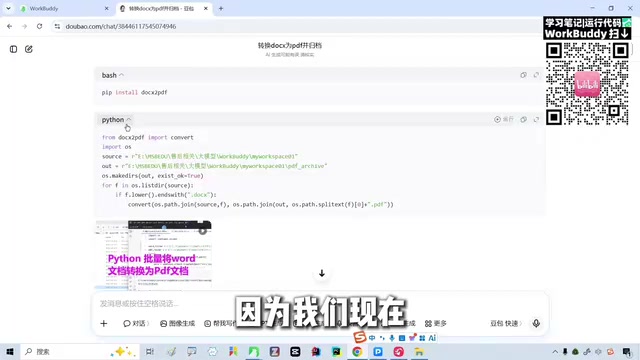
This is precisely the core divide between ordinary chat-based large models and AI Agents: the former outputs a plan, the latter delivers the result.
Technical Definition of an AI Agent: An AI Agent refers to a system capable of perceiving its environment, making autonomous decisions, and taking actions to achieve a goal. Unlike traditional large models that only output text, an Agent typically possesses four capabilities: Tool Use, Planning, Memory, and an execution Loop. Tool Use lets the model operate the file system, run code, or access external APIs; planning enables it to break complex goals into subtasks; memory preserves intermediate state; and the execution loop supports repeated iterations of "observe—think—act" until the task is completed or fails. It is this architecture that allows an Agent to leap from "giving a plan" to "delivering a result."
WorkBuddy in Practice: Real Work After Authorization
When the same request is sent verbatim to WorkBuddy, things start to change. The user enters a natural language instruction in the dialog box, and after being granted "full access" authorization, the Agent directly reads the local folder, batch-converts the files, and automatically archives them into a newly created directory. In the demo, you can see the conversion progress, elapsed time, and credit consumption (a single task costs only single-digit credits), and the resulting PDFs are properly formatted with a clean archive structure.
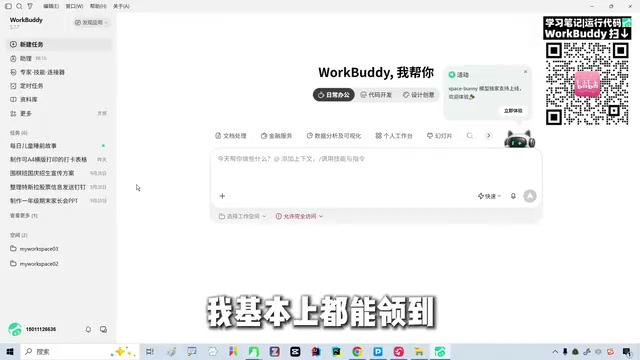
WorkBuddy is launched by Tencent and targets office scenarios. It grants 100 credits daily, with additional initial credits upon registration—enough for everyday lightweight tasks; users must actively claim the daily credits. Installation and use require no VPN, which is why the author repeatedly emphasizes how "smooth and friendly" it is.
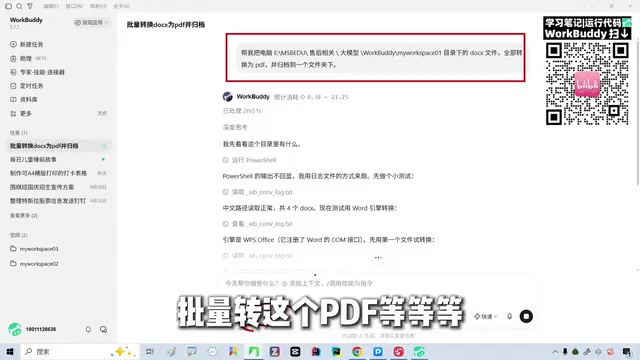
The Risks and Boundaries of "Full Access" Authorization: Granting an Agent full access to the local file system means it can read, modify, and delete files in directories—convenient, but also introducing security and privacy risks. Industry practice typically recommends the principle of least privilege: grant only the directory scope the task requires, avoiding whole-disk access; set up confirmation steps for destructive operations like deletion and overwriting; and run untrusted tasks in isolated environments (such as sandboxes or cloud PCs). WorkBuddy uses "full access" mode in the demo, which suits trusted local office scenarios, but users still need to stay mindful of the authorization scope, especially when handling sensitive documents.
Chat-Based Large Models vs AI Agents: Four Key Differences
The author outlines the capability boundaries of the two types of tools in the demo, and this comparison forms the foundational framework for understanding Agents:
- Understanding needs, breaking down tasks, providing solutions: Both can do this; it's now standard for AI tools.
- Calling local tools, operating files, executing system commands: Chat-based large models are powerless here, while an Agent can do it once authorized.
- Self-adjusting based on intermediate results: An Agent can try alternatives and self-debug when a step fails, forming an execution loop; chat models rely on the user manually passing results and driving the next step across multiple rounds of dialogue.
- Positioning difference: A chat-based large model is more like an "intelligent consultant," while an Agent is more like an "intelligent assistant"—the former gives advice, the latter delivers results.
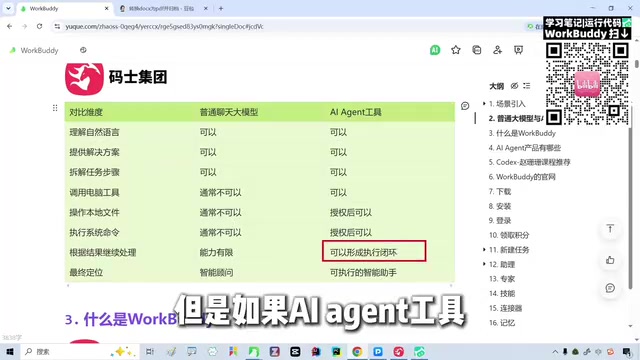
This closed-loop capability is the key to an Agent. An ordinary model gives a result and doesn't follow up on whether it works; an Agent judges on its own during execution, switches approaches, and keeps going until delivery.
Execution Loop and Self-Adjustment Mechanism: An Agent's "execution loop" relies on ReAct (Reasoning + Acting) or similar paradigms—the model first reasons out the next action, observes the result after executing, then adjusts its strategy based on the feedback. If a path fails (e.g., a missing dependency or a script error), the Agent reads the error message, tries an alternative, or replans, rather than terminating outright. This dynamic adjustment based on intermediate results is what distinguishes an Agent from single-turn Q&A. Chat-based large models can also "correct errors" across multiple rounds of dialogue, but each execution and handoff of results depends on manual user effort, so the loop's efficiency and automation level are significantly lower than an Agent's.
There's a Capability Gap, but the Trend Is Convergence
The author doesn't shy away from WorkBuddy's shortcomings. In a task to "design an Excel file based on the Xiaohongshu image format," WorkBuddy took 23 minutes and the result was unsatisfactory, while Codex met the requirement in just two and a half to three and a half minutes. The gap is real.
But the cost structures differ: Codex costs about 200 yuan per month (membership fee plus VPN), while WorkBuddy can be used at zero cost by claiming free credits each day. The author's judgment is that trading time for cost and using multiple rounds of dialogue to bridge the performance gap is a viable path for budget-sensitive users.
The broader judgment is product convergence: provided competing products all function correctly, the understanding, reasoning, and hands-on capabilities of domestic and international models will sooner or later converge—it just takes time. This view also explains why WorkBuddy's interface likewise includes modules for code development, design creativity, projects, plugins, cloud PCs, and more—the capability boundaries of general-purpose Agents are increasingly overlapping.
Product Spectrum: General-Purpose vs Development-Oriented Agents
The author divides Agents on the market into two categories:
- General-purpose: WorkBuddy, OpenClawAd, and others, aimed at ordinary users' office and daily work scenarios, where code is just one use case.
- Development-oriented: Codex, Claude Code, and domestic tools like Trae, centered on code and software engineering.
To be clear, development-oriented Agents aren't incapable of office tasks, and general-purpose ones aren't incapable of writing code—the difference lies in product focus. For users with no programming needs who simply want to boost efficiency in office scenarios with an Agent, general-purpose tools like WorkBuddy are more suitable: users needn't walk through operational details step by step; they just describe their needs in natural language, and after authorization the Agent handles execution and delivery.
From answering questions to executing tasks, from giving advice to delivering results—this is the core change AI Agents bring, and the tool upgrade ordinary users most deserve to experience firsthand.
Architectural Differences Between General-Purpose and Development-Oriented Agents: Development-oriented Agents (like Codex and Claude Code) are typically deeply integrated with code editors, version control, and terminals, with optimization goals around code understanding, generation, and debugging, emphasizing awareness of repository context and precise engineering output. General-purpose Agents focus more on natural language interaction, multi-tool orchestration, and office software integration (documents, spreadsheets, browsers, etc.), with code execution being just one link in their toolchain. The two may share similar large models and tool-calling frameworks under the hood, but their product focus, interaction design, and evaluation metrics differ. Understanding this layering helps users choose the right tool for their task type, rather than simply comparing "who is stronger."
One-line Summary
Comparing chat-based large models with AI Agents, and analyzing the office automation capabilities and boundaries of Tencent's WorkBuddy.
Paragraph Summary
Through an office task of batch-converting DOCX files to PDF, the article compares the differences between chat-based large models and AI Agents. Chat models like Doubao can understand the need and provide a complete Python solution but cannot execute it; Tencent's WorkBuddy, once authorized, can read local folders, batch-convert, and archive files, with a single task costing only single-digit credits, 100 free credits daily, and no VPN required. The author summarizes four key differences: both can understand and break down tasks; only an Agent can call local tools and execute commands; an Agent can self-adjust based on intermediate results to form a closed loop; and in positioning, chat models are "intelligent consultants" while Agents are "intelligent assistants." The article also notes WorkBuddy's performance gap versus Codex on complex tasks, partly offset by zero cost and multi-round dialogue, and distinguishes the product spectrum of general-purpose versus development-oriented Agents.
Related articles
11 Tested Rules to Slash Claude Token Costs to the Bare Minimum
Claude Token costs too high? Creator Doobie rewrote 11 token-saving rules after 30 days of logs: keep effort at medium, use /clear when switching tasks, don't let cache expire, downgrade auxiliary agents to Haiku—with official Anthropic data and cost comparisons.

Build Your First AI Agent with Zero Code: A Claude Code Practical Guide
Build an AI agent in Claude Code with zero code. Learn the full workflow: folder setup, claude.md rulebook, plan-mode briefs, skills, and independent review.
Claude Code Advisor Mode Explained: How Fable 5.2 and Sonnet 5.5 Collaborate on Code
A deep dive into Claude Code's experimental Advisor mode: how Fable 5.2 and Sonnet 5.5 split the work, access requirements, version thresholds, three ways to enable it, Fable's special billing rules, and a fact-check of the "3.4x cost reduction" claim against official docs.