AI Agent in Practice: From Prompts to Few-Shot for Building Enterprise-Grade Agents
The best entry point for ordinary people to tap into enterprise AI needs is helping companies deploy deliverable AI Agents.
The article points out that SMEs know AI is useful but don't know how to connect it to their business, and this gap is precisely an opportunity for ordinary people: building enterprise-grade AI Agents does not depend on a deep programming background. The course emphasizes that prompts are the only channel for interacting with large models, and all application-layer design ultimately comes down to assembling a suitable prompt. In a prompt, role setting and constraints are baseline items; what really affects performance is reference materials and examples. Through a comparison of a Sony store sales scenario, the article shows how Few-shot turns excellent scripts into examples, aligning model output with business standards rather than simply making it smarter. Behind this, the core is "as much intelligence as there is manual work"—the main workload of Agent building lies in manually organizing business know-how, which is precisely the most pragmatic entry point for zero-foundation learners.
Why AI Agents Are the Best Entry Point for Ordinary People to Tap Into Enterprise Needs
SMEs' demand for AI is exploding, but the vast majority of bosses face the same dilemma: they know AI is useful, but they don't know how to connect it to their own business. This "can't connect" gap is precisely the best entry point for ordinary people—helping a company build an AI Agent that can actually be deployed doesn't require a deep programming background, and you can get started at low or even zero cost.
According to the viewpoint of this hands-on tutorial on Bilibili, the core of the large model field is shifting toward AI Agents, and the ability to build enterprise-grade Agents will become a key skill. The course doesn't stop at the conceptual level but focuses on a practical path that is "deployable and deliverable," breaking down the complete closed loop from zero foundation to independently building and delivering an Agent.
Prompts Are the Only Channel for Interacting with Large Models
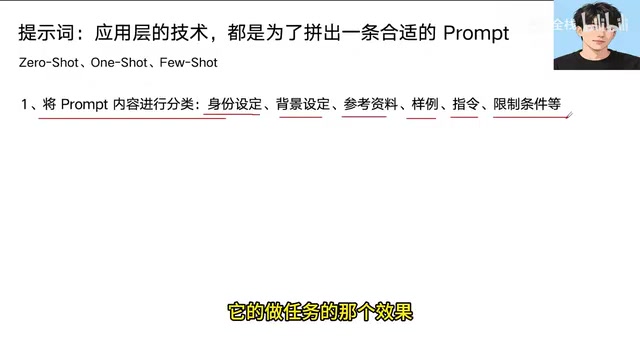
The course first clarifies an easily overlooked premise: prompts are the only way we interact with large language models at the application layer. No matter how fancy your design is—prompt engineering, context engineering, loop engineering, or harness engineering—essentially you're trying every possible way to assemble a suitable prompt and hand it to the large model to do the work.
Once you understand this, the structure of a prompt makes sense. A complete prompt usually includes sections such as role setting, task background, reference materials, examples, specific tasks, and constraints. But what really has a major impact on task performance is reference materials and examples. Role setting and constraints are baseline items that "must be written if they should be written," while reference materials and examples are the key variables that determine output quality.
Context Engineering refers to how, when calling a large model, to systematically organize, filter, and arrange all the information fed into the model, including system instructions, historical conversations, retrieved external knowledge, tool return results, and so on. It is broader than simply "writing prompts," focusing on which information to put into the limited context window, in what order, and in what format, so that the model can make correct judgments. Related to this, loop engineering emphasizes letting the model iterate repeatedly in a "think—act—observe" loop, such as autonomously calling tools and correcting the next step based on results; harness engineering refers to the peripheral execution framework built around the model, responsible for tool invocation, state management, error retries, and safety constraints. Together, the three show that no matter how complex the upper-level design is, it ultimately has to land on a reasonably structured prompt.
Zero-shot, One-shot, and Few-shot: How Examples Change Outputs
The Difference Between the Three Example Paradigms
The course uses a translation task for the most intuitive demonstration. Directly asking the model to translate "Hello" into Chinese without giving any examples is called Zero-shot; first giving an example of "Hungry→饿了" and then asking it to translate is One-shot; giving multiple examples is Few-shot—three examples is called Three-shot, five examples is called Five-shot. With different numbers of examples, the model's depth of understanding of the task also differs.
Zero-shot, One-shot, and Few-shot originate from the large model's In-Context Learning capability. Zero-shot means giving no examples and relying solely on instructions for the model to complete the task; One-shot gives one example; Few-shot gives multiple examples. The model does not update its parameters because of the examples; rather, at inference time it infers the task pattern, output format, and judgment criteria from the examples. More examples is not always better: limited by the context window, too many examples will take up space, increase costs, and may also introduce noise. In practice, it's common to start with a small number of high-quality examples covering typical boundaries, then observe stability through multiple runs and add more as needed—this is also why the course recommends "running it several times to evaluate effectiveness."
A Real Sales Scenario Comparison
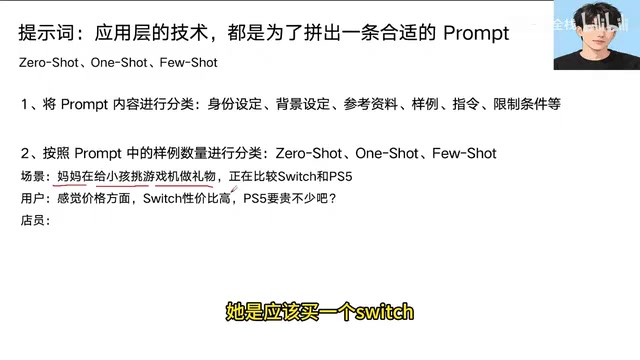
The course uses a Sony store case to show the power of examples. The scenario is a mother choosing a gift for her child, comparing the Switch and PS5, who asks the salesperson: "I feel like the Switch is more cost-effective in terms of price, and the PS5 seems quite a bit more expensive."
On the Coze platform, using the Doubao Seed 2.0 Pro model with a general system prompt, the model's reply is a typical "head-on price confrontation": it acknowledges that the Switch is cheaper but emphasizes that the PS5 has smooth graphics, exclusive blockbuster titles, and discounted in-stock units. The problem with this answer is that it puts two products with completely different positioning into the price dimension for a head-on comparison, while the PS5 itself cannot possibly beat the Switch on price.
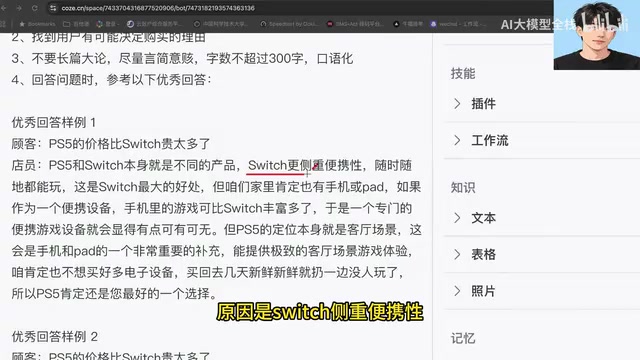
A truly top-tier Sony salesperson wouldn't respond this way. They would first dismantle the premise of the comparison: the Switch focuses on portability, but phones and tablets can already replace most portable gaming scenarios, so the Switch seems somewhat dispensable; the PS5 is positioned for the living room scenario, providing the ultimate living room experience. The two are simply not on the same dimension, and comparing prices together is itself wrong.
Turn Excellent Scripts into Examples and Put Them into the Prompt
When the course writes this type of excellent Q&A as examples into the system prompt, and then asks the same question again, Doubao's answer changes significantly: it begins to emphasize the positioning differences between the two products, explaining the Switch's substitutability and the PS5's non-substitutability, rather than getting tangled up over price.
This is the practical value of Few-shot—it doesn't make the model "smarter," but aligns the model's output with your business standards. The course recommends running it several times in actual operation (for example, ten times) and observing how many times the model can stably give answers that meet business requirements according to the prompt's guidance, so as to evaluate the effectiveness of the examples.
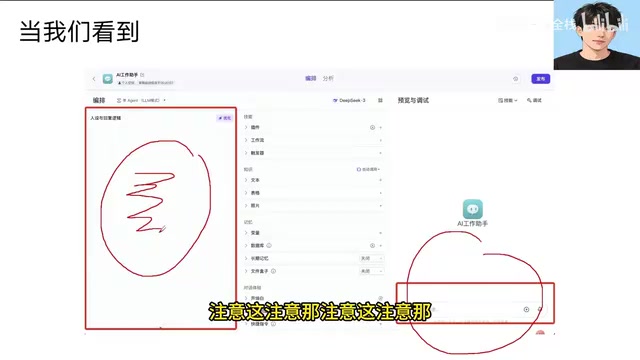
Coze is an AI Agent and chatbot building platform launched by ByteDance, offering visual orchestration, prompt editing, knowledge bases, plugins, and model selection. Users can assemble a usable Agent without writing backend code from scratch. The Doubao Seed 2.0 Pro selected in the course case is one of the underlying large models callable on the platform, responsible for generating replies based on the system prompt and user input. Understanding the division of labor between the platform and the model is crucial: the platform organizes prompts, examples, knowledge bases, and tools, while the model is only responsible for generating text under the given context. Therefore, whether the examples are written well is directly reflected in the model's output.
As Much Intelligence as There Is Manual Work
A natural question is: real users' questions vary endlessly—do we have to stuff all the excellent conversation examples into the prompt? The answer given by the course is—the excellent examples themselves are manually organized.
There is a saying in the AI field: as much intelligence as there is manual work. A large amount of the manual work in an AI project team is squatting on the business frontline doing organization and knowledge sorting. The first "organization work" mentioned in the course is going to Sony stores and working with top-tier salespeople to sort out their real approaches to various problems. It is precisely these manually organized excellent examples that make AI's performance better and better, letting end users feel a sense of "intelligence."
This also explains why an enterprise-grade Agent builder is a role with a threshold, but the threshold is not programming—the core ability is transforming business know-how into structured examples and reference materials, not writing more complex code. For people with zero foundation who want to enter this direction, starting with prompts and Few-shot is the most pragmatic first step.
One-line Summary
The best entry point for ordinary people to tap into enterprise AI needs is helping companies deploy deliverable AI Agents.
Paragraph Summary
The article points out that SMEs know AI is useful but don't know how to connect it to their business, and this gap is precisely an opportunity for ordinary people: building enterprise-grade AI Agents does not depend on a deep programming background. The course emphasizes that prompts are the only channel for interacting with large models, and all application-layer design ultimately comes down to assembling a suitable prompt. In a prompt, role setting and constraints are baseline items; what really affects performance is reference materials and examples. Through a comparison of a Sony store sales scenario, the article shows how Few-shot turns excellent scripts into examples, aligning model output with business standards rather than simply making it smarter. Behind this, the core is "as much intelligence as there is manual work"—the main workload of Agent building lies in manually organizing business know-how, which is precisely the most pragmatic entry point for zero-foundation learners.
Related articles
 Tech Frontiers
Stylome Bot Slammed as Useless Junk: Why Do AI Detection Tools Keep Failing?
Reddit users test the Stylome AI detection bot: Gemini-rewritten text judged human-written, consistently low confidence. An analysis of AI text detection's technical dilemmas, privacy concerns, and credibility crisis in community governance.
 Tech Frontiers
When AI Becomes a Productivity Divide: Clarity or "AI Psychosis"?
A civil engineer's deep use of agentic AI boosted efficiency but bred contempt for peers who refuse to learn. Is this clarity or AI psychosis? An analysis of the cognitive and psychological challenges behind the AI productivity divide.
 Tech Frontiers
Opus 5.5 Benchmark Scores Climb, Community Says Its "Weights Are Blessed"
Reddit community discusses Opus 5.5's rising scores on the Benchmaxxing Bench, with users describing its performance as "weights are blessed." This article interprets the community reaction and cautions against conflating benchmark scores with real capability.