AI Agent Learning Roadmap for Beginners: Four Stages from Zero to Employment

A four-stage AI Agent learning roadmap: from LLM fundamentals to RAG, tool calling, real-world projects, and job placement.
This article presents a structured four-stage AI Agent learning roadmap for beginners. It argues that breaking into the field is about having the right path, not natural talent. Stage 1 covers understanding LLM capability boundaries and hallucinations. Stage 2 tackles RAG, tool calling, and workflow orchestration — the three skills enterprises value most. Stage 3 emphasizes going deep on one real-world scenario, with a focus on evaluation and fallback handling to distinguish production-grade work from toy demos. Stage 4 closes the loop with resume writing, interview prep, and role targeting.
From "Q&A" to "Getting Things Done": AI Agents Are Reshaping How We Work
When ChatGPT arrived at the end of 2022, it brought AI to ordinary people for the first time. But back then, AI was still trapped in a "you ask, I answer" box — capable of writing poetry and holding conversations, yet unable to think independently or actually get things done on its own. Between "conversation" and "action" lay a very obvious gap.
The pace of evolution since then has far exceeded expectations. According to the Bilibili tutorial this article is based on, entering 2026, a wave of intelligent agent products like Codex and WorkBuddyAd have gone viral one after another. These Agents can now take over computers and phones 7×24, autonomously learning new skills, breaking down tasks, and completing work independently — all while remembering user habits and getting smarter over time.

The more critical shift is happening on the enterprise side. Automated workflows are reshaping productivity, AI-driven data analysis is beginning to inform corporate strategy, and 7×24 intelligent customer service is replacing human agents. Agent development has shifted from a long-horizon "nice to have" to a hard business requirement, and talent demand and salaries have risen accordingly.
How Can Ordinary People Break In? It's About the Roadmap, Not Talent
The opportunity is big, the roles are hot — but how should a beginner actually get started? The core insight from this tutorial is worth taking seriously: breaking into Agent development is about having the right roadmap, not natural talent. Skimming a pile of scattered tutorials online is no substitute for completing one solid, well-structured path from start to finish.

This point hits on a real pain point for most beginners. The AI space is heavily fragmented, tutorial quality varies wildly, and many learners keep switching directions before mastering anything. Rather than bouncing around a sea of resources, it's more effective to commit to a complete learning path and follow it through. The tutorial breaks this path into four stages: Fundamentals, Advanced Skills, Hands-On Practice, and Job Placement.
Stage 1: Understand the Boundaries of LLMs and Agents
The first step isn't to rush into writing code — it's to first understand what large language models and agents can and can't do, and where their limits lie. From there, you learn Prompt Engineering to get models producing stable, consistent outputs.
This sequencing is genuinely practical. The tutorial puts it bluntly: "90% of people don't even understand why models hallucinate, so everything they learn after that is built on sand." Understanding the capability boundaries of LLMs and the root causes of hallucinations is the foundation for all downstream engineering work. Skip this step and jump straight to building, and you'll easily end up with systems that appear to run but are fundamentally unpredictable.
Hallucination refers to when a model generates content that sounds fluent and confident but is factually wrong or entirely fabricated — such as inventing non-existent paper citations, making up dates, or producing incorrect code. The root cause lies in the nature of LLMs: they are probabilistic language models trained on massive amounts of text, generating at each step "the word most statistically likely to follow the previous text" — not "a logically verified fact." When the training data doesn't contain the correct answer to a question, or when the question falls beyond the model's knowledge cutoff date, the model will typically "complete" a plausible-sounding response rather than admitting it doesn't know.
Understanding hallucination is critical for Agent development: it directly explains why RAG is needed to inject external knowledge, why tool calling is needed to retrieve real-time data, and why evaluation must be built into any real-world system rather than relying on gut feeling. Prompt Engineering is the practice of carefully designing the format, constraints, and examples of input instructions to guide models toward more stable, expected outputs — the most direct way to control model behavior without modifying model weights.
Stage 2: RAG, Tool Calling, and Workflow Orchestration — Three Core Skills
The advanced stage covers three core skills in one go — the capabilities enterprises prioritize most heavily and that come up in virtually every interview:
- RAG (Retrieval-Augmented Generation): Lets agents answer questions based on your own data, reducing hallucinations;
- Tool Calling: Lets agents query databases and actually take actions in the world;
- Workflow Orchestration: Chains multi-step tasks together for automated execution.

These three components form the technical core of the transition from "chatbot" to "capable agent." RAG addresses knowledge accuracy, tool calling connects agents to the outside world, and workflow orchestration enables complex tasks to be automatically chained together. Mastering all three is what truly bridges the gap between a conversational model and a functional agent.
RAG (Retrieval-Augmented Generation) is currently one of the most mainstream approaches for deploying AI applications in enterprise settings. The core idea is: before sending a user's question to the LLM, first retrieve the most relevant content snippets from an external knowledge base (such as company documents, product manuals, or databases), then pass that content to the model as contextual reference. This way, the model's response is no longer purely dependent on what it "memorized" during training — it has verifiable sources, dramatically reducing the probability of hallucinations.
Tool Calling (also called Function Calling) gives models the ability to "reach out and interact with the external world." By pre-defining a set of tool functions (such as querying a database, calling an API, executing code, or sending an email), the model can decide during a conversation when to invoke which tool and then incorporate the results into its final response. This mechanism is the key leap that transforms an agent from a "chatbot" into an "assistant that can actually get things done."
Workflow Orchestration chains multiple tool calls and model reasoning steps into a directed graph or pipeline, enabling complex multi-step tasks (such as "scrape data → clean → analyze → generate report → send notification") to execute automatically without human supervision. Tools like LangGraph, Dify, and n8n all serve this layer.
Stage 3: Pick One Real Scenario and Go Deep
The key in the hands-on stage is depth over breadth. Pick one real scenario — intelligent customer service, knowledge base Q&A, or a data analysis assistant all work — and focus your energy on building it out thoroughly.
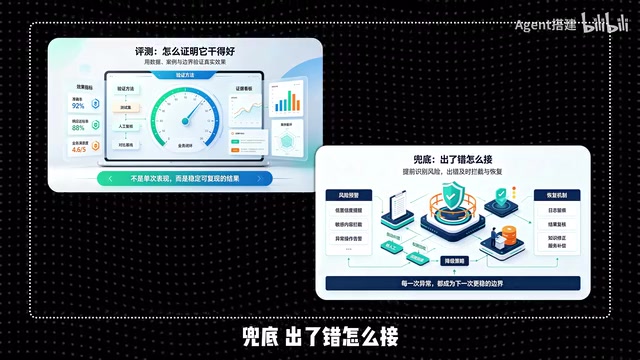
The tutorial specifically emphasizes two things that "most people skip":
- Evaluation: How to use data to demonstrate that your agent performs well, rather than just saying it "feels okay";
- Fallback handling: What happens when things go wrong, ensuring the system remains usable under edge cases and failure conditions.
These two things are exactly what separates a "toy project" from a "production-grade project." Many learners stop after building a demo, skipping evaluation and error handling — the result is a project that can't withstand follow-up questions in an interview. Complete both of these, and you'll have project experience that genuinely belongs on a resume.
Stage 4: The Complete Loop from Project to Offer
The final stage focuses squarely on job hunting: how to present Agent projects on a resume, how to answer common interview questions, and which types of roles to target based on your background. A full end-to-end plan from preparation to offer.
This stage is often ignored by technical tutorials, but it's critical for anyone who genuinely wants to make a career transition. Technical ability and "clearly communicating that ability while matching the right role" are two very different things. By incorporating resume writing, interview preparation, and role matching into the curriculum, this stage closes the last gap between knowing the skills and landing the job.
Final Thoughts: Who Is This Roadmap For?
Taken as a whole, the value of this four-stage roadmap lies not in any single technical topic, but in providing a complete, logically sequenced learning map. It's especially worth following for three groups: people looking for a career change, those on the fence about transitioning, and complete beginners who want to add a practical new skill.
One caveat worth noting: the tutorial itself is a promotional learning framework overview, and the actual depth and difficulty of each stage will need to be verified through real study. That said, the core methodology it offers — first understand the boundaries, then master core skills, then go deep on a real scenario, then close the employment loop — is a clear and actionable starting point for anyone looking to break into AI Agent development.
Related articles

How Big Can Stars Really Get? The Physical Limits of the Largest Stars
Red supergiants are the largest stars by volume, with radii up to 2,000 times the Sun, engulfing the inner solar system. But there is no precise upper limit on stellar size—models predict up to 15,000 solar radii. The most massive blue stars are far smaller than red supergiants—biggest and heaviest are two different things.

Apple HomeView Smart Display Full Feature Breakdown: Wall-Mount or Desktop, $299
Apple launches HomeView, a $299 smart display with wall-mount and desktop options, 12MP camera for facial recognition, smart home control, music playback, and recipe step-by-step cooking. Full breakdown of watch faces, apps, privacy, and cooking integration.

Where Did the Promised New Studio Go? Craft Computing Answers After Five Years
Craft Computing's host responds to viewer questions: the new studio promised five years ago was shelved as construction costs soared from $30,000 to $75,000, and was replaced by a 168-square-foot garage conversion.