AI Agent Pentesting from Zero: Skill Mechanism and Code Auditing for Bug Hunting

AI Agents standardize pentesting workflows through the Skill mechanism, enabling cross-platform reuse and practical implementation.
Based on Bilibili creator "Teacher Wuya's" AI + Security Training Camp tutorial, this article systematically breaks down how AI Agents are implemented in cybersecurity. The core argument: traditional complex prompts struggle to consistently reproduce multi-step tasks, while the Skill mechanism packages processes, specifications, scripts, and reference materials into folders so Agents can load standardized operating procedures on demand. The article details the Skill folder structure (skill.md, scripts, reference documents) and uses an EDU platform vulnerability discovery Skill to demonstrate a complete workflow. It also emphasizes that Skill, as a common industry specification, can be used across mainstream agents such as Claude, Tongyi Lingma, and Codex, marking the evolution of AI Agents from "prompt engineering" to "skill engineering." The tutorial covers three practical scenarios—AI bug hunting, code auditing, and CTF—and reminds learners to pay attention to security and compliance boundaries.
AI Agents are evolving from chat assistants into operators capable of executing complex tasks. This evolution is especially evident in cybersecurity: using AI to find vulnerabilities, audit code, and solve CTF challenges has moved from concept to practice. Bilibili creator "Teacher Wuya" systematically demonstrated the complete path from agent concepts to real-world implementation in the AI + Security Training Camp at Bafang Wangyu. Based on that tutorial, this article breaks down the core mechanisms and practical methods of AI Agent pentesting.
Why Skills Are Needed: From Complex Tasks to Standardized Skills
The traditional way to use an Agent is to write a complex prompt each time and have the model execute according to instructions. The problem is that complex tasks often require multi-step, multi-tool collaboration; the longer the prompt, the harder it is to reproduce results consistently. The creator used his own teaching scenario as an example: creating a customized learning plan for each new student involves course selection, prerequisite relationships, and time scheduling (see image below), yet it is repeated daily and cannot be simplified into fixed rules.
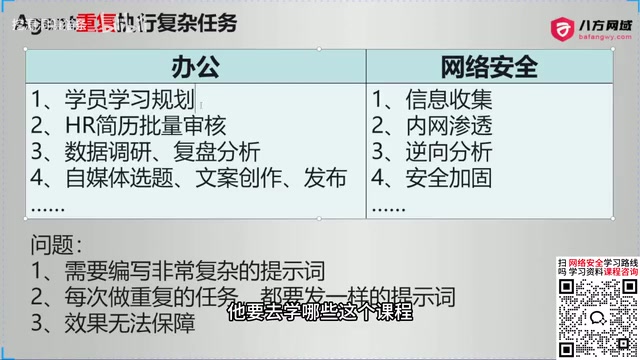
HR resume screening, industry data research, and self-media topic selection and multi-platform publishing are all "vague-rule but high-frequency repetitive" complex tasks. The same is true in security: information gathering must cover subdomains, directories, ports, and corporate关联 information; the process is long and detail-heavy, and prompts alone can hardly guarantee compliant execution every time.
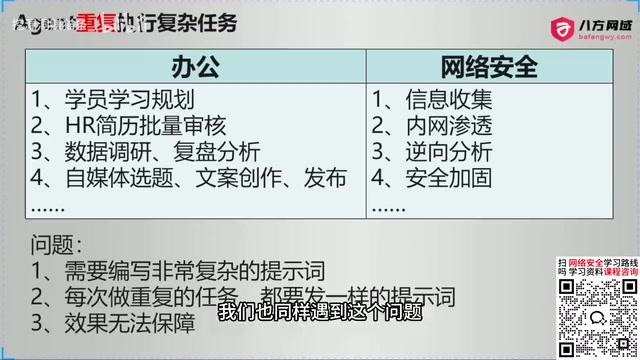
The Skill mechanism was created precisely to solve this pain point. It packages the processes, specifications, constraints, reference materials, and scripts needed to complete a task into a folder, which the Agent automatically loads when needed. The creator defines it as: "A skill is a folder," with the core being the skill.md prompt document, supplemented by callable Python scripts and reference documents.
Prompt Engineering refers to the practice of designing and optimizing text instructions input to large language models to guide them toward desired outputs. In Agent scenarios, prompt engineering further evolves into the overall design of system prompts, tool-call descriptions, and task decomposition steps. Its limitation is that prompts are essentially one-off text in the context window and can hardly carry complex process logic, external tool calls, and large amounts of reference material; when tasks involve multi-step decision-making, prompts become lengthy and fragile, and models easily miss constraints or deviate from the process. In addition, prompts cannot directly encapsulate executable code or be version-managed, making experience hard to accumulate and reuse. The Skill mechanism is an engineering upgrade to prompt engineering—structurally packaging instructions, scripts, and reference materials so that Agents can load on demand and execute stably, turning "one-off instructions" into "maintainable skill assets."
Structure of a Skill Folder and a Real-World Case
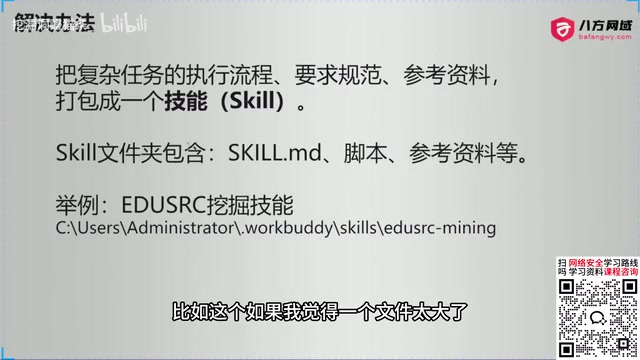
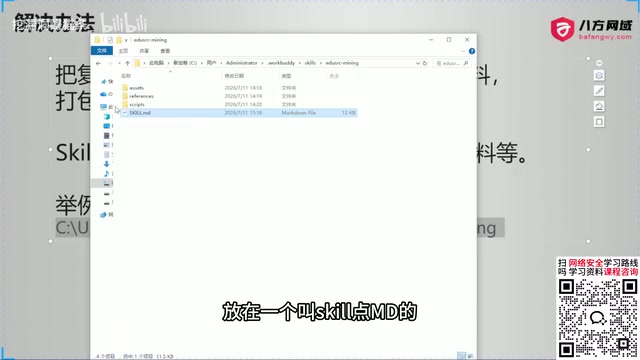
A typical Skill folder contains three parts:
- skill.md: The most core prompt file, specifying the task description, trigger conditions, standard workflow, and output specifications.
- Script files: Such as Python scripts for connecting to the FOFA platform to obtain assets, directory scanning scripts, etc., which the Agent can call directly at runtime.
- Reference documents: Supplementary materials split into Markdown files to avoid a single file becoming too large.
The creator demonstrated his own EDU education platform vulnerability discovery Skill. The skill.md defines a complete workflow: clarify the target → asset collection → liveness detection and fingerprinting → attempt entry breakthroughs → vulnerability probing. The asset collection stage is further divided into specific actions such as subdomains, ports, and directories (see image below).
The script section hardcodes parameters such as FOFA query syntax, entry credentials, and backend directory dictionaries. The creator specifically mentioned that when a single reference document is too large, it is split into multiple sub-documents (see image below) to keep the Skill maintainable.
The value of this structure is that the Agent no longer relies on hastily assembled prompts but loads a validated, standardized operating procedure. For tasks with extremely high process-standardization requirements, such as vulnerability discovery, a Skill is equivalent to distilling a senior engineer's experience into a reusable "operations manual."
Cross-Agent Universality: Skill as an Industry Specification
The creator emphasized that Skill is an "industry specification for use by agents" and is universal across all mainstream agents. He demonstrated placing a Skill in the working directory, where Claude, Alibaba's Tongyi Lingma, Codex, and other agents can all recognize and invoke it.
The significance of this feature lies in ecosystem compatibility. If each Agent vendor created its own proprietary format, developers would have to repeatedly adapt for each platform at extremely high cost. As an open specification, Skill allows the same skill package to be migrated across platforms and also forces agent products to support the specification—"if you don't support it, you're out of the game."
From a broader perspective, the emergence of the Skill mechanism marks the evolution of AI Agents from "prompt engineering" to "skill engineering." Prompts are temporary and one-off; skills are accumulable, reusable, and distributable. For security practitioners, this means pentesting methodologies can be solidified into skill packages to reduce repetitive work; for enterprises, it means AI capabilities can be managed and audited like software modules.
AI Agent refers to a form of large language model application capable of perceiving its environment, planning autonomously, and invoking tools to execute multi-step tasks. Unlike single-turn chat assistants, Agents typically possess capabilities such as task decomposition, tool invocation, memory, and reflection, and can accomplish complex goals with no or minimal human intervention. In security, Agents can be used for process-oriented work such as information gathering, vulnerability scanning, and code auditing. However, agents from different vendors differ in tool interfaces, context management, and skill loading methods, making the same workflow difficult to migrate across platforms. This is exactly where the value of Skill as an open specification lies: it defines the directory structure, prompt format, and script invocation conventions of skill packages, enabling Agents to discover, load, and execute skills in a unified way. This standardization reduces cross-platform adaptation costs and makes skill packages "portable capability units" that can circulate among different Agents.
Practical Scenarios: AI Bug Hunting, Code Auditing, and CTF
The tutorial explicitly covers three practical scenarios: using AI to find vulnerabilities, using AI to audit code, and using AI to solve CTF challenges. Although the original text provides limited detail on the latter two, their implementation paths can be inferred from the design logic of Skills.
The vulnerability discovery scenario was detailed above: through Skills, the standard process of information gathering, fingerprinting, and vulnerability probing is solidified, and the Agent executes step by step and calls external tools. In the code auditing scenario, Skills can encapsulate auditing rules, dangerous function lists, and data-flow analysis templates, allowing the Agent to scan code according to a fixed methodology. In the CTF scenario, challenge classifications, solving approaches, and commonly used toolchains can be written into Skills to improve the Agent's consistency in solving challenges.
The creator also provided a systematic learning path for students who want to find vulnerabilities, play CTF, or find employment in the security industry. Although the original text does not elaborate on the details of the path, its core logic is clear: first understand how Agents and Skills work, then accumulate experience through practical scenarios, and finally feed that experience back into reusable skill packages.
The Boundary of Security and Compliance
At the beginning of the tutorial, the creator specifically reminded: the techniques learned should "never be used for illegal activities." This reminder is not mere courtesy. AI lowers the barrier to penetration testing, and it also lowers the barrier to abuse. The Skill mechanism makes attack processes packageable and distributable; once used maliciously, they spread far faster than manual operations.
For learners, compliance awareness should be established alongside technical capability. Vulnerability discovery should be conducted within authorized scope, CTF is a legal arena, and code auditing should serve defensive purposes. AI Agents are amplifiers—they amplify both capability and intent.
Conclusion: Skill Is the Key Piece for Putting AI Security into Practice
From agent concepts to the Skill mechanism, and then to the three practical scenarios of bug hunting, auditing, and CTF, the core contribution of this tutorial is to break "AI + Security" down from a slogan into operable engineering practice. The Skill folder seems simple—a prompt document, a few scripts, and several reference files—but it solves the most difficult problem in Agent implementation: how to enable AI to complete complex tasks stably, compliantly, and reusably.
For zero-foundation learners, this is a clear entry point; for practitioners, this is an opportunity for a methodology upgrade. AI will not replace security engineers, but security engineers who use Skills are replacing those who do not.
Related articles

Random Pruning of the DPO Computation Graph: 1.4x Training Speedup and Lower Peak Memory
DPO training too slow and memory-hungry? This paper proposes a random pruning framework for the DPO computation graph, sampling independently across position, sequence, and branch dimensions; branch pruning achieves a 1.426x step-time speedup and cuts training time by about 30%, with in-depth attribution of memory and time gains.

Why Does JEPA Underperform MLM in Longitudinal EHR Representation Learning?
New study compares JEPA and MLM for longitudinal EHR representation learning on MIMIC-IV: three JEPA variants train stably without collapse but underperform MLM; target size, not heterogeneity, drives prediction error.

Transfer Learning + Visible Light Communication: A New Approach to Energy-Efficient Indoor Positioning
A study proposes a transfer learning-based visible light communication indoor positioning method, achieving 47% accuracy improvement on the BOSCH factory dataset, 67.5% model efficiency under high noise, and introducing the ME composite metric for energy-efficient positioning in energy-constrained industrial IoT scenarios.