AI Agent Practical Guide: Building an Enterprise-Grade Agent from Scratch

A systematic overview of AI agents' essence, capability loop, evolution, enterprise tech stack, and use cases.
The article contrasts traditional closed programs with agents that respond dynamically to vague requests, breaks down the perception-decision-action loop, traces evolution from rule engines to LLMs with tool calling and memory, explains the enterprise tech stack (LLM, tool invocation, memory, RAG), and lists use cases in customer service, data analysis, and productivity, with practical tips to start small and iterate.
AI Agents are becoming a hot topic in artificial intelligence, yet many beginners remain confused about their essence and implementation. Based on a complete hands-on tutorial, this article systematically breaks down the core concepts, technical architecture, and application scenarios of agents, helping you build a complete understanding from theory to practice.
Traditional Programs vs. Agents: The Essential Difference
A defining feature of traditional programs is "fixed input, fixed output." Whether written in Java, Python, or any other language, developers predefine the logic and the program can only execute along preset paths. Like a vending machine: pick cola, insert coins, dispense—the process is fully deterministic and won't change based on your mood or the weather.
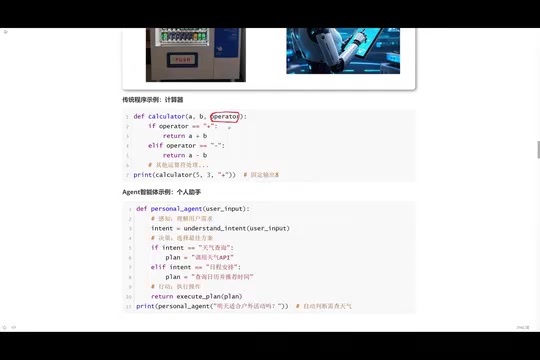
An agent (AI Agent) is more like an assistant capable of thinking. Give it a vague request—such as "I'm traveling for the May Day holiday, recommend a place for me"—and it will analyze factors like your city, transportation, and season to dynamically offer suggestions. This ability to "respond dynamically" is precisely what distinguishes agents from traditional programs.
The contrast at the code level is even more intuitive: a traditional program takes operators and numeric values and returns a computed result; an agent takes a natural-language request, performs intent recognition and tool invocation internally, and ultimately returns a personalized result. The former is closed; the latter is open.
The Agent's Core Capability Loop: Perception, Decision, Action
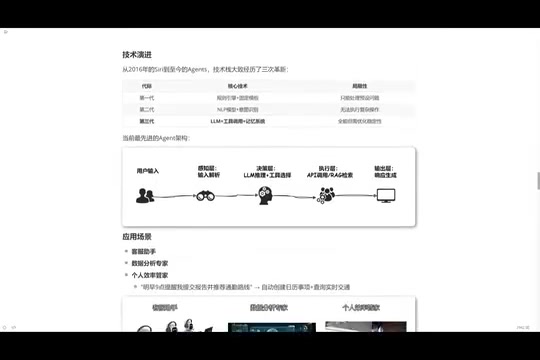
An agent's capabilities can be broken down into three stages that form a closed loop.
Perception engine is responsible for understanding user input. Like human eyes and ears, it receives natural language, speech, and even image information. For example, when a user says "book me a cheap hotel," the perception engine extracts three key elements—action (book), object (hotel), condition (cheap)—structuring the vague request.
Decision brain performs reasoning based on large language models. It determines which tools to invoke and how to combine results. This stage is the agent's "thinking center" and determines the quality of the response.
Execution organs carry out actual actions. Whether calling APIs, querying databases, or operating hardware devices, the execution layer translates decisions into concrete behaviors and feeds results back to the user.
These three stages are interlocking and indispensable. Inaccurate perception leads to biased decisions; unwise decisions lead to ineffective execution.
Intent recognition is the core task of the perception stage; essentially it is a text classification and slot extraction problem: determine which type of operation intent the user's utterance belongs to and extract key parameters (i.e., "slots") such as action, object, and constraints. In engineering, two common approaches are used: prompt-based extraction with large models—flexible but requiring stability controls—and fine-tuning a small model for specialized classification—lower cost and lower latency. Real systems often adopt a hybrid strategy of "rules as fallback + model as primary," and trigger clarification questions for low-confidence inputs. The accuracy of intent recognition directly determines whether subsequent tool selection is correct; it is the stage with the strongest error-amplification effect in the entire pipeline, so it deserves prioritized optimization.
Technical Evolution: From Rule Engines to Modern Agents
The development of agents has roughly gone through three stages.
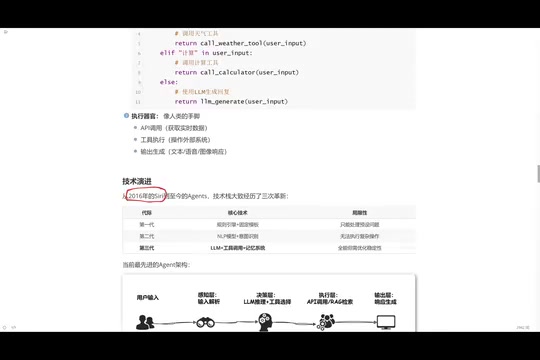
First generation: rule engines + fixed templates. Early Siri and smart speakers mostly belonged to this category. Ask "What time is it?" and it can answer; rephrase it as "Help me adjust the time" and it no longer understands. The system can only recognize preset commands and lacks generalization ability.
Second generation: NLP models + speech recognition. This generation could preliminarily understand user intent and was no longer limited to fixed sentence patterns. But the shortcoming was obvious—no memory system. You just asked about the weather, then ask "Is it suitable to go out?" and it won't incorporate the previous turn; every interaction starts fresh.
Third generation: large language models + tool invocation + memory systems. This is the mainstream architecture of current enterprise-grade agents. Large models provide powerful understanding and reasoning capabilities, tool invocation expands the boundaries of action, and memory systems make multi-turn conversations coherent and feasible. Combined, these three enable agents to truly "remember context, invoke external resources, and complete complex tasks."
Breaking Down the Enterprise Agent Tech Stack
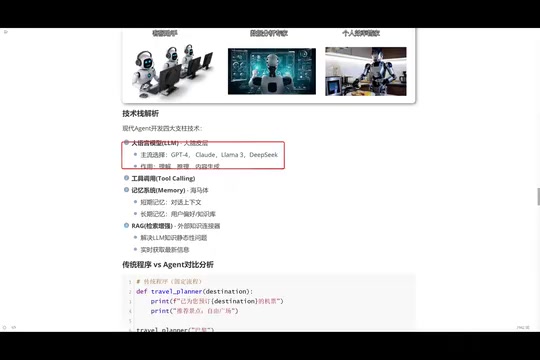
To build a usable agent, four key technologies need attention.
Large language models (LLM) are the cerebral cortex, responsible for understanding, reasoning, and generating content. When selecting one, balance capability, cost, and response speed.
Tool invocation lets agents break through the limitations of pure text interaction. Through function calling or API integration, agents can query databases, operate software, and control devices—truly "taking action."
Memory systems are divided into short-term and long-term. Short-term memory maintains the context of the current session; long-term memory stores user preferences and historical interactions, making the agent better at "understanding you" the more it is used.
Retrieval-augmented generation (RAG) solves the problem of outdated knowledge in large models. By connecting to external knowledge bases, agents can retrieve the latest documents when answering, reducing hallucinations and improving accuracy.
These four technologies are not isolated but work collaboratively: LLMs drive decisions, tool invocation executes actions, memory systems maintain coherence, and RAG supplements knowledge. Understanding how they work together is the foundation for building enterprise-grade agents.
Retrieval-augmented generation (RAG) works by retrieving document snippets relevant to the question from an external knowledge base before the large model generates an answer, then concatenating these snippets as context into the prompt so the model can "take an open-book exam." A typical pipeline has three parts: the indexing stage chunks documents, vectorizes them, and stores them in a vector database; the retrieval stage vectorizes the user question and performs similarity matching to recall the top-K documents; the generation stage feeds the recalled content together with the original question into the large model. RAG's value lies in low-cost knowledge updates, providing traceable citations, and significantly suppressing hallucinations where the model fabricates facts—especially suitable for enterprise private-domain knowledge Q&A scenarios.
Tool invocation (Function Calling) is the standardized mechanism for large models to interact with the outside world. Developers register available tools with the model via structured descriptions (name, function description, parameter schema); during reasoning the model decides whether to invoke a tool, which tool to invoke, and outputs parameter JSON conforming to the schema; the execution layer actually initiates the API request and then passes the result back to the model for continued reasoning. This mechanism decouples "saying" from "doing": the model is responsible only for planning and decision-making, while actual actions are completed by deterministic code, ensuring reliability and facilitating permission control and auditing. In multi-tool scenarios, the model can also orchestrate serial or parallel invocations—this is precisely the technical foundation for agents to complete complex multi-step tasks.
Typical Application Scenarios
Agents have penetrated multiple business domains. In customer service, agents can understand user emotions and vague descriptions, giving responses close to those of a real person and greatly improving the experience. In data analysis, agents can automatically identify data characteristics and generate analysis reports, lowering the manual threshold. In personal productivity, a single sentence—"Remind me to submit the report at 9 tomorrow morning and recommend a commute route"—can be decomposed into two tasks, calendar creation and real-time traffic lookup, executed in parallel.
The common thread across these scenarios is: vague requirements, the need for multi-step reasoning, and involvement of external tool invocation. This is exactly where agents excel.
Workflow and Practical Tips
A typical agent workflow includes: user input → intent recognition → tool selection → execution and invocation → result generation → feedback output. Each stage requires careful design, especially the accuracy of intent recognition and the reliability of tool invocation.
For beginners, it is recommended to start with simple scenarios: first get the minimal "perception–decision–action" loop working, then gradually introduce memory and RAG. Don't aim for something big and comprehensive from the start; iterative optimization is the pragmatic path.
Agents are not magic but engineering. Only by understanding their boundaries can you make good use of their capabilities.
One-line Summary
A systematic overview of agents' essence, capability loop, technical evolution, enterprise tech stack, and application scenarios.
Paragraph Summary
The article begins with the essential difference between traditional programs and agents, noting that the former is a closed system with fixed input and output, while the latter can respond dynamically to vague requests. An agent's capabilities can be broken down into a loop composed of a perception engine, decision brain, and execution organs, all interlocking. Technical evolution has gone through three stages: rule engines, NLP models, and large models plus tool invocation and memory systems, with the third generation now mainstream in enterprise architecture. The tech stack includes four key technologies—large language models, tool invocation, memory systems, and RAG—which work together to support an agent's understanding, action, coherence, and knowledge updates. The article also lists typical scenarios such as customer service, data analysis, and personal productivity, and offers practical advice to start from a minimal loop and iterate gradually.
Related articles

64 Releases in 40 Days: How Strata Uses Release Velocity to Define Its AI Local Inference Roadmap
Strata shipped 64 releases in 40 days with 460k+ characters of notes. From 0.1.0 to 0.2.10, a three-step path: make it run, make it fast, make it trustworthy.
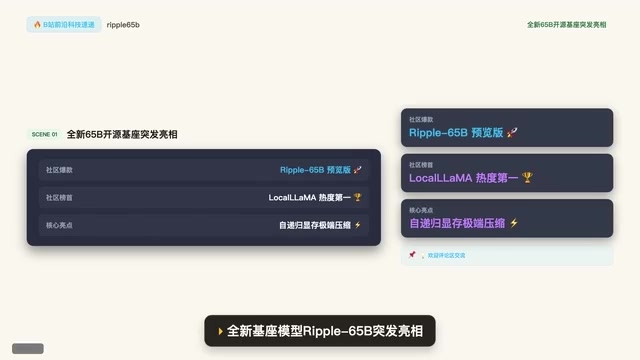
Ripple-65B Open-Source Model Tops Community Charts
Ripple-65B open-source LLM debuts atop community charts, using a self-recursive architecture to slash long-context KV cache for low-latency hundred-billion-scale inference on ordinary GPUs, with preview weights, quantized files, and one-click Olema & VLM deployment.

Deploy Open-Source Video Model MiniMax H3 Locally in 5 Minutes and Skip Cloud Generation Fees
Bilibili creator tests local deployment of open-source video model MiniMax H3: three-step ComfyUI install, 5-minute setup, no coding. Same prompt generates in 2 minutes locally vs 4 minutes online with queuing, saving about 30 RMB per 15-second 720P video. Includes VRAM requirements and RTX 5080 test results.