AI Agent Production Runtime: Tech Stack Selection and Real-World Pain Points

Reddit-sourced guide to orchestration, language, sandbox, and long-task choices for production AI Agent runtimes.
This article synthesizes Reddit discussions on production AI Agent runtime tech stacks. Orchestration splits between custom Agent loops and persistent workflow engines like Temporal/Inngest. Python+FastAPI remains mainstream, with TypeScript+NestJS rising for full-stack type safety. Sandbox options range from E2B/Daytona for rapid launch to Firecracker microVMs for scale. Long-task handling centers on durable execution, retries, and SSE/WebSocket streaming. Scaling breaks first on context bloat, tool reliability, cold start, cost, and observability.
Introduction: From Demo to Production — Where the Gap Lies in Agent Runtime
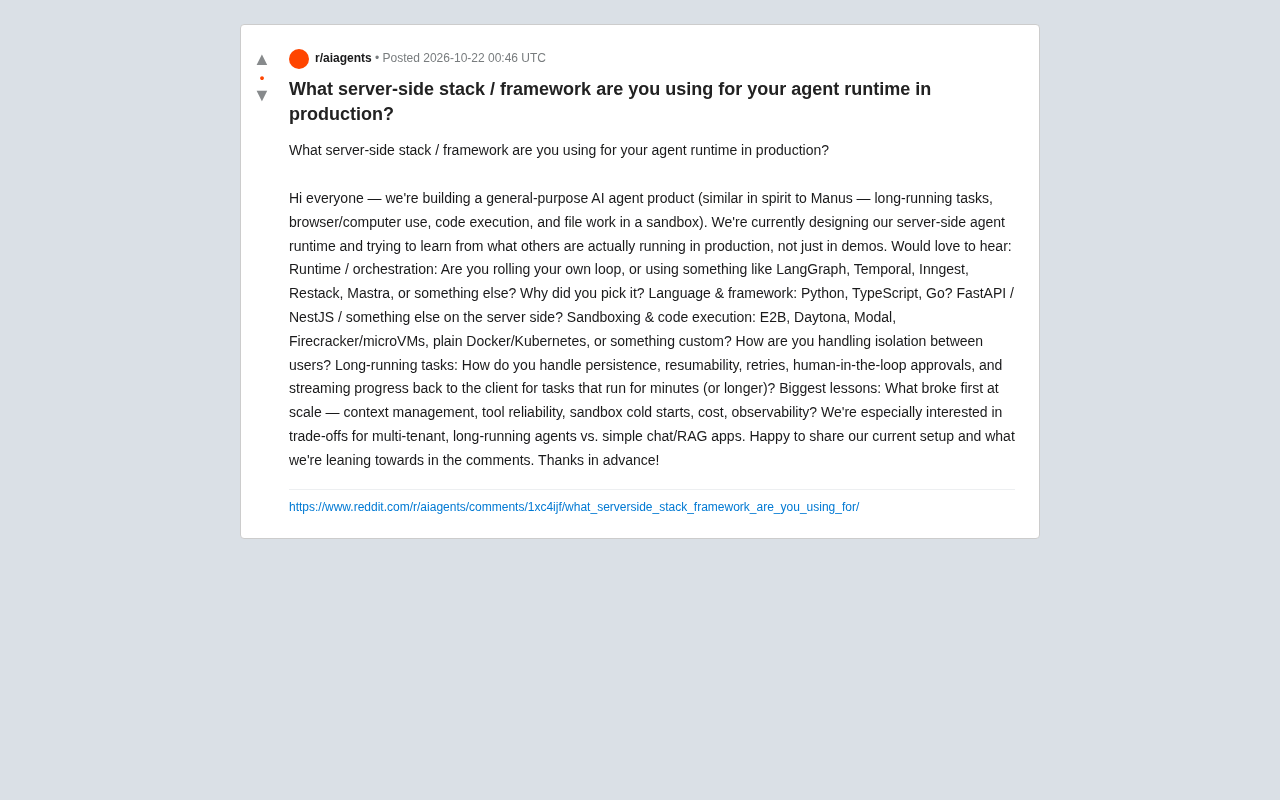
A developer on Reddit posed a pointed question: What server-side tech stack are you actually using for your AI Agent runtime in production? The question sparked extensive discussion because many teams can get a demo working with a simple loop and tool calls, but once they need to handle long-running tasks, multi-tenant isolation, and resumable execution, the complexity of tech stack selection rises exponentially.
The original poster is building a general-purpose AI Agent product covering long-running tasks, browser/computer operation, and sandboxed code execution and file processing — similar in positioning to Manus. They wanted to learn from the community's real-world experience with runtime orchestration, language frameworks, sandbox solutions, long-task persistence, and scaling pitfalls.
This article synthesizes the original thread and feedback from multiple practitioners to map out the key decision points and common traps in production-grade Agent runtimes.
Runtime Orchestration: Custom Loops vs. Workflow Engines
At the core of the Agent runtime — the task orchestration layer — the community's choices show a clear split.
Some teams opt for custom Agent loops. The rationale is usually control: the Agent's reasoning-acting loop is deeply coupled with business logic, and the abstractions of off-the-shelf frameworks become a constraint. One developer mentioned they initially used LangGraph but found its state management model didn't match their long-task requirements, eventually reverting to a custom loop based on event sourcing.
The other camp leans toward persistent workflow engines like Temporal or Inngest. Temporal is particularly popular in scenarios requiring human approval, failure retries, and long waits — its deterministic replay mechanism is a natural fit for the stepwise execution of Agents. One respondent noted: "If your tasks might run for hours or even days, Temporal's durable execution model is more reliable than any Agent framework."
Restack and Mastra were also mentioned, but with less discussion heat, viewed more as supplements for specific scenarios. LangGraph still has a substantial user base, especially suited to scenarios requiring complex state graphs, but production complaints center on debugging difficulty and breaking changes during version upgrades.
Multi-source consensus: There's no silver bullet. The choice of orchestration layer depends on task duration, the team's requirements for determinism, and willingness to accept framework constraints.
Temporal's deterministic replay mechanism deserves elaboration. Temporal records the execution of workflow code as an Event History; when a process crashes or needs to recover, it re-executes the workflow code but substitutes the results of recorded events for real side-effect calls (such as network requests or database writes). This requires workflow code to be deterministic — it cannot depend on random numbers, the current time, or external state, otherwise replay will diverge from the original execution. For Agent scenarios, this means inference calls and tool executions must be encapsulated as Activities (retryable, with timeouts, with persisted results), while the orchestration logic itself only makes decision branches. Understanding this is critical: many teams initially write LLM calls directly inside workflow functions, leading to duplicate charges or state corruption during replay. The correct approach is to push all non-deterministic operations down to the Activity layer, with the workflow layer only consuming their results.
Language and Frameworks: Python Still Dominant, TypeScript Closing In
For server-side language choice, Python remains the top pick for most Agent teams, mainly because the AI ecosystem's libraries and toolchains are the most complete. FastAPI is the most common web framework in the Python camp, paired with Pydantic for request validation and configuration management.
TypeScript's share is rising, especially among teams with complex frontend interactions that need full-stack type safety. NestJS was mentioned multiple times for its structured module system and dependency injection, which suit large applications. One developer using TypeScript said: "Our Agent runtime and frontend share type definitions, which eliminates a huge number of interface errors."
Go appears less frequently, typically in scenarios with extreme requirements for concurrency and resource efficiency, but AI-related SDK support is less mature than Python and TypeScript.
One detail worth noting: language choice is strongly correlated with the sandbox solution. If the sandbox needs to execute Python code, using Python for the runtime itself is smoother; if the focus is browser automation, TypeScript's Playwright ecosystem has the advantage.
Sandboxing and Code Execution: Isolation Is the First Principle
The most sensitive part of a multi-tenant Agent product is the code execution sandbox. In community discussions, E2B and Daytona are the most frequently mentioned managed sandbox solutions, offering out-of-the-box isolated environments and APIs suitable for rapid launch. Modal drew attention for its serverless GPU and sandbox capabilities, especially suited to scenarios requiring elastic compute.
For teams with stronger customization needs, Firecracker microVMs and Kubernetes + namespace isolation are common choices. One engineer building a similar product shared: "We initially used Docker containers for isolation, but ran into escape risks and resource contention under multi-tenancy, then migrated to Firecracker, and cold start time dropped from seconds to milliseconds."
Cold start is the core trade-off in sandbox solutions. Managed solutions typically optimize startup speed but cost more; self-built solutions are controllable but require engineering investment. A lesson that recurred throughout the discussion: don't underestimate the severity of sandbox escapes, especially when executing user-provided code — network isolation and filesystem isolation must be enabled by default.
Firecracker microVMs are lightweight virtualization technology open-sourced by AWS, designed specifically for secure multi-tenant isolation. Unlike Docker containers that share the host kernel, Firecracker launches an independent micro VM for each workload, with its own kernel, achieving hardware-level isolation via KVM, thereby fundamentally eliminating the risk of container escape. Its streamlined design (retaining only the components necessary for virtualization) keeps startup time under 125 milliseconds with about 5MB of memory overhead, balancing VM security with container startup speed. This is precisely why it suits Agent code execution sandboxes: each user session can have an independent VM, fully isolated from others, while cold start latency has a controllable impact on interactive experience. The cost is managing VM lifecycle, image building, and network configuration yourself, with higher engineering complexity than managed sandbox services.
Long-Task Handling: Persistence, Retries, and Human Intervention
Long-running tasks (from minutes to days) are the biggest difference between an Agent runtime and an ordinary chat application. In community feedback, durable execution is an unavoidable requirement.
Temporal is repeatedly recommended in this scenario because it natively supports activity retries, timeout control, signal mechanisms (for human approval), and state queries. One user described their architecture: each step of the Agent executes as a Temporal Activity, state is stored in Temporal's Event History, and clients subscribe to progress updates via WebSocket.
For teams not using a workflow engine, the common alternative is a database-based state machine: writing task state, step results, and checkpoints to Postgres, paired with a message queue to trigger the next step. Retry logic must be implemented yourself, typically combining exponential backoff and dead-letter queues.
Streaming progress updates are another high-frequency pain point. Simple polling is inefficient for long tasks; Server-Sent Events (SSE) or WebSocket are more common choices. One developer cautioned: "Streaming must handle backpressure and reconnection properly, otherwise clients will receive duplicate or out-of-order events."
Database-based state machine solutions require attention to several design points in practice. First is state idempotency: each step's execution result must be written idempotently, typically using a step ID with a unique constraint to prevent duplicate execution. Second is checkpoint granularity: too coarse means replaying a lot of completed work after a failure, too fine increases database write pressure; a common compromise is to set checkpoints at LLM call or tool call boundaries. Third is concurrency control: multi-step execution of the same task requires locking or optimistic concurrency control to avoid parallel step execution caused by duplicate message queue delivery. Finally, state cleanup: long-running tasks accumulate large amounts of intermediate state, requiring archival or compression strategies. Compared with Temporal's built-in capabilities, a self-built state machine requires the team to bear these correctness guarantees themselves — which is why many teams turn to workflow engines after scaling.
Scaling Pitfalls: What Breaks First
When asked "what breaks first after scaling," community answers were highly concentrated in a few areas:
- Context management: As task steps increase, the context window balloons rapidly, causing costs to soar and model performance to degrade. Most teams adopt a sliding window plus summarization strategy, but how and when to summarize remains a manual tuning challenge.
- Tool reliability: External API rate limiting, timeouts, and return format changes are common failure sources. Retry, fallback, and circuit-breaker mechanisms need to be designed for every tool call.
- Sandbox cold start: If a new sandbox is launched for every user request, cold start latency directly impacts experience. Warm pools and session reuse are common mitigations.
- Cost: Token consumption and sandbox compute costs for long tasks can easily spiral out of control. Setting budget caps and forced termination on timeout are necessary safeguards.
- Observability: The Agent's decision chain is hard to trace. Structured logging, distributed tracing (such as OpenTelemetry), and step-level metrics are necessities in production.
Conclusion: A Selection Framework for Production-Grade Agent Runtimes
Synthesizing the community discussion, building a production-grade Agent runtime can follow this decision path:
- Orchestration layer: If tasks last more than a few minutes and require human approval, prioritize Temporal or Inngest; if pursuing ultimate control and the team has engineering capability, a custom event-driven loop is also viable.
- Language: Python suits AI-intensive tasks, TypeScript suits full-stack type safety and browser automation.
- Sandbox: For rapid launch, choose E2B/Daytona; for long-term scaling, consider Firecracker or K8s isolation, evaluating cold start and isolation together.
- Long tasks: Durable execution is the core; use SSE/WebSocket for streaming updates and handle reconnection.
- Observability: Integrate distributed tracing and step-level logging from day one, otherwise debugging costs become extremely high after scaling.
The original thread's discussion continues, and the poster promised to share their own architecture. For teams currently designing Agent runtimes, these first-hand experiences are more valuable than any framework documentation.
One-line Summary
Synthesizing Reddit discussions, this piece maps out orchestration, language, sandbox, and long-task choices for production-grade AI Agent runtimes, along with scaling pitfalls.
Paragraph Summary
This article synthesizes Reddit community discussions to systematically map out tech stack choices for production-grade AI Agent runtimes. The orchestration layer splits between custom Agent loops and persistent workflow engines like Temporal/Inngest — the former for control, the latter for reliability in long tasks and human approval scenarios. Python+FastAPI remains dominant, while TypeScript+NestJS gains share for full-stack type safety. Among sandbox solutions, E2B/Daytona suit rapid launch, while Firecracker microVMs offer stronger isolation and lower cold start at scale. The core of long-task handling is durable execution, retry mechanisms, and SSE/WebSocket streaming. After scaling, the first problems to surface concentrate in five areas: context bloat, tool reliability, sandbox cold start, cost overruns, and missing observability.
Related articles

Codex for Absolute Beginners: Connect to Domestic LLMs + Four Hands-On Case Studies
A Codex beginner tutorial: three steps to install and connect to the DeepSeek domestic LLM, with CC Switch for provider switching, plus essential plugins, skills, and four hands-on cases.

Claude Detects Early Signs of Sepsis, Reddit User Says AI Saved Their Life
A Reddit user shared symptoms of sudden difficulty urinating and confusion late at night; Claude identified possible sepsis and urged immediate medical care, which doctors confirmed could have been fatal if delayed. Exploring AI's potential and limits in health early warning.

The Goose Programming Language: John Carmack and the Great Abstraction Debate
Starting from the Hacker News post "The Goose Programming Language," we explore the programming language design philosophy sparked by John Carmack and the trade-offs between performance and abstraction.