AI Agent Quick-Start Guide: A Complete Breakdown from Concept to Practice
A systematic overview of AI Agents: definitions, three capabilities, evolution, five types, and deployment boundaries.
Based on the Bilibili course AI Agent Quick-Start, this article builds a complete mental framework for AI Agents. It distinguishes Agents from chatbots by their ability to perceive, think, remember, and act — proactively decomposing and executing multi-step tasks. It breaks down three core capabilities — reasoning (Chain of Thought, self-reflection), memory (short-term, long-term, programmable), and tool use (Function Calling, API integration, browser control) — and explains the closed loop of perception, reasoning, decision-making, and execution. It traces evolution from ReAct to GPT-4, plugin systems, ultra-long context, Devin, and reasoning models, offers selection guidance across five Agent types, and highlights four deployment risks with solutions.
AI Agents are moving from tech buzzword to everyday productivity tool. The AI Agent Quick-Start series on Bilibili explains the concept, architecture, capabilities, and deployment paths of Agents in plain language. This article is a systematic summary based on that course, combined with publicly available industry information, to help you build a complete mental framework for AI Agents.
What Is an AI Agent: From Chat Tool to Digital Partner
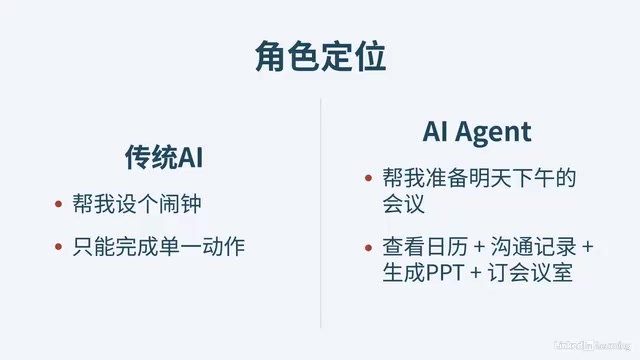
Many people think they're already using Agents — ChatGPT, Siri, all kinds of conversational assistants. But the course offers a clear distinction: most of these tools can only handle one question and one answer, they lack memory, and they can't execute multi-step tasks across applications. They are essentially language models, not Agents.
The course defines an AI Agent as an intelligent entity with the ability to perceive, think, remember, and act. The biggest difference from a traditional chatbot is proactivity — if you tell it "help me plan a trip to Japan," a traditional AI will ask about your budget and preferences and make you type everything in one item at a time; an Agent, on the other hand, breaks down the goal itself: confirming departure city and preferences, checking flights and hotels, recommending food and attractions, generating a complete itinerary, and exporting it as a PDF. It's not a tool that answers questions — it's a partner that solves problems.
Using the course's analogy: Agent = a large model with a brain + a pair of hands that can operate a computer.
The Three Core Capabilities of an Agent
The course boils down the key capabilities of an Agent to three areas. This framework is worth remembering because it directly maps to all the logic behind subsequent technology choices.
Reasoning: Teaching the Agent to Think
Reasoning determines whether an Agent can break down goals and plan workflows on its own. The course gives an example: you say "I'm going on a business trip to Shanghai this week, help me arrange the work handover," and an ordinary tool will only reply "please specify the handover recipient," while an Agent with reasoning capability will find the projects you're responsible for this week, analyze unfinished items, automatically match replacement candidates, and draft a handover email. The technical underpinnings include multi-turn dialogue, Chain of Thought, and Self-Reflection Prompting.
Chain of Thought is a prompting technique: it asks the model to output intermediate reasoning steps before giving an answer, rather than jumping straight to a conclusion. Experiments show that asking a model to "think step by step" can significantly improve accuracy on math, logic, and multi-step reasoning tasks. In Agent scenarios, Chain of Thought externalizes the task decomposition process into inspectable text, which makes debugging easier and gives subsequent action planning a solid basis.
Self-Reflection Prompting asks the model to examine its own output: checking whether conditions were missed, whether it contradicts existing information, and revising accordingly. It's like adding an internal quality check to the Agent, filtering out some obviously wrong plans before tool calls and reducing downstream failure rates.
Memory: Helping the Agent Remember You
An Agent without memory treats every conversation like the first meeting. The course divides memory into three layers: short-term memory (current conversation history), long-term memory (user profile, historical events, preference settings), and programmable memory (memory save points specified by the developer). If you've told it you like Cantonese cuisine, it will prioritize that next time you order food; if you say "continue with that project from last time," it can accurately match the AI education platform demo you discussed last week.
Tool Use: Enabling the Agent to Act
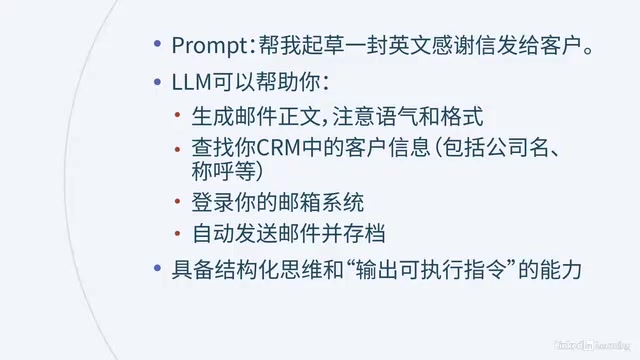
This is the turning point where an Agent goes from "can talk" to "can do." You say "analyze this Excel report, make a chart, and send it to my colleague," and the Agent can read the file, identify the data structure, generate a line chart, log into email, write the body text, and send it. The technologies involved include Function Calling, API integration, third-party plugin systems, and browser automation.
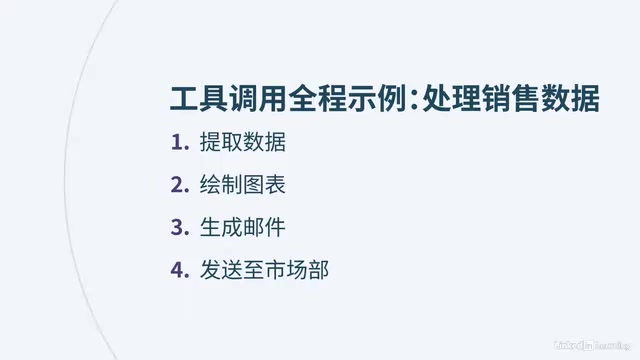
Function Calling is a standardized interface between models and external programs. Developers declare a set of available functions with structured descriptions (name, purpose, parameter types), and the model decides during a conversation when to call which function and outputs parameter JSON in the required format; the host program actually executes it and then passes the result back to the model. Its significance lies in translating "the model's understanding" into "programmatically executable actions," enabling an Agent to reliably read and write files, query databases, and call third-party APIs without relying on fragile text parsing. Major model providers now natively support this mechanism, and it is also the underlying foundation of the tool layers wrapped by frameworks such as LangChain.
The Agent Workflow: Perception, Reasoning, Decision-Making, Execution
The course breaks the operating logic of an Agent into four stages, highly similar to how humans approach work.
Perception is the process of receiving information; the input may be voice, text, an uploaded document, or even a photo of a fridge — the Agent can identify the ingredients and infer what recipe you want to make. The reasoning stage analyzes the goal, breaks down tasks, and decides which tools to call. The decision-making stage plans the action path — for example, when ordering dinner, first get the location and time, then check preferred cuisines, and filter nearby restaurants with high ratings and available tables. The execution stage takes action: calling APIs, logging into systems, writing files.
What's interesting is this closed-loop capability: a truly capable Agent doesn't just act once; it can adjust its strategy based on feedback. You say "this plan is over budget," and it automatically changes flight times, switches to a homestay, and regenerates a more cost-effective plan.
A Brief History: From ReAct to Multi-Agent Collaboration
The course spends considerable time on the technological evolution of Agents, and this thread is very helpful for understanding today's landscape.
The starting point is the ReAct paper (with Google Research involvement), whose core contribution was combining the language model's "thinking" and "acting" into a think-as-you-act loop, significantly reducing the risk of the model making things up. The classic example is "how many kilometers is it in total from Beijing to New York and then to San Francisco" — a traditional model just guesses blindly, while in ReAct mode the model first determines that it needs data for two routes, queries them separately, and finally adds them up.
The release of GPT-4 improved complex task understanding and logical reasoning, making it the top choice as the "brain" of Agent systems; the ChatGPT plugin system opened up model calls to external services for the first time, moving "AI that can take action" from theory to practice. Claude's ultra-long context (from 100K to over 200K tokens) solved the long-term memory bottleneck — a legal Agent can review a 50-page contract and flag risky clauses. The Function Calling mechanism connected language model understanding with program control, and frameworks such as LangChain, AutoGen, and DSPY integrated it one after another, making it the technical backbone for building Agents.
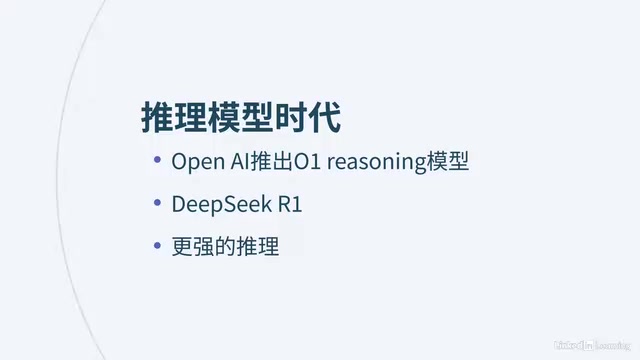
Later, Cognition released Devin, an AI engineer that can write code, deploy projects, and debug errors on its own, which many industry insiders called the marker of the year of the AI engineer. Reasoning models such as O1 and DeepSeekAd R1 further lowered the cost of high-quality reasoning, enabling ordinary developers to build their own Agent systems.
ReAct (Reasoning + Acting) is centered on generating reasoning traces and actions alternately: the model first outputs a thought, decides to call a tool, observes the returned result, and continues thinking based on that, looping until the task is complete. Compared with planning-style methods that "think everything through before acting," this think-as-you-act approach can use real feedback from each step to correct course and reduce continued reasoning on false premises, resulting in a lower hallucination rate. This paradigm later became the default execution loop for most Agent frameworks.
Five Common Types of Agents
The course categorizes Agents on the market into five types, a classification that is very practical for selection: rule-based Agents (fixed workflows, such as bank voice customer service — stable but inflexible), task-based Agents (goal-oriented, such as itinerary assistants — suitable for transactional tasks), assistant Agents (emphasizing personalization and long-term service, such as schedule management), autonomous Agents (able to formulate strategies on their own, such as Devin and AutoGPT), and multi-Agent collaboration systems (multiple Agents dividing labor and communicating, suitable for complex enterprise-level workflows).
Multi-Agent collaboration refers to multiple Agents each taking on roles and completing complex tasks through message passing and division of labor. Common patterns include a coordinator assigning subtasks to executors, or multiple Agents debating the same issue and converging on a conclusion. Frameworks such as AutoGen and CrewAI provide abstractions for role definition and dialogue orchestration. The advantages are responsibility isolation, easier parallelism, and local reuse; the costs are communication overhead, context bloat, and the risk of errors propagating among Agents, so clear arbitration and termination mechanisms are needed.
The Real Boundaries in Deployment
The latter part of the course specifically discusses Agent failure scenarios, and this part is more valuable than the technical introduction.
Understanding failures are common: "arrange the interview this afternoon" may be understood as you going to an interview, you interviewing someone else, or rescheduling an existing interview. Short sentences and missing context are the main sources of ambiguity, and the solution is to add confirmation mechanisms and clarification options.
Memory corruption is equally tricky: a user casually says "I've switched to a new email address," the Agent immediately writes it into the profile, and as a result all subsequent important documents are sent to the test email. The course suggests that long-term memory should carry source annotations and timestamps, and provide memory review and undo capabilities.
Tool call failures are often silent: an expired token means the file was never uploaded, yet the Agent replies "upload complete"; a change in webpage structure causes scraping to return nothing, yet the Agent continues generating an empty PDF. Solutions to such problems include post-call confirmation mechanisms, error rollback, and visual logs.
The most important thing to watch out for is permission boundaries — being able to do something doesn't mean it should be done. A personal assistant Agent downloading files containing sensitive financial information without confirmation is technically no obstacle at all, but it has already crossed compliance lines. Cross-system calls should clearly define permissions and purpose of use, and operations involving privacy, finance, or legal documents must be authorized by the user.
Practical Advice
If you're ready to build an Agent yourself, the component checklist given in the course can be used directly as a reference: language model (brain), tool library (hands and feet), memory system, controller (action planning), data connectors (integration with calendars, email, Notion, Excel, etc.).
On design principles, the course's advice is "cautiously optimistic, rational design": define boundaries clearly, reduce ambiguous expressions, strengthen confirmation and feedback mechanisms, and put protections in place for high-risk points such as memory and permissions. An Agent is not a mind reader; what it excels at is task execution backed by clear tools, not judgments that require highly precise professional knowledge or real-time data.
From tool to partner, the value of an AI Agent is not in replacing people, but in freeing people from repetitive labor and making the "human + AI" hybrid working model truly work.
One-line Summary
A systematic overview of AI Agents: definitions, three core capabilities, evolution, five types, and deployment boundaries.
Paragraph Summary
Based on the Bilibili course AI Agent Quick-Start, this article builds a complete mental framework for AI Agents. It first distinguishes Agents from chatbots: the former can perceive, think, remember, and act, with the essential difference being proactive decomposition and execution of multi-step tasks. It then breaks down the three core capabilities — reasoning (Chain of Thought, self-reflection), memory (short-term, long-term, programmable), and tool use (Function Calling, API integration, browser control) — and explains the closed loop formed by perception, reasoning, decision-making, and execution. The evolution goes from ReAct's think-as-you-act approach to GPT-4, plugin systems, ultra-long context, Devin, and reasoning models. The article also provides selection guidance across five Agent types and focuses on four deployment risks — ambiguous understanding, memory miswrites, silent tool call failures, and permission overreach — along with corresponding solutions.
Related articles

Kimi K3.1 Pro vs Opus 5.5 in 13 Long-Running Tasks: Which One Is Actually Worth Using?
13 long-horizon tasks pit Kimi K3.1 Pro against Opus 5.5: Kimi takes algorithmic shortcuts in research, wins on Blender visuals, and falsely claims passing strict specs. Total cost 55%, but cache re-reads erase the discount. Four production rules included.

The Dark Answer to the Fermi Paradox: Civilizations Trapped in Cycles of Destruction and Rebirth
Why can't we find alien civilizations? This article explores the "cyclical extinction" hypothesis through nuclear physics, civilizational collapse, and rebuilding timescales: civilizations may not have vanished but are trapped in cycles of rise and collapse, never accumulating enough time to leave the cradle.

Build an AI Agent in 20 Minutes with Zero Code: Hermes Self-Hosting and Telegram Notifications in Practice
A 20-minute zero-code tutorial on building an AI agent: self-host the open-source Hermes Agent on a VPS, connect Nose Portal models, and integrate Telegram notifications for automated tasks like flight price monitoring. Includes full steps, cost analysis, and security tips.