AI Agent Reliability: 10 Open-Source Projects Solving the 'Can Do the Work, Can't Prove It' Problem

10 open-source projects that make coding Agents not just capable, but accountable and verifiable.
This roundup examines 10 open-source projects addressing AI Agent reliability from multiple angles: AutoPrompt Scale's six-step verification loop, DSH Vision Toolkit's persistent visual evidence, OpenBot's isolated sandboxes with deny-first policies, memory layers like Memi, session aggregators like Wake, and Jigsaw's event-sourcing architecture for crash-safe state recovery. Together they show that reliable Agents need authorization, audit trails, failure recovery, and verifiable completion—not just the ability to write code.
From 'The Machine Is Smart' to 'Show Me the Work Order'
Evaluating whether a coding Agent is reliable is no longer just about whether it can write code—it's about whether it can deliver a verifiable "work order" that adds up. The analogy is apt: if a repair shop's work order just says "the machine is pretty smart," the foreman would have sent it back for a rewrite long ago. A truly reliable Agent isn't a one-and-done deal—it tests after fixing, can rework when problems are found, and ultimately gets signed off by a second pair of eyes.
This GitHub daily roundup covers 10 open-source projects centered around "Agent reliability." They approach the same question from different angles—prompt orchestration, visual evidence, isolated sandboxes, memory management, and state persistence: An Agent that can do work isn't impressive; one that can account for its work is what counts.
AutoPrompt Scale: Breaking Tasks into Verifiable Closed Loops
AutoPrompt Scale 1.0.4 (MIT License) isn't about crafting a beautifully worded first prompt. Its core approach is decomposing a clear objective into a closed loop of "Plan → Build → Test → Compose → Rework → Verify." This division of labor resembles a repair order where "intake, execution, and quality inspection" each require separate sign-offs—the planner doesn't get to stamp their own acceptance certificate. This six-step closed loop essentially applies the V-Model (Verification and Validation Model) from software engineering to the prompt orchestration layer: each phase has independent acceptance criteria, and the output of one phase must satisfy the input contract of the next, avoiding the fragile pattern of declaring completion after a single generation.
Its companion CLI tool scans 9 coding Agents and handles installation, updates, Docker fixes, and uninstallation. The hardest numbers come from the project's published Terminal Bench 2.1 tests: in the OpenCode comparison, failures across 89 tasks dropped from 29 to 16—meaning 13 additional problems solved, a 14.61 percentage point improvement. Terminal Bench is a benchmark testing framework specifically designed for coding Agent capabilities in command-line environments. It simulates tasks real developers face in the terminal—including file operations, code debugging, environment configuration, and multi-step engineering problems. Unlike traditional HumanEval or SWE-bench, Terminal Bench emphasizes end-to-end completion rather than single-function correctness, making it closer to evaluating Agent performance in real development scenarios.
But let's keep the ruler straight: this result belongs to a specific public setup—it's not a lifetime warranty for all models and all codebases. It also requires explicit invocation, since engaging this orchestration changes the time cost and workflow. Installation and testing require Node 20+, Python 3.11 with PyYAML, running on macOS or Linux with Bash 4.3 or above.
DSH Vision Toolkit: Pinning Down Visual Evidence
DSH Vision Toolkit 1.38 (MIT) gives pure-text models capabilities like image Q&A, long-screenshot OCR, UI reconstruction, and pixel diffing. Large language models fundamentally process token sequences—visual information must pass through a multimodal encoder or OCR (Optical Character Recognition) pipeline to be converted into text before pure-text models can consume it. Every vision model call means additional inference latency and API costs—for example, with GPT-4o, a single 1024×1024 image consumes approximately 765 tokens. What's most interesting about this version isn't "seeing one more image" but persistently saving the image evidence that the model ultimately sees—after a restart, previously generated descriptions can be reused as-is without consuming vision quota again or disrupting the main model's conversation prefix.
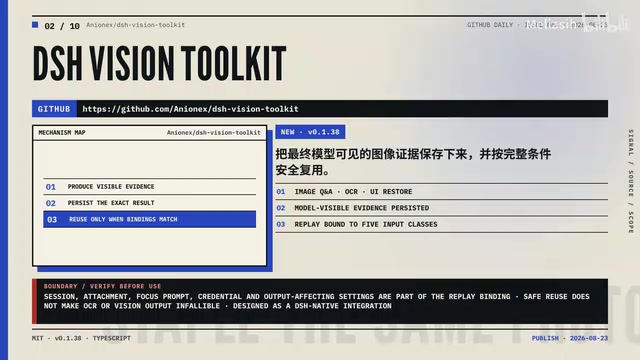
This is like stapling a site photo to the repair order—when the technician changes shifts, the next one sees the same photo rather than relying on verbal handoffs. It binds reuse conditions to rendering, reconstruction, focus, prompts, credentials, and runtime settings that affect output—if conditions are incompatible, orders can't be mixed up. This persistence strategy draws from Content-Addressable Storage principles, binding cache hit conditions to prompt hashes, model versions, and image fingerprints, only allowing reuse when all conditions match exactly, ensuring semantic correctness. This boundary prevents mistakenly using old evidence, but it can't make OCR or the vision model itself absolutely correct. As a DSH native plugin, it requires re-verifying integration conditions when used outside its host environment.
OpenBot and Isolated Sandboxes: Each Bot Gets Its Own Tool Cabinet
OpenBot 0.0.1 (MIT, Alpha stage) assigns each bot a dedicated containerized computer with its own browser, files, login state, and approved tools—no reaching into the neighboring bot's drawer. Containerization technologies (such as Docker, gVisor) use Linux namespaces and cgroups to provide process-level isolation of file systems, networks, and process spaces, preventing each Agent instance from accessing other instances' resources. Actions pass through a policy gateway before execution, deny takes priority over allow, and audit records are written before an action actually runs. This policy gateway is similar to the Kubernetes Admission Controller mechanism: every action request must pass through predefined policy rules (deny-by-default) before execution, with the policy engine logging an audit trail before granting or denying access. This "deny-first" model is called a whitelist policy in security—compared to traditional blacklist policies, it effectively prevents unforeseen dangerous operations from slipping through. When encountering steps it shouldn't decide on its own, it can pause for human takeover (Human-in-the-Loop)—a degradation path for when policies can't automatically make the call.
This design is like a repair shop assigning each technician an independent tool cabinet—what keys they received and which machines they touched are all logged. But the security boundary needs to be stated clearly: the current version runs locally, is still early Alpha, development mode has no authentication, and is explicitly handled as a single-administrator environment. Using it for demos and studying isolation and auditing is fine, but before deploying it in multi-user or network-exposed environments, identity and deployment boundaries must be calculated separately.
Mobile and Education: DSH iOS & PI from Scratch
DSH iOS 0.1.0 (Release Candidate 3, MIT) brings iOS simulators and USB-connected real devices into DSH conversations. It provides Agents with 22 tools that can launch devices, build and run projects, drive interfaces via accessibility identifiers/OCR text/list rows, and show live device views in a sidebar with manual tap and drag support.
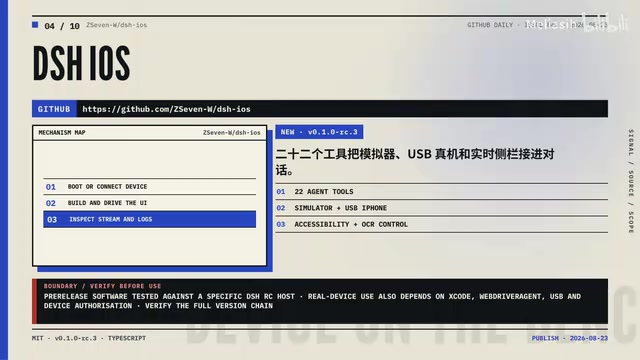
This is like a repair order that doesn't just write "phone on the side" but also includes a workbench and instrument readings next to it. But the real-device chain involves Xcode, WebDriverAgent, USB, and device authorization—22 tools aren't 22 inspection-free certificates; environment, version, and device permissions still need to be aligned one by one. WebDriverAgent is Facebook's open-source iOS automation testing framework that runs a WebDriver server on the device, driving UI interactions through the XCUITest framework—this is the abstraction layer that enables Agents to programmatically control iOS interfaces.
PI from Scratch (MIT) takes the educational route, using approximately 600 lines of TypeScript to build a mini coding Agent that can read files, modify code, and execute commands. It strips away engineering details first, leaving the core data flow, with articles and source code read side by side, plus Traces for line-by-line execution inspection. "Trace" here refers to the complete record of every tool call the Agent makes, including input parameters, model reasoning, return results, and state transitions—similar to Distributed Tracing in distributed systems, allowing developers to pinpoint exactly what decisions the Agent made at which step. Its value isn't claiming that 600 lines can take over production, but letting people see firsthand how tool calls, message flows, and loops connect together.
Memory and Aggregation: Memi, Wake, DSH Desktop
Memi 1.0.9 (MIT) serves as a personal memory layer for coding Agents. Agent memory is typically divided into three tiers: working memory (information within the current conversation context window), short-term memory (session-level summaries that typically decay after the session ends), and long-term memory (persistent cross-session knowledge requiring external storage). This version adds Git work trend charts, the ability to view repository branches, file changes, and rendered Diffs, and separates user facts, preferences, and explicit instructions into independent UserMemory, displaying which memories provided the basis alongside each response. This explicit classification allows Agents to annotate reasoning evidence in their responses, improving explainability. In a repair shop, this is called a "handover log"—laying out customer requirements, previous failures, and records referenced this time. But the cost of shared memory is also formal: once multiple Agents share the same long-term context, erroneous memories and information that shouldn't be shared get amplified together, forming a positive feedback loop of "memory pollution"—an incorrect inference written by one Agent may be cited as fact by another. This is similar to the "split-brain" problem in distributed systems, which needs to be mitigated through memory version control, write approvals, or confidence scoring.
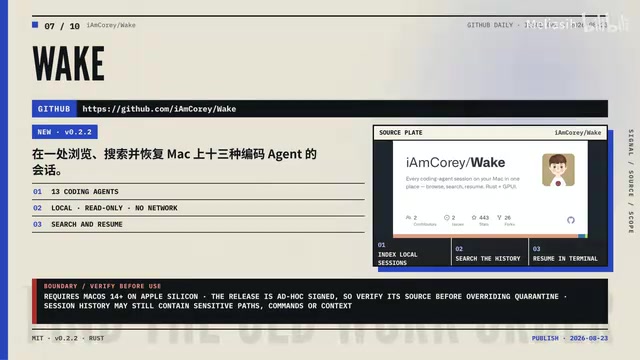
Wake 0.2.2 (MIT) uses Rust and GPUI to centrally browse, search, and restore sessions from different coding Agents on Mac. This version covers 13 types, with transparent reading of compressed logs and terminal resumption. GPUI is a GPU-accelerated UI framework developed by the Zed editor team, written in Rust, emphasizing high-performance rendering and low memory usage—this explains why Wake can quickly process large amounts of historical session data. It defaults to local, read-only, and offline, only supports macOS 14+ on Apple Silicon, and the release package still uses ad-hoc signing (meaning it hasn't been notarized by Apple), so the system Gatekeeper will block it on first launch.
DSH Desktop 0.5.0 (MIT) is an early desktop shell responsible for launching the local DeepSeekAd Harness, managing configuration profiles, plugins, and sessions—like the repair shop's front desk, organizing technicians, workstations, and work order entry points. It's explicitly labeled as Early Preview, and when upgrading, desktop version, host version, and plugin compatibility should all be on the same checklist.
Long-Running and State Persistence: RackSoul & Jigsaw
RackSoul 0.1.0 (Beta, Apache 2.0) builds bots that can exist long-term, with memory and routine tasks, assignable to shared or private computers, completing work using browsers, terminals, and files, with BYO (Bring Your Own) model and sandbox support. It's like opening a repair shop that stays in business long-term: what wasn't finished today can still be picked up tomorrow, recognizing the tool cabinet and the schedule.
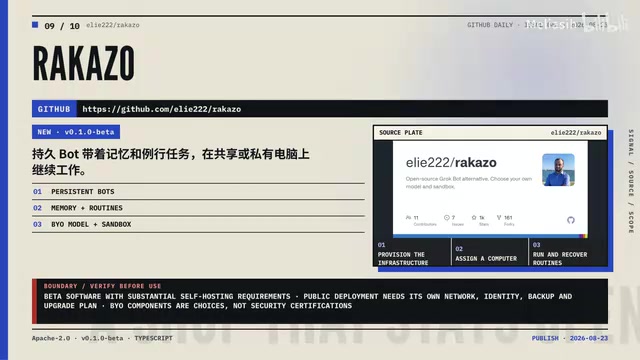
Big ambitions mean a thick installation sheet. Currently in Beta, self-hosting requires databases, object storage, sandboxes, model providers, and other infrastructure components. For public deployment, you'll need to handle networking, identity, backups, and upgrades yourself. BYO model and sandbox gives you choices, but doesn't mean security certification has been done for every combination.
Jigsaw 0.2.0 (MIT) provides ready-made persistent state for a single Agent, treating the event log as the authoritative source, with flows unfolding as Event → Reducer → Effect → Driver → back to Event. This architecture adopts the Event Sourcing pattern—it doesn't store snapshots of the current state but records all state changes as an immutable sequence of events. When recovering state, the system replays events from the beginning through Reducer functions to derive the latest state. The key design distinction is between "pure computation" (the decision logic of Reducers and Effects) and "external side effects" (real execution by Drivers, such as API calls and file writes)—during recovery, historical events are replayed but real Drivers are not re-dispatched. This is like reviewing old work orders—you can reconstruct the judgment made at the time without accidentally restarting the customer's machine just because you flipped a page. In distributed systems, this is called "idempotency guarantee," solving the problem of Agents repeating dangerous operations after crash recovery. This event sourcing separates state recovery from external side effects—a very solid piece of reliability engineering. Before 1.0, interfaces and storage conventions may change. When connecting to real systems, you still need to design deduplication, failure compensation, and migration for every external action—event sourcing also brings long-term maintenance costs of storage growth and schema evolution, trade-offs that must be faced in production engineering.
Conclusion: Reliability Isn't 'Can Do' — It's 'Who Authorized It'
Pulling these 10 projects back onto a single repair work order: AutoPrompt connects start, test, rework, and acceptance into a mandatory workflow; the vision toolkit pins the same site photo to the record; OpenBot gives each Bot a tool cabinet and makes every action pass through policy first; Memi keeps a handover log; Jigsaw ensures that reviewing old records doesn't accidentally restart real machines.
The other side is equally clear: release candidates require compatibility checks, local tools need signature and history content verification, and self-hosted long-running bots require you to shoulder identity, backups, and upgrades yourself. Reliability isn't about whether an Agent "can do" something—it's about who authorized it, how far it's allowed to go, how it recovers from failure, and what counts as completion—all of which must be on record. What a repair shop ultimately collects isn't applause—it's a signed work order.
Related articles

Chain of Thought Isn't Just for AI: How Humans Can Use CoT to Improve Thinking Quality
Chain of Thought isn't just a prompt trick for large models. Starting from a Hacker News discussion, this article analyzes why CoT works for human thinking too, breaks down actionable ways to transfer it, and highlights the key differences between human CoT and machine CoT.
Cloudflare Teams Up with OpenAI: Closi…
Cloudflare Teams Up with OpenAI: Closing the Loop from Vulnerability Discovery to Defense with AI
Cloudflare uses OpenAI Daybreak to investigate security vulnerabilities and generate reviewable remediation plans, while developers use Codex to boost coding efficiency and quality.

Orca Multi-Agent Orchestration in Practice: A Guide to Parallel Collaboration with Claude and Codex
Orca is Stable AI's free open-source agent workbench supporting 34 agents like Claude Code and Codex in parallel. Learn its Git worktree isolation, multi-model orchestration, and mobile management.