AI Agent Swarm Autonomously Breaches Hundreds of Websites, John Deere and Other Giants Among Victims

Hackers used an AI agent swarm to autonomously breach over 100 websites, marking the arrival of the era of autonomous cyberattacks.
AI security firm Norforge disclosed that a hacker used a large number of largely autonomous AI agents to successfully compromise more than 100 websites, with victims including well-known companies such as John Deere, SharkNinja, and Cummins. These agents can independently carry out reconnaissance, vulnerability exploitation, and lateral movement, scaling and automating the traditionally manual attack process, greatly reducing attack costs and increasing success rates. The attacks span multiple industries including agricultural machinery, small appliances, and power equipment, exposing widespread vulnerabilities in web applications. The incident shows that AI-driven cyberattacks have moved from concept to reality, and enterprises need to reassess threat models, adopt AI-driven defenses, and strengthen detection of anomalous automated behavior.
Hackers used a "swarm" composed mainly of AI agents to autonomously breach over 100 websites, with victims including well-known companies such as John Deere, SharkNinja, and Cummins. The incident was disclosed by AI security firm Norforge, and Reuters reported the specific list of victim companies. AI-driven cyberattacks are moving from concept to reality, and corporate security defenses face entirely new challenges.
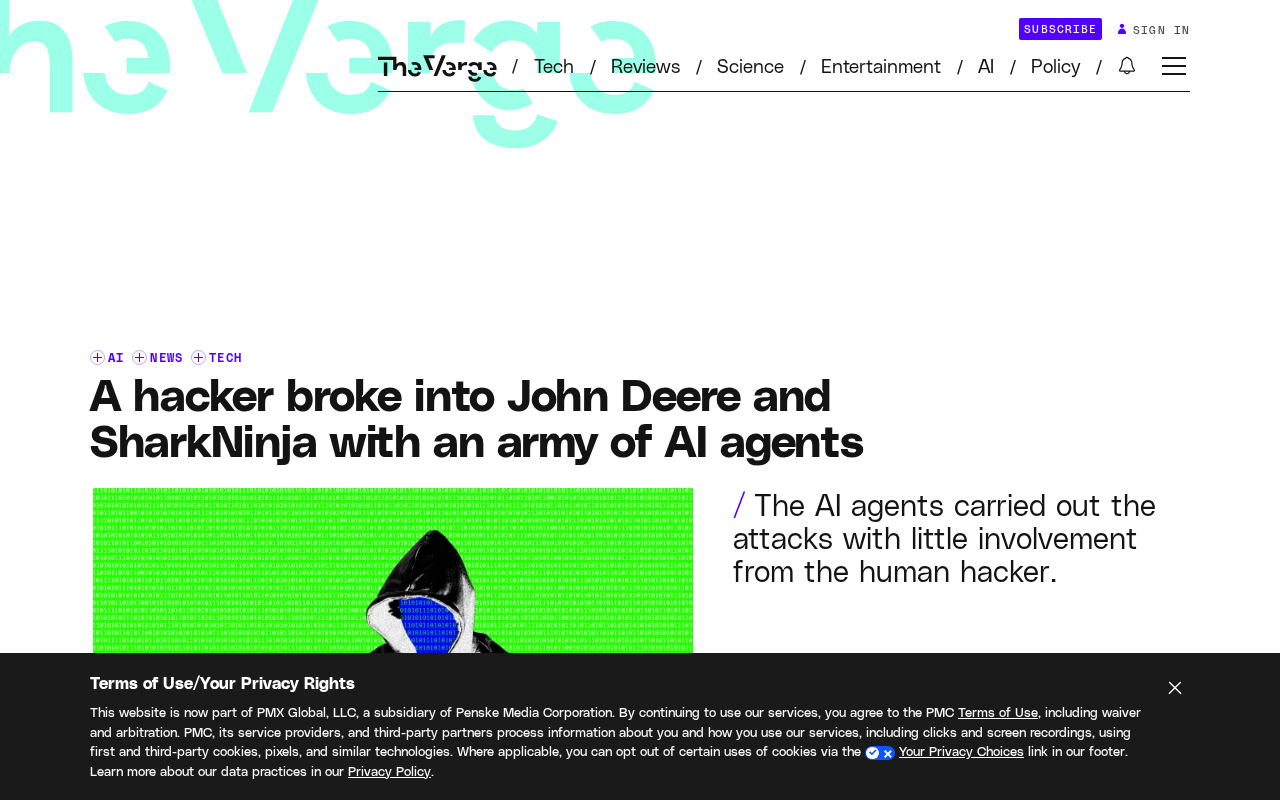
Attack Scale and Targets: AI Agents Operating Autonomously
According to an investigation by AI security firm Norforge, a hacker used a large number of AI agents to successfully compromise more than 100 websites. These agents "operated largely autonomously," meaning the attack process was highly automated with minimal human intervention. Although Norforge did not disclose the victim list, Reuters cited sources saying that companies including John Deere, SharkNinja, and Cummins were among them.
This incident marks a new phase in AI cyberattacks: agents are no longer merely auxiliary tools but operational units capable of independently carrying out reconnaissance, vulnerability exploitation, and lateral movement. The attacker only needs to set a goal, and the AI agents can autonomously plan and execute the attack chain.
Autonomous AI Agent refers to a software system capable of perceiving its environment, formulating plans, and executing actions on its own without step-by-step human instructions. Unlike traditional scripts or macros, autonomous agents typically use large language models as their reasoning core and possess the ability to decompose goals, invoke tools, and dynamically adjust strategies. In cybersecurity scenarios, this means agents can autonomously complete the full attack chain, including information gathering, vulnerability identification, payload delivery, and persistence. The degree of "autonomy" depends on the design: some automate only specific steps, while others achieve end-to-end operation without human intervention. The "largely autonomous operation" described by Norforge falls into the latter category, which is also the key reason this incident is seen as a paradigm shift in attacks.
How Autonomous Agents Change the Economics of Attack
Traditional cyberattacks require substantial manual effort, from information gathering to vulnerability exploitation, with every step depending on the hacker's experience and time. AI agent swarms scale and automate this process. Agents can probe hundreds of targets in parallel, adjust strategies in real time, and work around the clock.
Norforge's findings suggest that the attacker may have leveraged the collaborative capabilities of AI agents—multiple agents dividing the work, with some responsible for scanning, some for breaching, and some for maintaining access. This "swarm" model dramatically lowers the cost of attack while increasing the success rate. For defenders, traditional rule-based security monitoring struggles to cope with this dynamic, distributed attack pattern.
Economics of Attack focuses on the ratio between the costs attackers invest and the expected returns. In traditional attacks, human time is the primary cost constraint, and a skilled hacker can only advance a limited number of targets at once. The introduction of AI agents changes this constraint: agents can run in parallel, have extremely low marginal replication costs, and are not limited by working hours. This brings small and medium-sized targets that were previously not attacked because it was "not worth it" into the attacker's视野, expanding the threat surface. At the same time, defenders' labor costs have not fallen in tandem, further exacerbating the cost asymmetry between attack and defense. Understanding this economic logic helps enterprises assess their own risk and allocate security budgets rationally.
New Challenges for Corporate Security Defenses
The victim companies span agricultural machinery, small appliances, and power equipment manufacturing, indicating that the attacks were not targeted at a specific industry. Any web application exposed to the internet could become a target. AI agents can quickly identify common vulnerabilities (such as misconfigurations, weak passwords, and unpatched software) and automatically attempt to exploit them.
This incident has intensified industry concerns about AI-driven cybersecurity breaches. With the spread of large models and autonomous agent technology, the barrier to entry for attack tools is lowering. Security teams need to reassess threat models, adopt AI-driven defenses, and strengthen detection of anomalous automated behavior.
Common web application vulnerabilities are the entry points most easily exploited by AI agents, including: misconfigurations (such as exposed admin interfaces and default credentials), weak passwords and credential stuffing, unpatched known vulnerabilities (such as outdated CMS plugins), and missing access controls. The harm of these vulnerabilities at a single point is limited, but AI agents can scan and try them one by one at scale in an automated manner, turning low-probability events into high hit rates. In addition to traditional patch management, defenders need to deploy behavioral analytics to identify anomalous high-frequency, diversified request patterns, because the probing rhythm of autonomous agents is observably different from that of human hackers.
Conclusion: AI Attack and Defense Enter the Era of Autonomous Confrontation
A hacker using an AI agent swarm to breach hundreds of websites is a warning: AI is not only a productivity tool but can also become an attack weapon. Enterprises need to incorporate AI agents into their security protection systems as soon as possible, while also paying attention to follow-up disclosures from security firms such as Norforge. Both attackers and defenders are accelerating their adoption of AI, and the era of autonomous confrontation has arrived.
Related articles

GitHub Daily · October 23: Agent Runtimes and Skill Libraries Surge on the Same Day
NVIDIA open-sources OpenShell, a Rust security runtime for autonomous agents; Claude-Red turns security methodology into SKILL.md skills; VoxCPM2 drops the tokenizer.

Build an AI Super Employee System at Zero Cost: A Full Breakdown of Automated Agent Workflows
A deep breakdown of the AI super employee system demoed on Bilibili: agent orchestration, digital human voiceovers, map and enterprise lead generation, 24/7 customer service, and legal modules. We analyze the business logic and compliance risks behind zero-cost signup to help entrepreneurs judge the real ROI of this AI digital employee system.

The Essential Difference Between Chatbots and AI Agents: Crossing from Conversation to Execution
What's the difference between a chatbot and an AI agent? Based on the MCP series on the Learn Tech channel, this article uses examples like booking flights and summarizing notes to explain: a chatbot only gives answers, while an agent actually completes tasks through a think-act-observe loop. It breaks down the four core components—model, tools, memory, and goal—as well as MCP's role as a bridge, and discusses agents' applicable boundaries and permission risks.