AI Agent Tool-Call Security Gateway: The Evolution and Blind Spots of Aegotrax v0.2.4
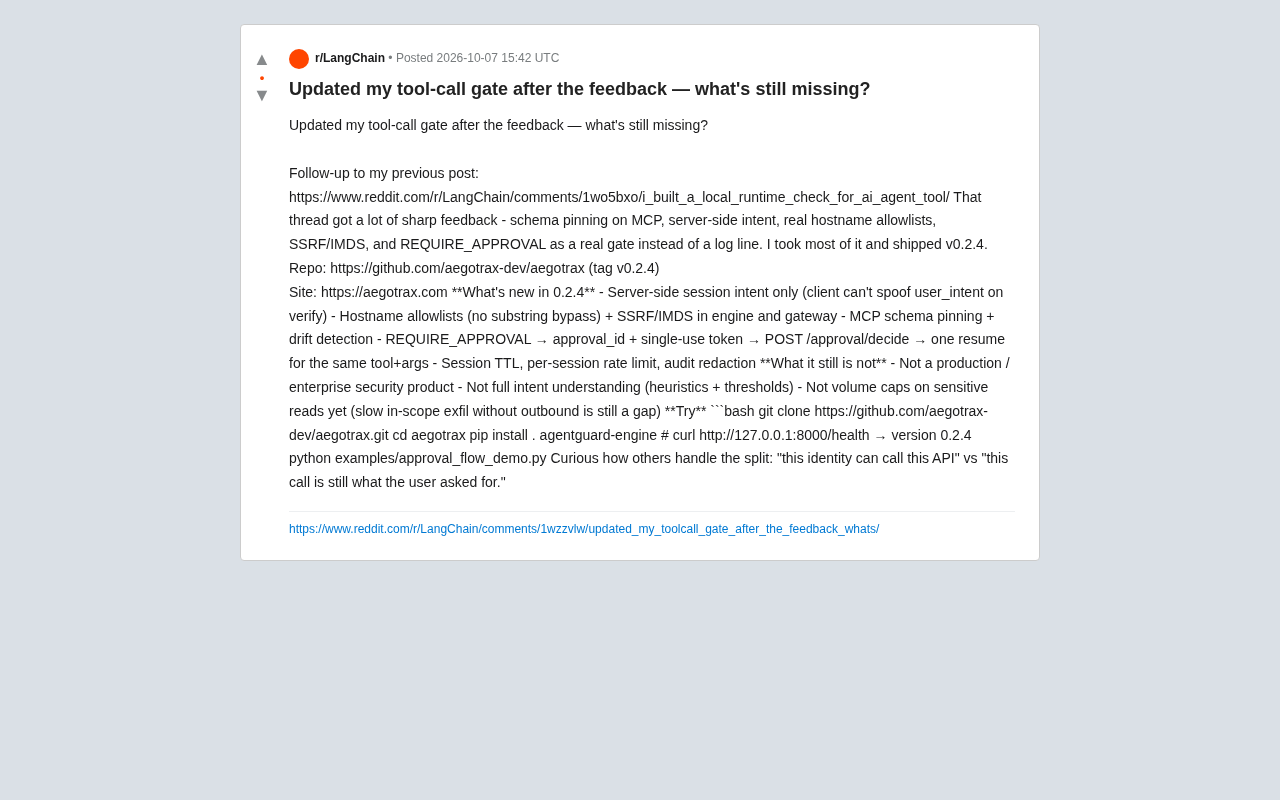
Aegotrax v0.2.4 explores LLM Agent tool-call security via server-side intent checks, approval gates, and schema pinning.
As LLM Agents move from answering questions to executing real actions, ensuring every tool call matches the user's actual intent becomes a critical security challenge. Aegotrax v0.2.4 addresses community feedback with key hardening measures: server-side intent validation, hostname allowlists with SSRF/IMDS protection, MCP schema pinning with drift detection, and a real one-time-token blocking approval flow to replace what was previously just a log entry. The author candidly acknowledges remaining blind spots — particularly slow, in-scope data exfiltration. Ultimately, the project highlights Agent security's core divide: traditional IAM answers "can it call," while intent consistency must answer "should it call" — a question permission models alone cannot solve.
When AI Agents Start Calling Tools, Where Is the Security Boundary?
As LLM Agents evolve from simple Q&A into genuine "executors" — calling APIs, reading databases, triggering external services — a long-neglected question has come to the surface: How do we ensure that every tool call an Agent makes is an operation the user actually authorized?
A developer shared their ongoing exploration of this problem in Reddit's r/LangChain community. After a previous post on "runtime checks for AI Agent tool calls" drew significant feedback, they iterated based on community input to produce Aegotrax v0.2.4 — and once again asked a core question: What am I still missing?
What makes this project worth paying attention to isn't whether it's mature (the author openly admits it's far from an enterprise-grade security product), but rather how clearly it outlines a security challenge that is taking shape in the age of Agents.
What Security Vulnerabilities Did v0.2.4 Fix?
The feedback on the previous version was sharp, zeroing in on several classic attack surfaces. The author addressed each one in v0.2.4, and the resulting changelog itself serves as a practical Agent security hardening guide.
Preventing Client-Side Intent Forgery
The new version moves session intent entirely to the server side. This means clients can no longer forge a user_intent parameter during the verify phase. This is a critical design decision — if intent validation happens on the client, a malicious caller only needs to forge a "legitimate intent" to bypass all checks. Pulling the trust boundary back to the server is a foundational principle of any security system.
Closing Off Network-Layer Attacks
v0.2.4 introduces a hostname allowlist with an explicit note: "no substring-match bypasses." This detail matters: naive allowlist implementations often use substring matching, allowing an attacker to trick a trusted.com check using a domain like evil-trusted.com.
Both the engine and gateway layers also gained SSRF/IMDS protection. Blocking SSRF (Server-Side Request Forgery) and access to cloud metadata services (IMDS, such as AWS's 169.254.169.254) is the standard defense against an Agent being manipulated into stealing cloud credentials. For any Agent that actively makes network requests, this is essentially a mandatory safeguard.
SSRF (Server-Side Request Forgery) is a classic class of network attack: by crafting malicious input, an attacker tricks the server (in this case, the Agent) into making requests to internal addresses of the attacker's choosing. In cloud environments, the most dangerous target for such an attack is the IMDS (Instance Metadata Service) — cloud platforms like AWS, GCP, and Azure host this service at a reserved IP (e.g., 169.254.169.254 on AWS) to distribute temporary credentials, IAM role information, and other sensitive data to VM instances. If an Agent is manipulated into accessing this address, the attacker can use it to obtain high-privilege cloud account credentials and ultimately take control of the entire cloud infrastructure. For LLM Agents, prompt injection is the typical path to triggering SSRF: an attacker embeds instructions in content the Agent processes (web pages, documents, database return values) to drive the Agent into making malicious requests, potentially bypassing user awareness entirely.
MCP Schema Pinning and Drift Detection
For the Model Context Protocol (MCP), the new version adds schema pinning + drift detection. Agents rely on tool interface definitions to determine how to make calls; if an underlying tool's schema is quietly altered at runtime (drift), the Agent could be guided into performing entirely different operations. Pinning the schema and detecting drift is a defense against "supply-chain-style" attacks.
Model Context Protocol (MCP) is an open protocol introduced by Anthropic in late 2024, designed to standardize how LLMs connect with external tools and data sources. Its core design: tools describe their capabilities and parameter formats via a structured schema, which the LLM uses to decide how to construct call requests. This improves the composability of tool calls but introduces a new attack surface — if a tool's schema is quietly modified at runtime (schema drift), the LLM will continue to trust and follow the new description, potentially being guided into executing completely different operations. This type of attack is essentially a supply-chain attack: rather than targeting the LLM itself, it tampers with the "instruction manual" the LLM depends on. The schema pinning defense works by locking the hash or signature of the tool interface at initialization time, then continuously comparing against it at runtime — triggering an alert or refusing the call the moment any deviation is detected, blocking this style of "man-in-the-middle" tampering.
From a Log Line to a Real Approval Gate
In the previous version, REQUIRE_APPROVAL was just a log entry — it would mark an operation as "requires approval" but didn't actually block it. Community feedback cut right to the heart of this: an approval mechanism that only logs without blocking is meaningless.
v0.2.4 transforms it into a complete approval flow: generate an approval_id and one-time token → make a decision via POST /approval/decide → execute a single resume for that specific tool+args combination.
The elegance of this design lies in the "single-use" and "tool+args binding" properties. Once an approval is granted, the token can only be used for that one specific call with those exact parameters — it cannot be replayed or applied to any other operation. Combined with newly added session TTL, per-session rate limiting, and audit log redaction, the entire gate system has been upgraded from "observer" to true "gatekeeper."
Three Blind Spots the Author Openly Acknowledges
The most valuable aspect of this project is the author's clear-eyed awareness of its own limitations. They explicitly list what Aegotrax is "not yet":
- Not a production/enterprise-grade security product — still in the exploration phase;
- Not complete intent understanding — currently relies on heuristic rules and threshold judgments rather than genuinely understanding user intent;
- No rate limits on sensitive reads — "slow in-scope exfiltration" remains an unresolved gap when there's no outbound network access to block.
That last point is especially worth sitting with. Even if all outbound network connections are blocked, a compromised Agent could still continuously read sensitive data at an extremely slow pace — all within its authorized scope — and ultimately complete an exfiltration. These attacks are extremely difficult to detect precisely because "every step is compliant." This is the genuinely hard problem at the heart of Agent security.
The Core Tension: Identity Authorization vs. Intent Consistency
The question the author poses at the end of the post strikes at the fundamental divide in Agent security:
"Can this identity call this API" vs. "Is this call still what the user asked for"
The former is a traditional Identity and Access Management (IAM) problem — technically quite mature, handled through static authorization based on roles, permissions, and API keys. But the latter is an entirely new challenge: an Agent having permission to call a certain API doesn't mean its current call reflects the user's actual intent.
An Agent compromised by prompt injection may operate entirely within its authorized scope while doing things the user never asked for. This is the core challenge of "intent consistency" — it cannot be solved with traditional permission models, because the question isn't "can it" but "should it."
Currently, Aegotrax uses heuristic rules and thresholds to approximate this judgment, but the author themselves admits this is far from "complete intent understanding." This is perhaps exactly where future Agent security infrastructure needs to focus: how to continuously verify, at runtime, that every tool call remains consistent with the user's original intent.
Prompt injection is currently one of the most closely watched attack vectors in Agent security. Similar to traditional SQL injection, it exploits the blurry boundary between "data" and "instructions": when an Agent processes content from external sources (web page summaries, email bodies, database results), an attacker can embed text disguised as user instructions within that content, steering the LLM away from its original task to execute attacker-specified operations. Indirect prompt injection is particularly insidious — the attacker doesn't need to interact with the Agent directly; they only need to pre-plant malicious instructions in a data source the Agent will access, then wait for the Agent to "read" and execute them. This is precisely what makes the intent consistency problem so difficult: an injected Agent operates entirely within its authorized scope, appearing fully compliant from a permission-model perspective, yet executing the attacker's intent rather than the user's. No mature, universal defense exists in the industry today; input filtering, sandbox isolation, and runtime behavioral verification tools like Aegotrax can only partially mitigate the risk, not eliminate it.
What This Means for Agent Developers
Whether or not you use Aegotrax, the iteration process behind this open-source project offers a valuable checklist. When building Agents that call tools, you should at minimum consider:
- Is intent validation happening on the server side?
- Do network requests have an allowlist and SSRF/IMDS protections?
- Could tool schemas be tampered with at runtime?
- Do high-risk operations have a truly blocking approval flow, rather than just logging?
- Are there rate limits on sensitive data reads?
The project is open source on GitHub (aegotrax-dev/aegotrax, tag v0.2.4) and can be run locally via pip install . to try the approval flow demo. For Agent developers moving from "it runs" to "it runs safely," this kind of exploration is worth tracking closely.
Related articles

Cursor AI Programming in Practice: Build a Student Management System from Scratch in 30 Minutes
A Bilibili creator demonstrates Cursor AI programming: generating a student management system in 30 minutes with natural language. Details on Agent mode, Claude selection, prompt techniques, and thresholds.

Top 20 AI Coding Tools Ranking: From Rock-Solid to Lackluster, a Scored Matrix
Bilibili creator releases top 20 AI coding tools ranking, tiered T0–T4 from rock-solid to lackluster, with Claude Code and Codex tied at T0. This article details the scoring dimensions (capability, reliability, robustness, durability, cost, domestic availability) and tool performances to help developers choose the right AI coding assistant.

Vibe Coding Systematic Tutorial: Master AI-Assisted Programming from Zero
A three-month Vibe Coding tutorial from a Bilibili creator covering Codex, ClaudeCode, and Cursor, from core logic to commercial project practice for beginners.