AI Agents Acting on Your Behalf: How Will You Explain What They Did Six Months Later?
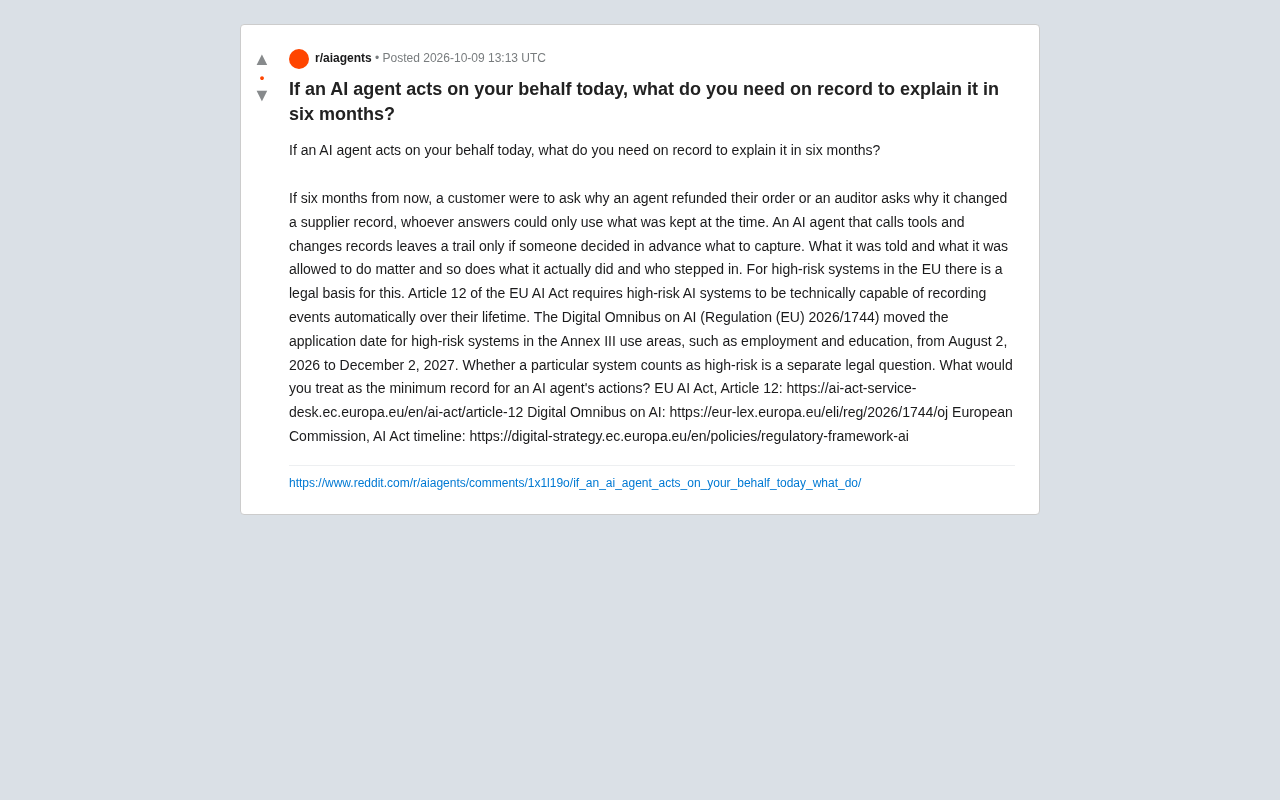
AI agent audit trails must be designed upfront — traceability is the entry ticket to production-grade deployment.
When AI agents are authorized to execute real business operations like refunds and record modifications, the inability to reconstruct logs after the fact becomes a core governance challenge. Drawing on a Reddit discussion, this article maps out four essential dimensions of a traceable AI agent record: what it was told, what it was allowed to do, what it actually did, and who intervened. Legally, EU AI Act Article 12 already mandates automatic lifecycle logging for high-risk AI systems. The conclusion: governance design must precede deployment, compliance and engineering teams must collaborate at the architecture stage, and traceability is no longer optional — it's the baseline requirement for any AI agent operating in production.
When an AI agent processes a refund, modifies a vendor record, or handles an HR decision on your behalf, a long-overlooked question comes to the surface: six months later, when a customer or auditor asks "why did it do that?", what evidence do you actually have?
This is the core question raised in a Reddit community discussion. It may look like a technical topic, but it cuts to the heart of one of the thorniest governance challenges in AI agent deployment — auditability.
The Core Problem: You Can't Reconstruct Logs After the Fact
The original poster laid out a sharp scenario: suppose six months from now, a customer asks why the agent refunded their order, or an auditor questions why the agent changed a vendor record. The only people who can answer those questions are those who have access to data that was preserved at the time.
This exposes the fundamental vulnerability in AI agent governance: logs cannot be reconstructed after the fact. An AI agent that calls tools and modifies records will only leave a traceable trail if someone decided in advance what to capture. If nothing was recorded at the time, no amount of investigation six months later will recover it.
This shares some logic with traditional software logging, but AI agents are different in a critical way: their action chains are longer and their decision-making is far less transparent. Four dimensions must all be captured: what instructions it received, what it was authorized to do, what it actually did, and who intervened along the way.
What a Complete Behavior Record Should Contain
The original post broke down the traceable record of an AI agent into several key layers, each worth examining in turn.
What it was told
The input instructions, context, and prompts the agent received. This establishes the starting point for its decisions. Without this layer, there's no way to determine whether the agent followed its instructions or deviated from them.
What it was allowed to do
The agent's permission boundaries and the scope of tools it could invoke. Whether high-risk operations like refunds or record modifications fell within its authorized scope is central to any question of accountability.
What it actually did
The real sequence of actions the agent executed — which tools it called, what parameters it passed, what data it changed. This is the most direct form of behavioral evidence.
Who stepped in
The record of human intervention. In human-in-the-loop scenarios, when and how a human intervened often determines how responsibility for the final outcome is assigned.
These four elements together form the foundation of a minimum viable explainable record. The original post also posed an open question to the community: What do you think the minimum record of an AI agent's behavior should include?
Human-in-the-Loop (HITL) is an architectural pattern in AI system design that mandates a human review or approval step before the AI executes critical decisions. It comes in several variants: Human-in-the-Loop requires human approval for every high-risk action; Human-on-the-Loop allows the AI to act automatically while humans monitor in real time and can intervene; Human-out-of-the-Loop is fully automated. In audit contexts, recording only "what the AI did" is often insufficient — you must also record "which node should have had human oversight but didn't." This kind of negative record is equally critical evidence for accountability. As AI agents are authorized to execute high-impact operations like refunds and contract modifications, organizations need to define the required intervention level for each operation type at the architecture stage, and treat the intervention decision itself — including approver identity, timestamp, and rationale — as mandatory log fields.
The EU AI Act Already Provides a Legal Basis
This isn't just spontaneous thinking from the tech community — in the EU, it now has a clear legal foundation.
Under Article 12 of the EU Artificial Intelligence Act, high-risk AI systems must be technically capable of automatically logging events throughout their entire lifecycle. In other words, for high-risk systems, maintaining an audit trail is no longer optional — it is a statutory technical requirement.
The compliance timeline has also recently shifted. As cited in the original post, the AI Digital Integration Act (Regulation (EU) 2026/1744) has pushed back the applicability date for Annex III high-risk use cases — such as employment and education — from August 2, 2026, to December 2, 2027.
However, the post also includes an important caveat: whether any specific system qualifies as "high-risk" is itself an independent legal determination. Not all AI agents automatically fall into the high-risk category — but that's precisely why organizations need to clarify their system's classification well in advance.
The EU Artificial Intelligence Act (EU AI Act, Regulation (EU) 2024/1689) entered into force in August 2024, making it the world's first comprehensive legislation systematically regulating AI. The Act uses a risk-tiered framework, classifying AI systems into four categories: unacceptable risk, high risk, limited risk, and minimal risk. Annex III explicitly enumerates typical high-risk AI scenarios, covering employment and workforce management (e.g., CV screening and performance evaluation), education and vocational training (e.g., grading), and access to essential private services (e.g., credit scoring). Article 12 specifically establishes logging obligations for high-risk AI systems, requiring them to automatically capture event data sufficient to trace their operational state throughout the system lifecycle — including but not limited to activation and deactivation records, input data characteristics, and output results. The core logic of this provision is that accountability must be underpinned by technical traceability; otherwise, regulators conducting post-incident investigations will find themselves with nothing to audit.
Practical Implications for AI Agent Deployment
This discussion yields several insights worth taking seriously by practitioners.
Governance design must come first. Logging strategy, authorization boundaries, and intervention recording mechanisms all need to be designed before the system goes live — not patched in after something goes wrong. Once an AI agent's action has occurred without being recorded, its explainability is permanently lost.
Compliance and engineering must work together. Article 12 of the EU AI Act turns "automatic logging" into a technical compliance requirement, which means legal, compliance, and engineering teams need to be in the same room at the architecture stage — jointly defining what to log, how long to retain it, and who can access it.
Traceability is the foundation of trust. Whether facing customers, auditors, or regulators, only a system that can clearly reconstruct "why the agent did what it did" is qualified to be deployed at scale in high-stakes scenarios. This is the dividing line between an AI agent as a "flashy demo" and one as a "production-grade trustworthy system."
As AI agents are increasingly authorized to execute real business operations, "explainable, traceable, and accountable" will no longer be a bonus — it will be the price of admission. Fail to build proper logging today, and six months from now, you'll have nothing to show.
Related articles

Cursor AI Programming in Practice: Build a Student Management System from Scratch in 30 Minutes
A Bilibili creator demonstrates Cursor AI programming: generating a student management system in 30 minutes with natural language. Details on Agent mode, Claude selection, prompt techniques, and thresholds.

Top 20 AI Coding Tools Ranking: From Rock-Solid to Lackluster, a Scored Matrix
Bilibili creator releases top 20 AI coding tools ranking, tiered T0–T4 from rock-solid to lackluster, with Claude Code and Codex tied at T0. This article details the scoring dimensions (capability, reliability, robustness, durability, cost, domestic availability) and tool performances to help developers choose the right AI coding assistant.

Vibe Coding Systematic Tutorial: Master AI-Assisted Programming from Zero
A three-month Vibe Coding tutorial from a Bilibili creator covering Codex, ClaudeCode, and Cursor, from core logic to commercial project practice for beginners.