AI Agents Claimed to Discover a Maya Site—Why Archaeologists Pushed Back
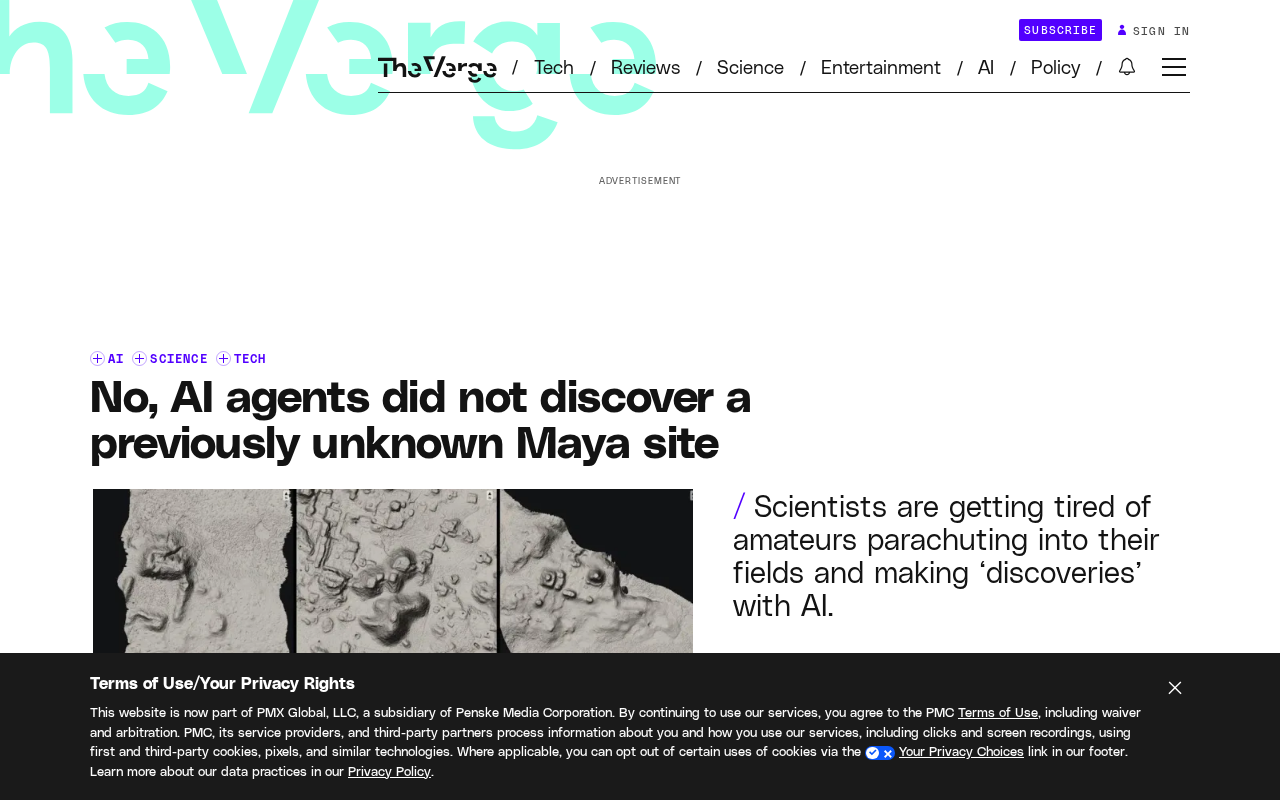
A Google researcher claimed AI agents discovered a Maya site, but it was already published last year, prompting archaeologists to criticize AI overhyping.
Google researcher Pietro Miotti claimed AI agents discovered a Maya site in Mexico, but it was pointed out that the site had already been published in an academic journal last year. Archaeologists criticized the claim for equating AI model candidate outputs with scientific discovery and skipping field surveys, stratigraphic analysis, and peer review. The incident exposes unclear confidence boundaries in AI-assisted remote sensing: models can flag high-probability areas but cannot declare a "new discovery." The article notes that AI's real value in archaeology lies in narrowing survey scope and assisting remote sensing interpretation, not replacing fieldwork. Unverified "AI breakthroughs" can undermine public trust in AI-assisted research, and AI practitioners should clearly communicate uncertainty levels in outputs.
A "Discovery" That Sparked Controversy
This week, Google researcher Pietro Miotti claimed that, with the help of a group of AI agents, he had discovered a potentially unrecorded Maya site in Mexico. The news spread quickly across social networks. But it wasn't long before people pointed out: this site had already been discovered, and had been published in an academic journal last year.
According to the original report, the incident drew criticism from archaeologists. What looked like an exciting "AI archaeology breakthrough" turned into an overhyped portrayal of AI capabilities within hours. The issues behind this are far more worth examining than a simple "duplicate discovery."

Recapping the Event: What the AI Agents Did
Miotti's team used multiple AI agents working in coordination to try to identify potential archaeological sites from public data. From a technical standpoint, this is a classic case of "AI-assisted remote sensing"—using satellite imagery, terrain data, and other public information to identify possible traces of human-made structures through models.
The problem is that the output of this method is "candidate areas," not "confirmed discoveries." Archaeological discovery requires field surveys, stratigraphic analysis, and peer review. Miotti's claim skipped these steps and directly equated algorithmic output with an academic discovery. According to public criticism from archaeologists, a paper on this site was already published last year, meaning the AI agents merely "rediscovered" known information—which may be meaningful at the level of information retrieval, but is far from a "discovery of an unknown site."
AI-assisted remote sensing archaeology refers to the use of remote sensing data such as satellite imagery, aerial photography, and LiDAR, combined with machine learning or deep learning models, to automatically identify possible traces of human-made remains on or near the surface. Common technical approaches include: anomaly detection on multispectral imagery, using convolutional neural networks to identify linear structures (such as roads or canals), or extracting building foundations from LiDAR point clouds after removing vegetation. The output of this method is typically "candidate areas" or "probability maps," which archaeologists must verify through field reconnaissance, surface collection, or excavation. Therefore, remote sensing itself is not equivalent to discovery—it is a preliminary screening step that narrows the scope of investigation.
Why Archaeologists Reacted So Strongly
Archaeology has a strict definition of the word "discovery." For a site to be "discovered" typically means it has been recorded and described for the first time in the scientific literature and verified in the field. Calling the candidate output of an AI model a "discovery" is, in the eyes of the professional community, a substitution of concepts.
The deeper concern is that incidents like this undermine public trust in AI-assisted research. When "AI discovery" becomes an attention-grabbing label that cannot withstand basic fact-checking, genuine AI archaeology applications—such as using machine learning to accelerate site surveys or assist in interpreting remote sensing imagery—end up being drowned out by the noise.
The definition of "discovery" in archaeology carries a strict consensus within the discipline: for a site to be recognized as "discovered," it typically must be recorded and described for the first time in the scientific literature and verified in the field, or at least published through peer-reviewed academic work. Merely identifying an anomalous structure in satellite imagery does not constitute a discovery, because the structure could be a natural landform, a modern artifact, or a known site that has already been recorded but not retrieved. Academic publication itself includes a literature review step, requiring authors to confirm whether the same site has been previously reported. In the Miotti case, a paper on the site had already been published last year, indicating that the AI agents did not generate new knowledge but missed the literature comparison—precisely the situation that the academic verification process is designed to prevent.
Where AI's Real Value in Archaeology Lies
AI is indeed changing some of archaeology's workflows. The combination of public satellite data and deep learning has helped researchers in multiple regions narrow the scope of investigations and identify surface anomalies. But the value proposition of these tools is "assistance" and "screening," not "replacing fieldwork" or "skipping academic verification."
A healthy collaboration model should be: AI models flag high-probability areas from massive datasets, and archaeologists then conduct field reconnaissance and literature comparison. The problem with the Miotti incident is not that AI was used, but that the candidate results of an assistive tool were packaged as definitive discoveries.
Typical applications of deep learning in remote sensing archaeology have been validated by multiple public studies for their assistive value. For example, convolutional neural networks have been used for surface anomaly detection on satellite imagery, helping researchers narrow the scope of investigations in regions such as Mesopotamia and Mesoamerica; LiDAR point clouds have been combined with vegetation removal to identify building foundations and water management systems in the Maya lowlands; and machine learning has been used to prioritize large volumes of remote sensing imagery for archaeological teams to plan survey routes. What these efforts share is that model outputs are explicitly labeled as "high-probability candidate areas," accompanied by confidence scores and false-positive rate analyses, and are ultimately confirmed by archaeologists through fieldwork. AI's value lies in improving survey efficiency and reducing labor costs, not in replacing field verification or bypassing peer review.
What This Controversy Teaches AI Practitioners
For AI researchers and product teams, this incident offers a clear lesson: when deploying agents in professional domains, the "confidence boundaries" of output must be clearly communicated. A model can say "there may be a structure here," but it cannot say "there is a new site here." The former is a technical judgment; the latter is an academic claim, and between the two lies a verification process.
According to the original report, the incident has drawn widespread criticism in online communities of archaeologists. For teams eager to showcase AI capabilities, an unverified claim of "breakthrough" may do more damage to credibility than not publishing at all.
Confidence boundaries and output grading are key design principles when deploying AI systems in professional domains. Every result output by a model should come with a clear measure of uncertainty—such as probability values, confidence intervals, or false-positive rates—and should distinguish between levels such as "candidate," "high probability," and "confirmed." In archaeological contexts, a model can only say "a human-made structure may exist here," not "there is a new site here," because the latter implies conclusions from field verification and academic review. Product teams should clearly label the evidence level of outputs in interfaces and documentation to prevent users from misreading algorithmic output as definitive conclusions. This principle applies equally to high-stakes domains such as healthcare and finance, and is a basic requirement for trustworthy AI deployment.
Conclusion: AI Doesn't Need Mythmaking—It Needs Rigor
The potential of AI agents in archaeology and other fields is real, but potential is not achievement. The core lesson of the Miotti incident is not that "AI doesn't work," but that "equating AI output directly with scientific discovery" doesn't work. Whether you are a researcher or a communicator, when releasing AI-related results, first answer a basic question: has this conclusion been verified within the field?
If the answer is no, then no matter how dazzling the agent demo, it is just a demo.
Related articles

Gemini 4 Neon Review: Benchmark Scores Rival Carbon, API Pricing and Quota Breakdown
Google Gemini 4 Neon is now live, benchmark scores closely tracking Carbon, API pricing 3/15 at twice Hydrogen's rate. This article compiles Bilibili creator testing: Neon can replace 90% of Carbon scenarios, AntiGravity quota consumption is only one-third of Carbon, plus subscription channel restrictions and 2API ban risks.

Gemini 4 Helium Coming Soon? Signals of Google Loosening Subscription Restrictions
Google team member hints releases will continue; community speculates Gemini 4 Helium (Flash Lite) may be next. Subscription ban controversy gets a response as product lead says "Soon," suggesting restrictions may be lifted. This article covers Gemini developments, OpenAI Coding Agent and risk management, Doubao real-time audio-video API, and compute business dynamics.

AI-Assisted React Development in Practice: Optimizing a Video App and Handling Errors
A 14-year veteran developer demonstrates AI-assisted React video app optimization: compressing video from 80MB to 5MB (~94%) via ImageKit, plus reliable error handling and retry mechanisms. Includes planning, code understanding, and verification methods for working with AI.