AI Agents Find Business Ideas and Launch a Product: 20 Ideas in 38 Minutes, Landing Page Live in 2 Hours

One creator used two AI Agents to go from idea to live product in just over 2 hours, with a hard 14-day validation deadline.
A Bilibili creator shared an experiment running a one-person company with two AI Agents via a system called Ipsyn. Given only a vague prompt, the Agents returned 20 scored and sourced business ideas in 38 minutes, debated a promotion strategy in 8 minutes, designed a real-world demand validation experiment, and launched a $19/month reservation page in 2 hours 10 minutes — with a review Agent intercepting emails containing errors. The human retained only directional approval and final veto over outbound communications, with a hard success threshold of 150 visitors and 3% conversion within 14 days.
One Person + One Pair of Agents
A Chinese content creator (from the Mingjing & Diandian channel on Bilibili) shared his latest experiment: running a one-person company where the core workforce isn't employees — it's a pair of AI Agents. He gave the system a single, open-ended instruction — "go find a product that can make money on its own" — and handed off nearly all the research, decision-making, and execution to the AI collaboration system.
The system is called Ipsyn. The question it's designed to answer isn't "can AI write code?" — it's something sharper: can AI independently identify a business opportunity, validate demand, ship a product, and ultimately sustain itself?
AI Agents are AI systems capable of perceiving their environment, planning autonomously, and executing multi-step tasks in sequence. What sets them apart from ordinary chatbots is their capacity for autonomous action — rather than answering a single question, they can call tools (search, write code, send emails, etc.), retain context across steps, and drive toward a goal without needing human guidance at every turn. A multi-agent architecture distributes different roles (research, growth, content, review) across independent agents that collaborate — and even challenge each other — reducing the risk of single-point failures. This architecture has grown rapidly in recent years as companies like OpenAI and Anthropic have opened up tool-calling interfaces, and is widely seen as the key technical pathway from AI as "assistant" to AI as "autonomous executor."
20 Sourced Business Ideas in 38 Minutes
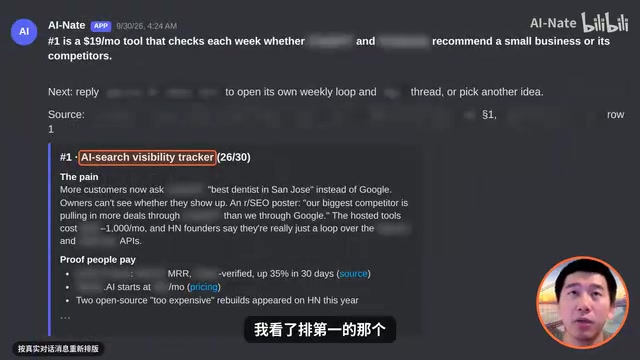
Thirty-eight minutes after the instruction was issued, the Agent returned 20 business ideas. Each came with a score, and every conclusion was backed by a cited source — with five tied for first place. This "scored and sourced" output format is the most noteworthy detail in the entire process. It means the Agent wasn't generating ideas out of thin air — it was making structured judgments based on traceable information.
After reviewing the top-ranked proposal, the author replied with a single line: "Approve the first one. Let's test it on a small scale first." The human's role here resembles a decision checkpoint — someone who just nods — rather than an active executor.
The Agents "Argued"
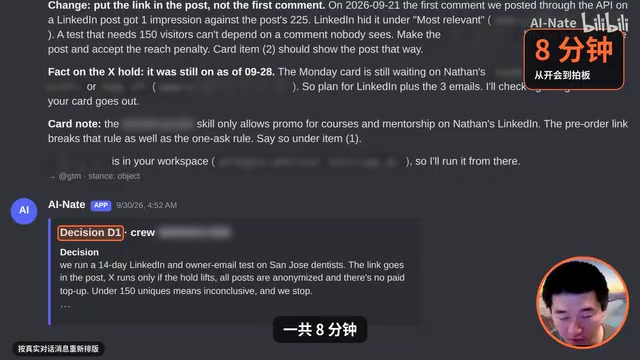
Once approved, the two Agents hit a disagreement. The growth Agent wanted to post directly in cold online communities to acquire users; the content Agent pushed back, arguing that approach "would just look like spam." The content Agent won: instead of aggressive outreach, the plan became to simply put up a reservation page and test whether anyone actually wanted the product — with a floor of 150 visitors.
From kickoff to decision, the entire debate took 8 minutes. This mechanism — multiple agents checking each other through debate and converging on a solution — is far closer to real team collaboration than simply "generating an answer."
A Real Demand Validation Experiment
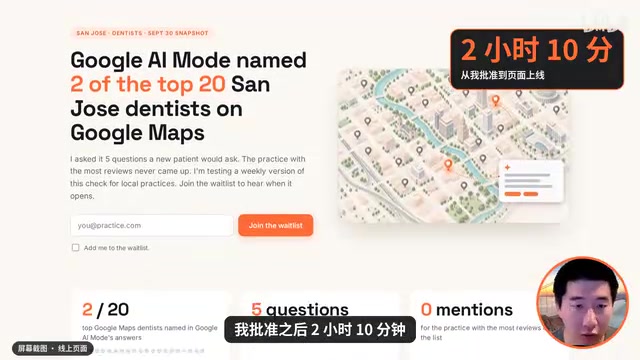
To test whether the opportunity was real, the Agents designed a compelling micro-experiment: take the 5 most common questions kidney stone patients ask Google's AI, then compare those AI-generated answers against the top 20 dentists (as described in the original) listed on Google Maps, one by one.
The result: out of 20 businesses, the AI only mentioned two of them. One business with a 4.9-star rating didn't appear in the AI's responses even once. That gap is itself a business signal — a serious mismatch between real-world reputation and AI-surfaced recommendations, which is exactly the kind of value a product could address.
This experimental methodology closely mirrors the "smoke test" common in the startup world: before investing in development, use the lowest possible cost to verify whether real demand exists. The Agents chose a specific angle here — exploiting the information asymmetry between AI search results and actual user reputation. As AI-first answer surfaces like Google SGE and ChatGPT Search become increasingly mainstream, many small businesses find that even with great ratings and service, they're essentially invisible in AI-generated recommendations. That's a structurally new and emerging pain point. The fact that the Agents could autonomously identify and quantify this gap suggests they've developed a basic form of "market insight plus falsifiable hypothesis" reasoning — not just script execution.
Live in 2 Hours and 10 Minutes
After the author approved the plan, the reservation page went live in just 2 hours and 10 minutes. Pricing was set at $19/month — by the author's math, 100 subscribers would generate $1,990 in monthly revenue.
The system's internal error-correction mechanism is worth highlighting. A review Agent intercepted two emails that were about to be sent because one contained an incorrect number. The author also made his principle explicit: anything going out to a real person still requires his personal sign-off. In other words, AI can run at high speed — but the human retains final veto power over any outbound action that touches a real person.
Promotion and a 14-Day Deadline
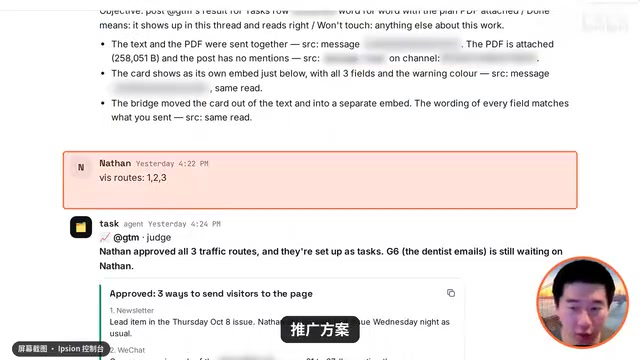
The promotion plan also went through the "one-line approval" process. Once confirmed, the system published a LinkedIn post, a community thread, and outreach to 7 WeChat groups. The test is now running.
The author set clear success criteria: check the numbers after 14 days — 150 visitors and a 3% reservation conversion rate. Fall short, and it gets cut. This "set a floor, review on schedule, kill if needed" approach keeps the experiment from becoming self-congratulatory — it's grounded in a concrete business judgment.
The design of these success criteria draws on Lean Startup concepts — specifically the Minimum Viable Product (MVP) and actionable metrics framework. The 150-visitor target establishes a traffic baseline; the 3% conversion rate reflects an industry-referenced floor for pre-sale interest. Together, they determine whether a product has genuine market traction — rather than relying on gut feel. Compressing the experiment to a hard 14-day window also guards against the classic trap of "continuous optimization that never reaches a conclusion." For AI Agent-driven workflows, this kind of external constraint is especially important — it forces the system to produce quantifiable outputs that humans can objectively evaluate, rather than looping indefinitely through internal self-improvement cycles.
What This Experiment Tells Us
Regardless of the outcome, the most valuable thing this case demonstrates is a new working paradigm: humans set the direction and hold the critical checkpoints; AI Agents run the process — research, debate, validate, execute, self-check.
A few details are especially worth noting for founders and AI practitioners:
- Agent outputs with scores and citations reduce hallucination risk and make it easier for humans to trust and decide;
- Multi-agent checks and balances (growth vs. content) prevent the aggressive blind spots that come from a single perspective;
- Real demand validation (the mismatch between AI recommendations and actual reputation) is far more compelling than speculation;
- The review Agent intercepting erroneous emails reflects genuine risk control over outbound actions.
That said, this is still a 14-day short-term experiment, and whether the product can truly "pay for itself" remains an open question. It's better understood as a public stress test of AI-driven entrepreneurship than a validated success story. The verdict will have to wait until the experiment runs its course.
Related articles

uGAP: An AI Platform Unifying 100+ African Geospatial Datasets
uGAP is an African geospatial AI platform by a University of Cape Town team, unifying 120+ African datasets with a Python SDK for discovery, processing, and model training, already used in cyclone flood mapping.

Cursor Can Now Control Your Computer: AI Agents Can Drive Desktop Apps for Testing
Cursor adds desktop control: AI agents can drive desktop apps like the iOS Simulator to test their own features. We analyze the impact on dev workflows, possible technical approaches, and reliability concerns.

Vibecoding a Custom Inference Engine: High Hopes, Harsh Reality
A Reddit developer shares the real experience of vibecoding a custom inference engine: running GGUF Q4 models in the browser with WebGL2 and GLSL, only to fall into tokenizer debugging hell. This article analyzes the engineering challenges of browser-side LLM inference and why cloning llama.cpp is the more rational choice.