AI and Humans Team Up to Crack the Riemann Hypothesis? The Truth Behind a 167-Year-Old Math Problem
Rumors claim AI and humans proved the Riemann Hypothesis, but there is no authoritative confirmation—computer verification is not proof.
The article examines the online rumor that AI and humans have proven the Riemann Hypothesis. It explains the conjecture's core—prime distribution and the non-trivial zeros lying on the critical line with real part 1/2—and reviews the rumor of a 17-million-line proof code passing independent verifiers. It stresses that computer verification is not a proof covering infinitely many cases, and that creative reasoning remains human-led.
Introduction: An Unsolved Math Problem
There is a famous conjecture in mathematics that has puzzled humanity for over a century and a half since it was first proposed. It concerns the deep patterns in the distribution of prime numbers and is one of the Millennium Prize Problems with a million-dollar bounty from the Clay Mathematics Institute. Recently, a claim has been circulating online: AI and humans working together have finally proven the Riemann Hypothesis. Is this a breakthrough or a misunderstanding? This article breaks down the core content of the Riemann Hypothesis, the details of the rumors about AI involvement, and the essential requirements of a mathematical proof.
What Is the Riemann Hypothesis?
Primes: The Atoms of Numbers
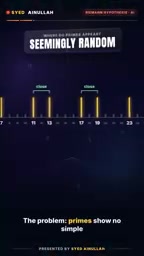
A prime number is a natural number that can only be divided by 1 and itself, such as 2, 3, 5, 7, 11, 13… They are the basic building blocks of all natural numbers, which is why they are often called "the atoms of numbers." For example, 12 can be factored into 2×2×3. The distribution of primes appears random—sometimes they cluster densely in certain intervals, and other times they are far apart.

The Contributions of Gauss and Riemann
The mathematician Gauss proposed an approximation formula for estimating the number of primes within a given range. Although effective, there is a small discrepancy between the actual prime count and the estimated value. Riemann built on this by introducing a special function—the Riemann zeta function. You can think of it as a machine: you input a number, and it outputs another number. At certain specific input points, the machine outputs zero, and these points are called zeros. The Riemann Hypothesis asserts that all non-trivial zeros lie on the line in the complex plane where the real part is 1/2 (the critical line).
If the conjecture holds, the "randomness" of primes would be constrained within certain bounds, which has profound implications for number theory and cryptography.
The Riemann zeta function and analytic continuation: The Riemann zeta function is initially defined as the infinite series ζ(s) = 1 + 1/2^s + 1/3^s + …, which converges only when the real part of s is greater than 1. Riemann's key contribution was to extend this function to the entire complex plane (except for a pole at s=1) through "analytic continuation." After continuation, the function takes the value zero at negative even numbers, which are called "trivial zeros"; the remaining zeros are the "non-trivial zeros," which are symmetrically distributed within the critical strip 0 < Re(s) < 1. The Riemann Hypothesis asserts that the real part of all non-trivial zeros is exactly 1/2. This symmetry is closely related to the error term in the prime counting formula and is the mathematical foundation for understanding why the conjecture matters.
The Rumors and Truth About AI-Human Collaborative Proofs
The Source of the Rumors
According to claims circulating online, a mathematician collaborated with an AI company, using AI to assist in completing a proof consisting of approximately 17 million lines of code, and claimed that the proof passed checks by multiple independent verifiers. The reports also mentioned that the proof even verified a broader version.
The Millennium Prize Problems: In 2000, the Clay Mathematics Institute announced seven "Millennium Prize Problems," each offering a $1 million prize for the first correct proof. The Riemann Hypothesis is one of them; the others include P vs NP, the Hodge conjecture, the Poincaré conjecture (solved by Perelman in 2003), Yang-Mills existence and mass gap, Navier-Stokes existence and smoothness, and the Birch and Swinnerton-Dyer conjecture. These problems represent core unsolved directions in mathematics. Any proof claiming to solve one of them must undergo extremely rigorous peer review, typically taking years before being widely accepted.
The Standards of Mathematical Proof
A mathematical proof requires every step to be logically rigorous and widely accepted by peers. Although computer-assisted proofs can verify massive computations, human mathematicians must still understand the overall logic of the proof. Currently, the Riemann Hypothesis has not been formally proven, and any claimed proof requires rigorous peer review.
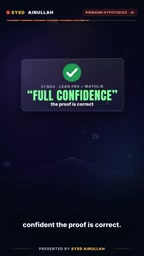
Computer-assisted proofs and verifiers: Computer-assisted proofs typically refer to the use of software for large-scale computations or logical deductions—for example, the proof of the Four Color Theorem relied on computers to check a large number of configurations. Modern proof assistants (such as Coq, Lean, and Isabelle) allow mathematicians to formalize proofs as code, with a kernel automatically checking whether each step of reasoning conforms to logical rules. However, formal verification only guarantees that "if the code is correct and the axioms are consistent, then the theorem holds"; it does not automatically mean that humans understand the overall idea of the proof. For a profound problem like the Riemann Hypothesis, even if a formal proof exists, human mathematicians would need to analyze its structure, confirm its significance, and subject it to peer review before the academic community could accept it.
The Significance and Future of the Riemann Hypothesis
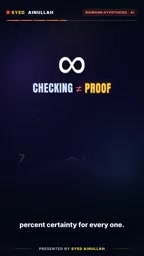
The Riemann Hypothesis is one of the 23 problems proposed by Hilbert in 1900 and one of the seven Millennium Prize Problems selected by the Clay Mathematics Institute in 2000, with a $1 million prize. If the conjecture is proven, many mathematical conclusions that depend on it will gain a solid foundation. Currently, humanity has verified vast numbers of zeros by computer, but verification is not the same as proof—a proof must cover infinitely many cases.
Beyond the Riemann Hypothesis, there are other unsolved problems in mathematics, such as the Hodge conjecture, Yang-Mills existence and mass gap, and the Birch and Swinnerton-Dyer conjecture. In addition, there are puzzles with simple statements that remain unsolved to this day, such as Goldbach's conjecture (every even number greater than 2 can be written as the sum of two primes) and the Collatz conjecture (the 3n+1 problem).
Conclusion: The Role of AI in Mathematics
AI is playing an increasingly important role in mathematical research, especially in assisting with verification, searching for counterexamples, and generating conjectures. But the core of mathematical proof—logical reasoning and conceptual innovation—still relies on human intelligence. The ultimate resolution of the Riemann Hypothesis may require deep collaboration between humans and AI.
Key points:
- The Riemann Hypothesis concerns the distribution of primes and is one of the most important unsolved problems in mathematics.
- The online claim that "AI proved the Riemann Hypothesis" lacks authoritative confirmation and should be treated with caution.
- Computer verification is not the same as mathematical proof; a proof must cover infinitely many cases.
- AI can assist mathematical research, but creative reasoning remains human-led.
One-line Summary
The claim that AI and humans have proven the Riemann Hypothesis is circulating online but lacks authoritative confirmation—computer verification is not the same as mathematical proof.
Paragraph Summary
The article examines the online rumor that "AI proved the Riemann Hypothesis." It first explains the core of the conjecture: the distribution of primes and the claim that all non-trivial zeros of the Riemann zeta function lie on the critical line with real part 1/2. It then reviews the rumor—a mathematician working with an AI company generated about 17 million lines of proof code that passed independent verifiers—but notes that a mathematical proof must be logically rigorous and peer-reviewed, and that computer verification of vast numbers of zeros does not equal a proof covering infinitely many cases. Finally, it emphasizes the significance of the Riemann Hypothesis as a Millennium Prize Problem and AI's role in assisting verification and searching for counterexamples, while creative reasoning still depends on humans.
Related articles
AI Cracks the Riemann Hypothesis? The Million-Dollar Prize Battle
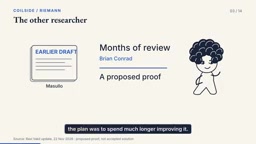
The Riemann Hypothesis million-dollar prize sparks a debate over scientific discovery in the AI era: Levent Alpoj's Claude-assisted 17-million-line Lean proof passes independent verification, while the manual draft still has errors. The Clay Institute's rules do not explicitly ban AI, but the gap between verifiability and understandability has become the core controversy.
AI Solves the 167-Year-Old Riemann Hypothesis? Formal Proof Sets the Math World Ablaze
The 167-year-old Riemann Hypothesis gets a formal proof: Levent Alpoge and Claude release 17 million lines of Lean code, verified by independent checkers. This article explains the link between prime counting and zeta zeros, the limits of machine verification, and AI's role in mathematical discovery.
AI Joins Forces with Mathematicians to Crack the Riemann Hypothesis? A 167-Year-Old Puzzle Reaches a Critical Turning Point
Anthropic mathematician Levent Alpoge collaborated with Claude for about six weeks to produce an AI-assisted proof of the Riemann Hypothesis, verified by the Lean formalization community. This article analyzes the relationship between the Riemann zeta function and prime distribution, the significance of formal verification, and the mathematical community's excitement and anxiety over machine-generated proofs.