AI Cracks the Riemann Hypothesis? The Million-Dollar Prize Battle
AI-assisted and manual proofs of the Riemann Hypothesis raise questions about verifiability and the definition of discovery.
The article examines two approaches to proving the Riemann Hypothesis: Levent Alpoj's claim of a Claude-assisted proof of about 17 million lines of Lean code, with a compressed version of about 76,000 lines that passed independent verification by MIT and University of Waterloo researchers, and Alessandro Maria Masulli's manual draft, checked for months by Brian Conrad and reported to have problems after leaking. Clay Institute rules do not ban AI but require publication, two years of review, and broad recognition. The core controversy is that formal verification can check the logical chain but may not yield a concise, human-understandable explanation, challenging traditional definitions of proof and discovery.
Two Ways to Solve a Million-Dollar Problem
Since it was proposed in 1859, the Riemann Hypothesis has remained one of the most famous unsolved problems in mathematics. Now it has returned to public attention for an unexpected reason: one mathematician claims to have found a proof with the help of Claude, while another researcher has submitted a manually written proof draft. The归属 of the million-dollar prize has suddenly become a question about how scientific discovery should be defined in the AI era.
According to a breakdown by the YouTube channel Coilside, Levent Alpoj stated in November that he and Claude had found a proof together, with AI playing an important role rather than merely helping fix typos. The initial proof was about 17 million lines of mathematical code, written specifically for computer verification. That number itself is telling—an ordinary laptop may lag when too many tabs are open, but the sheer size of this proof far exceeds the limit of manual human review.
What the Riemann Hypothesis Is Actually Asking
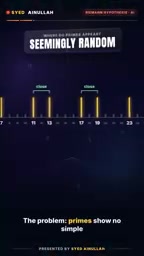
To understand the weight of this controversy, one must first return to the problem itself. The primes 2, 3, 5, 7, and 11 are the basic building blocks of multiplication, but their gaps follow no pattern—sometimes 2 apart, sometimes 4 or 6, more like, as the video puts it, "the operating conditions of public transit." Mathematicians want a smooth curve to estimate how many primes appear, and the core of the Riemann Hypothesis is a precise constraint on the error range of that curve.
The key to this problem is the zeta function. In a certain region, the same function can be represented both by all positive integers and by the primes—this is the bridge to the world of primes. Riemann's claim is that all nontrivial zeros lie on a vertical line whose horizontal coordinate is exactly one half—not approximately, but exactly. The positions of these zeros determine the amplitude of fluctuations in the prime-counting formula. One line affects the stability of the entire distribution of primes.
The zeta function and analytic continuation: The Riemann zeta function is initially defined as (\zeta(s)=\sum_{n=1}^\infty \frac{1}{n^s}), and this series converges when the real part of (s) is greater than 1. Riemann extended the domain to the entire complex plane (except for a pole at (s=1)) through analytic continuation, making it a meromorphic function. The extended function satisfies the functional equation (\zeta(s)=2^s\pi^{s-1}\sin(\frac{\pi s}{2})\Gamma(1-s)\zeta(1-s)), revealing the symmetry between (s) and (1-s). The negative even numbers (-2, -4, …) are trivial zeros, while all other zeros lie within the critical strip (0<\text{Re}(s)<1). The Riemann Hypothesis asserts that all these nontrivial zeros lie on the critical line (\text{Re}(s)=1/2).
Prime counting and the explicit formula: The Riemann Hypothesis matters because it is equivalent to the error between the prime-counting function (\pi(x)) and its logarithmic integral approximation (\text{Li}(x)) being controlled at the order of (O(\sqrt{x}\log x)). The explicit formula expresses (\pi(x)) as (\text{Li}(x)) minus the sum of oscillation terms corresponding to all nontrivial zeros, with each zero contributing a fluctuation of frequency (\text{Im}(\rho)). The farther a zero deviates from the critical line, the larger the fluctuation amplitude; if the conjecture holds, the fluctuation amplitude is minimized and the distribution of primes is the most "orderly." This is not only an aesthetic issue; it directly constrains the upper and lower bounds of prime gaps and also has foundational significance for the analysis of algorithms in cryptography that rely on the distribution of large primes.
How Strong Is the Verifiability of the AI Proof
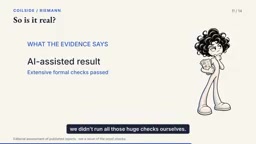
This is exactly why the AI-assisted proof deserves serious attention. Claude did not simply say "trust me"; the entire proof was written in the Lean system, a formal verification tool that checks logical steps one by one. According to reports published by Andrew Sutherland of MIT and Michael Rubenstein of the University of Waterloo, the verification program successfully passed the check, and independent verification programs also accepted the result. They also confirmed that the proof targeted the correct proposition and did not sneak the answer into the assumptions.
The version released on November 25 is about 76,000 lines in compressed form. Although it is still not easy reading, the published report states that this version also passed verification. There is a key distinction here: being able to check every logical step is not the same as humans already having a clear and concise explanation of the core ideas. A written guide has not yet been completed. But this itself does not overturn the independent computer verification result; it merely shows that "explaining the proof" is a separate task.
Lean and formal verification: Lean is an interactive theorem prover based on dependent type theory and also a programming language. Users write proof terms in it, and the system uses its kernel to check step by step whether each logical deduction conforms to the type rules. Once a proof passes checking, it means the proposition is true within the formal system (usually based on ZFC set theory or constructive type theory), provided the underlying logic is consistent. This contrasts with traditional "peer review + manual checking": the latter relies on mathematicians' intuition and experience, may miss subtle gaps, and is difficult to apply to very long proofs. Lean's checking is mechanical and repeatable, but proof scripts can be extremely large—this is why the initial proof reached 17 million lines. The formal verification community has built large mathematical libraries such as Mathlib, but a proof at the level of the Riemann Hypothesis still far exceeds the coverage of existing libraries, so this verification itself also constitutes a stress test of the toolchain.
Problems with the Manual Proof Draft and the Asymmetry of Evidence
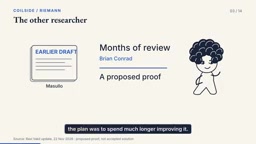
The other thread comes from Alessandro Maria Masulli. There were rumors that he had solved it long ago but had not published, but the actual situation is: he has a proposed proof that Brian Conrad has been checking for months, and the original plan was to spend even longer improving it. This story is associated with Stanford, not MIT. The draft leaked out in a hurry, and problems were subsequently reported. This does not mean all his work is worthless, but it does mean we cannot call it a fully tested solution.
The video author frankly points out the asymmetry of evidence: the AI-assisted result has a published verification report as strong evidence, far beyond "an impressively looking chatbot answer"; while the manually written draft still has reported errors that need to be addressed. Treating the two as equivalent evidence is unfair. The author also admits that it is impossible to verify the online rumor that "someone hid a lifetime of work and did not publish it."
What the Clay Institute's Rules Say
Regarding the prize, the published rules of the Clay Mathematics Institute do not explicitly prohibit AI assistance. But Clay decides who is eligible and who wins. A solution requires the right kind of publication—at least two years—as well as broad recognition from the mathematical community. The rules also allow prizes to be shared and acknowledge early published ideas that the solution genuinely required. Hours worked are not a scoring system.
So no one should be waving a winning check right now. There is no plagiarism accusation here—there is no evidence that the two teams borrowed from each other. The real question is: in an era of deep AI involvement, how should scientific discovery work? Is it most important to solve the problem, or is it more important to solve it without AI, or to explain the ideas clearly enough that everyone can use them?
The video author's view is: do not disqualify someone merely because they used AI, but be honest about how much AI did; give recognition to the ideas and work actually used in the solution; and do not award a still-flawed argument just because you like the story. Where to draw this line deserves serious thought from anyone concerned about AI and science.
Review rules for the Millennium Prize Problems: The Clay Mathematics Institute announced seven Millennium Prize Problems in 2000, each with a $1 million prize. Its official rules state that a solution must be published in a peer-reviewed mathematics journal and, after publication, must undergo at least two years of broad review and recognition before the Clay Scientific Advisory Board begins a formal evaluation. The rules do not mention restrictions on AI tools, because at the time AI was not yet involved in mathematical discovery. The rules also allow prizes to be shared by multiple people and acknowledge the contributions of authors whose early published results were used in the solution. Notably, the rules emphasize "broad recognition" rather than merely "logical correctness"—this means that even if a formal proof passes machine verification, if the mathematical community cannot digest its core ideas, it may still fail to win the prize due to a lack of community consensus. This gray area is precisely the focus of the current controversy: is machine verifiability sufficient to replace human understandability as the basis for "recognition"?
Why Many Correct Cases Do Not Equal a Proof
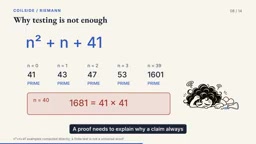
Some may ask: would not directly checking a large number of zeros be enough? We have already checked many. But a large number of correct examples cannot prove that every case holds. The video gives a classic counterexample: N²+N+41. Substituting 0 through 39 gives a prime every time, which looks great. Substitute 40 and you get 41×41, which is not prime, and the streak ends. This is the trap—a proof needs to explain why the assertion always holds, including cases no one has checked.
This is also where the value of formal verification lies. The Lean system checks the logical chain itself, not sample results. But this incident reminds us that there is still a gap between verifiability and understandability. When AI can generate proofs that are difficult for humans to review manually, the peer review mechanism of the mathematical community needs new tools and standards.
The Real Significance of This Debate
This is not a story about whether AI cheated, but a story about the definition of scientific discovery. If a 17-million-line formal proof passes independent verification, does it count as mathematical knowledge? If humans cannot explain the core ideas of the proof in a concise way, has it fulfilled the mission of knowledge dissemination?
The value of the Riemann Hypothesis lies not only in the answer itself, but also in the mathematical ideas developed during the process of proof. When AI becomes a co-author of proofs, what we may need is not only new verification tools, but also new frameworks for authorship, attribution of contribution, and understandability of knowledge. The million-dollar prize will eventually find its owner, but the questions left by this debate will have a more profound impact than the prize itself.
One-line Summary
AI-assisted and manual drafts of the Riemann Hypothesis proof have sparked controversy over verifiability and the definition of scientific discovery.
Paragraph Summary
The article revolves around two threads in the proof of the Riemann Hypothesis: Levent Alpoj claims to have jointly generated a proof of about 17 million lines of Lean code with Claude, with a compressed version of about 76,000 lines that has passed independent verification by researchers at MIT and the University of Waterloo; Alessandro Maria Masulli's manual draft was checked by Brian Conrad for months, and problems were reported after it leaked. The Clay Institute's rules do not prohibit AI, but require publication, two years of review, and broad recognition. The core controversy is that formal verification can check the logical chain, but it does not necessarily bring a concise explanation that humans can understand, which challenges the mathematical community's traditional definitions of "proof" and "discovery."
Related articles
AI Solves the 167-Year-Old Riemann Hypothesis? Formal Proof Sets the Math World Ablaze
The 167-year-old Riemann Hypothesis gets a formal proof: Levent Alpoge and Claude release 17 million lines of Lean code, verified by independent checkers. This article explains the link between prime counting and zeta zeros, the limits of machine verification, and AI's role in mathematical discovery.
AI and Humans Team Up to Crack the Riemann Hypothesis? The Truth Behind a 167-Year-Old Math Problem
The Riemann Hypothesis remains unsolved, yet rumors claim AI and humans have proven it. This article examines the conjecture, the AI rumors, and what a real proof requires.
AI Joins Forces with Mathematicians to Crack the Riemann Hypothesis? A 167-Year-Old Puzzle Reaches a Critical Turning Point
Anthropic mathematician Levent Alpoge collaborated with Claude for about six weeks to produce an AI-assisted proof of the Riemann Hypothesis, verified by the Lean formalization community. This article analyzes the relationship between the Riemann zeta function and prime distribution, the significance of formal verification, and the mathematical community's excitement and anxiety over machine-generated proofs.