AI Joins Forces with Mathematicians to Crack the Riemann Hypothesis? A 167-Year-Old Puzzle Reaches a Critical Turning Point
Anthropic mathematician and Claude collaborated for six weeks to produce an AI-assisted proof of the Riemann Hypothesis, verified by Lean, sparking excitement and anxiety in the mathematical community.
The article discusses a claim that Anthropic researcher Levent Alpoge, in collaboration with Claude, completed a proof of the Riemann Hypothesis. It clarifies that this is not AI independently discovering mathematics, but human-machine collaboration: the mathematician leads the reasoning, AI explores arguments, and the Lean formal tool checks the logic. It reviews the background of prime distribution and the Riemann Hypothesis, explaining the core assertion that non-trivial zeros of the zeta function lie on the critical line. The article emphasizes that formal verification, while crucial, is not equivalent to understanding mathematical ideas, and reactions in the mathematical community are divided. It notes that proving the Riemann Hypothesis will not directly affect cryptography; its significance is primarily mathematical, and the structure of human-machine collaboration is the real turning point.
A Mathematical Narrative Rewritten by AI
Few problems in the history of mathematics have consumed the life's work of generation after generation of top minds like the Riemann Hypothesis. According to the video source, this problem has remained unsolved for 167 years—some have devoted entire academic careers to it, others have claimed to find the answer only to discover flaws in their proofs. Now, a researcher from Anthropic working with Claude claims to have produced a proof of this conjecture.
The key point is not "whether AI can solve equations." The real question has become: did AI participate in cracking a puzzle that has defeated humanity for a century and a half? And if so, what will become of mathematics as a discipline?
It must be made clear upfront that this is not the narrative of "AI independently discovering mathematics." The video explicitly distinguishes between two claims: an experienced mathematician, Levent Alpoge, led the reasoning process, Claude explored and developed mathematical arguments within it, and the formal verification tool Lean checked the logical rigor of the final proof. The entire effort took about six weeks and has reportedly been independently verified by members of the Lean and Mathlib communities.
Why Prime Distribution Is So Hard to Predict
To understand the weight of this matter, we must return to prime numbers. 2, 3, 5, 7, 11, 13—these numbers divisible only by 1 and themselves are the fundamental building blocks of the integer world; any integer greater than 1 can be decomposed into a product of prime factors.
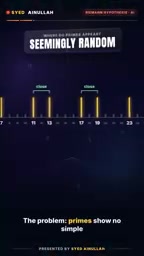
The problem is that primes appear seemingly randomly along the number line. Sometimes they are close together, sometimes separated by vast gaps. Mathematicians know primes are infinite, yet it is difficult to precisely predict where the next prime will appear. Behind this apparent randomness hides a mathematical relationship that has fascinated researchers for generations.
In 1859, German mathematician Bernhard Riemann published a paper that would become a cornerstone of number theory. He studied a function now named after him—the Riemann zeta function—and discovered that by examining where this function takes zero values, one can reveal important information about the distribution of primes.
His core conjecture is: all non-trivial zeros of the zeta function lie on a specific vertical line in the complex plane, called the critical line, whose real coordinate is exactly one-half. It sounds like a technical detail, but it is equivalent to a deep assertion about the regularity of prime distribution.
The Riemann Zeta Function and the Critical Line
The Riemann zeta function was originally defined by Euler as the infinite series ζ(s) = 1 + 1/2^s + 1/3^s + …, and Riemann later extended it to the complex domain. The function takes trivial zeros at negative even integers, while the distribution of the remaining zeros (non-trivial zeros) is closely related to prime counting. The Riemann Hypothesis asserts that all non-trivial zeros lie on the vertical line in the complex plane with real part 1/2, known as the critical line. This conjecture is important because it is equivalent to a precise estimate of the error term in the prime number theorem—if true, fluctuations in prime distribution would be confined to an extremely small range.
Why Formal Verification Is Key to This Event
AI systems can perfectly generate mathematical explanations that look plausible but hide errors. This is precisely why Lean exists.
Lean is a programming language and proof assistant that checks mathematical arguments according to strict logical rules. It does not ask "does this answer look right?" but requires mathematical propositions to be written in a formal language that a computer can verify line by line. The video points out a frequently overlooked distinction: checking a formal proof is not the same as understanding all the mathematical ideas behind it. This distinction is precisely the core of the current debate.
In other words, formal verification is an important step, but independent scrutiny and broad acceptance by the academic community are equally indispensable. A machine can verify the logical validity of a vast number of steps, but not necessarily can anyone immediately digest the mathematical insights carried by this proof.
Lean and the Mathlib Community
Lean is an interactive theorem prover initiated by Microsoft Research and now maintained by the community. It is based on dependent type theory, allowing users to write mathematical propositions as formal code, with the kernel checking step by step whether each deduction is valid. Mathlib is a mathematics library built on Lean, gathering tens of thousands of definitions and theorems covering areas from basic algebra to analysis and number theory. Community members can contribute code, fix errors, and independently verify new proofs. In this event, after the proof was submitted to the Mathlib community, multiple members confirmed its logical correctness by running the Lean kernel, which constitutes key support at the formal verification level.
Excitement and Anxiety Coexist in the Mathematical Community
According to Nature as cited in the video, mathematicians' reactions to this development are a mix of excitement and unease. Some researchers see it as a historic breakthrough, while others worry: how much human-understandable mathematical knowledge can actually be extracted from a large-scale machine-generated proof?
This divergence deserves serious consideration, rather than being simply dismissed as conservatives' discomfort with new technology. The value of mathematics lies not only in the truth of the conclusion but also in whether the argumentation process can be understood, transmitted, and recreated by the community. If the scale of a proof exceeds any individual's capacity to review it, then the very act of "being accepted" becomes delicate.
The video author's honest judgment is: this is not AI independently conquering mathematics, but a significant AI-assisted proof being announced, accompanied by strong formal verification claims and ongoing mathematical review.
What Does This Have to Do with Cryptography and the Real World?
The real-world significance of primes is often misunderstood. The security of public-key cryptosystems does indeed rely on mathematical problems involving large numbers and prime factorization. But the video clearly makes a key distinction: proving the Riemann Hypothesis does not automatically make encryption systems stronger or weaker, nor does it instantly break modern banking security systems.
Its importance is primarily mathematical, with potential implications for fields that rely on number theory. A proof of the Riemann Hypothesis would establish the precision of estimation methods used by mathematicians and resolve a large number of mathematical problems that assume the conjecture. This is why the Clay Mathematics Institute included it among the seven Millennium Prize Problems, with a one-million-dollar prize for whoever solves it.
This bounty has existed for years, and the problem remained unsolved—until this recent development.
Millennium Prize Problems and the Clay Mathematics Institute
The Millennium Prize Problems were established by the Clay Mathematics Institute in 2000. There are seven, each with a one-million-dollar prize, intended to honor solutions to long-standing core problems in mathematics. The Riemann Hypothesis is the earliest proposed and still unsolved among them; the others include P vs NP, Yang-Mills existence and mass gap, Navier-Stokes existence and smoothness, the Hodge conjecture, the Poincaré conjecture (solved by Perelman in 2003), and the BSD conjecture. The prize requires the proof to be published in an authoritative journal and to undergo more than two years of peer review. Therefore, even though this formal verification passed, there is still a long road of academic review before any official award.
Human-Machine Collaboration Is the Real Turning Point
What is most worth recording about this event may not be "what AI proved," but the structure of the collaboration itself. A senior mathematician poses the right questions, grasps the assumptions, and judges whether the conclusions are meaningful; AI rapidly trial-and-errors in the exploration space, seeking hidden connections; formal tools guarantee every step of logic. None of the three can be missing.
This provides a template for other long-unsolved mathematical problems. Problems that have resisted human researchers for decades may become more accessible with AI assistance. But this does not mean mathematicians become redundant—on the contrary, the work of posing the right questions, understanding assumptions, and scrutinizing arguments may become even more important.
If this proof withstands scrutiny, it could become a turning point in the history of mathematics. And the larger mystery it leaves behind is: when AI begins to participate in discovery, not just computing answers, what boundaries can intelligence itself reach?
One-line Summary
An Anthropic mathematician collaborated with Claude for six weeks, claiming to produce a proof of the Riemann Hypothesis verified by Lean, sparking excitement and anxiety in the mathematical community.
Paragraph Summary
The article centers on a claim that Anthropic researcher Levent Alpoge, in collaboration with Claude, completed a proof of the Riemann Hypothesis. It first clarifies that this is not AI independently discovering mathematics, but human-machine collaboration: the mathematician leads the reasoning, AI explores arguments, and the Lean formal tool checks the logic. It then reviews the background of prime distribution and the Riemann Hypothesis, explaining the core assertion that non-trivial zeros of the zeta function lie on the critical line. The article emphasizes that while formal verification is crucial, it is not equivalent to understanding mathematical ideas, and reactions in the mathematical community are divided. Finally, it points out that proving the Riemann Hypothesis will not directly affect cryptography, its significance is primarily mathematical, and the structure of human-machine collaboration is the real turning point.
Related articles
AI Cracks the Riemann Hypothesis? The Million-Dollar Prize Battle
The Riemann Hypothesis million-dollar prize sparks a debate over scientific discovery in the AI era: Levent Alpoj's Claude-assisted 17-million-line Lean proof passes independent verification, while the manual draft still has errors. The Clay Institute's rules do not explicitly ban AI, but the gap between verifiability and understandability has become the core controversy.
AI Solves the 167-Year-Old Riemann Hypothesis? Formal Proof Sets the Math World Ablaze
The 167-year-old Riemann Hypothesis gets a formal proof: Levent Alpoge and Claude release 17 million lines of Lean code, verified by independent checkers. This article explains the link between prime counting and zeta zeros, the limits of machine verification, and AI's role in mathematical discovery.
AI and Humans Team Up to Crack the Riemann Hypothesis? The Truth Behind a 167-Year-Old Math Problem
The Riemann Hypothesis remains unsolved, yet rumors claim AI and humans have proven it. This article examines the conjecture, the AI rumors, and what a real proof requires.