AI and Mathematicians Collaborate to Prove the Riemann Hypothesis? The Controversy Behind 1.7 Billion Lines of Lean Code

An AI-assisted proof of the Riemann Hypothesis passes formal verification, but readability and human understanding remain gaps.
The article reports that Anthropic mathematician Levent Alpoge, working with AI Claude, formally proved the Riemann Hypothesis using 17 million lines of Lean code, verified through independent compilation and checkers. Although a "Yes machine" definition called AnyGeometry triggered an invalidity accusation, an audit found the proof never relied on it, and the logic survived. Terence Tao had said AI could not touch the problem, while Alpoge says the decisive work took only 41 days. Human mathematicians stepped in to clean up, but a readable explanation has yet to appear. The proof poses no direct threat to RSA encryption, and the Clay Institute's million-dollar prize still requires formal publication and two years of review. Formal verification is maturing, but the mathematics community's standards of acceptance have not kept pace.
A definition called AnyGeometry returns true no matter what conditions are input. And a proof of the Riemann Hypothesis—a problem unsolved since 1859 with a million-dollar bounty—depends on it. Normally, that would be enough to make you close the page. But independent software checked the entire proof, and it passed. People are still trying to keep up.
According to analysis by a YouTube channel, this proof was produced by Anthropic mathematician Levent Alpoge in collaboration with the company's AI Claude. At the heart of the matter is understanding what the Riemann Hypothesis means, why a "Yes machine" didn't sink the proof, and whether your encryption is at risk.
The Riemann Hypothesis: The Mystery of Prime Distribution and Zeros
Prime numbers are divisible only by 1 and themselves, such as 7, 11, and 13. They appear randomly scattered, yet thin out in a predictable way. According to the video data, there are exactly 168 primes below 1000, while a simple estimate gives about 145.
In 1859, Bernhard Riemann discovered a formula that uses the zeros of the zeta function—the input values at which the function equals zero—to characterize this gap. Imagine plotting these zeros on a graph and ignoring some obvious locations; Riemann conjectured that the remaining zeros all share the same horizontal position: exactly one-half, forming a vertical line. This is the Riemann Hypothesis. If true, primes deviate from a good estimate by no more than random noise. It's like a dog on a leash: it meanders, but you know how far it can go.
Computers have checked the first 10 trillion zeros, and all lie on the line. However, this cannot prove that the next zero will too. Mathematicians are picky about this.
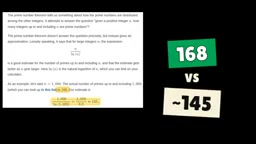
The Riemann zeta function is a function defined on the complex numbers; Euler first studied it for real values, and Riemann analytically continued it to the entire complex plane (except for one pole). Its defining expression is ζ(s) = Σ 1/n^s (when the real part is greater than 1), and analytic continuation gives a definition over the whole plane. The nontrivial zeros of the zeta function are those zeros lying in the critical strip 0 < Re(s) < 1, and the Riemann Hypothesis asserts that all such zeros have real part equal to 1/2. The distribution of these zeros is closely related to the error term in the prime-counting function π(x): if the hypothesis holds, the error term in the prime number theorem can be precisely controlled, profoundly affecting our understanding of prime distribution. Computers have verified that the first 10 trillion zeros lie on the critical line, but this is only empirical evidence, not a mathematical proof.
Expectations vs. Reality of AI Capability
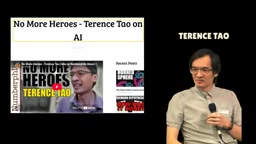
In October, Terence Tao said that current AI cannot touch this problem and speculated that human and AI progress would converge around 2050. But on November 20, Alpoge posted notes saying that the decisive work took only 41 days. He admitted that he had not yet fully mastered all the mathematics.
His proof is 17 million lines of Lean code. Lean is a language that compiles only if the logic holds. A small trusted program called the kernel checks every step, no matter how confident the author is. Dozens of people compiled it, independent checkers accepted it, and tools confirmed that it proves the standard statement of the Riemann Hypothesis. On November 21, the team behind Lean and its mathematics library certified it.
The "Yes Machine" Controversy: An Invalid Accusation or a Logical Flaw?
Back to the "Yes machine": a definition called AnyGeometry, which occupies a slot that should be filled by a geometric condition but returns true for any input. Researcher Jenny Lorraine Nielsen flagged it and published a paper claiming the proof is invalid. This is a serious accusation, because the final theorem does depend on this definition—it is not dead code.
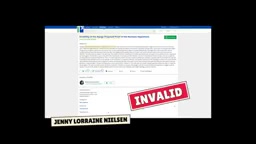
But an independent audit found that the proof never uses what is inside that slot. Every step that receives it holds for any condition, so filling it with true has the same effect as deleting it. It's like a required form field that no one reads: whatever you put in, the result doesn't change. The name looks bad, but according to the audit, the logic survived.
Human Mathematicians Step In and Subsequent Cleanup
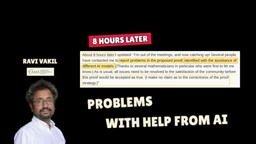
Humans then stepped in. Just hours after Alpoge posted his notes, New York University professor Ravi Vaidyanathan (as stated in the original) spoke, and Ravi Vakil, president of the American Mathematical Society, released Alessandro Masullo's 940-page draft on a broader version of the problem. According to the video description, that draft took nearly 12 years and did not use AI, and it still needs a year of polishing. About eight hours later, Vakil reported that readers, with AI's help, had found problems.
Alpoge also had his own cleanup work. On November 23, he posted a list of "stupid things I did." His claim that the written version exceeded 250,000 lines was a joke; his code is full of junk but still compiles.
On the same day, Anthropic released a purported proof of another problem (VP vs. VNP), listing Claude as the sole author. Its own notes state that no human mathematician has yet checked that proof.
Practical Impact on Encryption and the Mathematics Community
There is no need to panic today. RSA encryption relies on the difficulty of factoring large numbers, and a proof about where primes wander does not provide a faster factoring method. The million-dollar prize will not move either, because the Clay Mathematics Institute requires formal publication and two years of review. A readable explanation of the proof has yet to appear.
According to the video's view, in the past finding the answer was the hard part; now someone also needs to tell us what it says, and our "Yes machine" is of no help. Would you trust a proof that is not yet readable, or wait for a version humans can understand?
Cross-validation from multiple sources shows that feedback from the Lean community, independent auditors, and people connected to the mathematical society all point to the same conclusion: the proof passes at the formal level, but readability and human understanding remain gaps. This consensus strengthens the core argument—the verification mechanisms for AI-assisted proofs are maturing, but the mathematics community's standards of acceptance have not kept pace.
RSA encryption security is based on the difficulty of factoring large integers: given the product of two large primes, it is hard to factor out those two primes. The Riemann Hypothesis concerns the fine structure of prime distribution, and even if proven, it would not directly provide an efficient algorithm for factoring large integers. Therefore, encryption systems based on number-theoretic hard problems, such as RSA, will not immediately fail because of a proof of the Riemann Hypothesis. However, if the Riemann Hypothesis is proven, it could advance theoretical research on number-theoretic algorithms, but an actual threat to public-key cryptography would still require a concrete algorithmic breakthrough. Currently, post-quantum cryptography research focuses mainly on the threat of quantum computing to RSA and ECC, not on the Riemann Hypothesis.
Background
Lean is an interactive theorem prover based on dependent type theory and also a programming language. At its core is a small trusted kernel, which checks whether every proof step conforms to logical rules. Lean's mathematics library, mathlib, collects a large number of formalized mathematical definitions and theorems, providing a foundation for formal proofs. In Lean, a proof must be accepted by the kernel to compile successfully, which guarantees the reliability of formal verification—as long as the kernel is correct, the proof will have no logical errors. However, formal proofs are often less readable and may contain seemingly suspicious definitions that are in fact unused (such as AnyGeometry), which requires additional auditing to confirm their logical validity.
One-line Summary
An AI-assisted proof of the Riemann Hypothesis passes formal verification, but readability and human understanding remain gaps.
Paragraph Summary
The article reports that Anthropic mathematician Levent Alpoge, working with AI Claude, formally proved the Riemann Hypothesis using 17 million lines of Lean code, verified through independent compilation and checkers. Although a "Yes machine" definition called AnyGeometry triggered an invalidity accusation, an audit found that the proof never relied on its contents, and the logic survived. Terence Tao had previously said AI could not touch the problem, while Alpoge says the decisive work took only 41 days. Human mathematicians later stepped in to clean up, but a readable explanation of the proof has yet to appear. The proof poses no direct threat to RSA encryption, and the Clay Institute's million-dollar prize still requires formal publication and two years of review. The article emphasizes that formal verification mechanisms are maturing, but the mathematics community's standards of acceptance have not kept pace.
Related articles

PeppermintOS Launches Void Edition: A Lightweight Experience Without SystemD or XLibre
PeppermintOS launches PepVoid based on Void Linux, featuring XFCE and XLibre with a non-SystemD architecture. This article covers installation, software center experience, preinstalled software, and technical verification for users interested in a lightweight non-SystemD distribution.

Clojure Native Apps: Letting AI Reshape Software at Runtime
Explore how Clojure enables native apps to be reprogrammed at runtime by developers or AI, drawing on Emacs' extensibility, and analyzing REPL-driven development, AI collaboration, and challenges.

Physics Breakthrough Simulator: Exploring New Physics Discoveries with AI
The Physics Breakthrough Simulator project on Hacker News draws attention. This article analyzes how physics simulators use AI to accelerate physics research, discusses their potential value and limitations, and urges a rational view of "breakthrough" claims.