Physics Breakthrough Simulator: Exploring New Physics Discoveries with AI

The Physics Breakthrough Simulator on Hacker News draws attention, reflecting the trend of AI-physics simulation integration, though limited information calls for a calm view.
The article discusses the "Physics Breakthrough Simulator" project on Hacker News. Public information is minimal—no paper, documentation, or community discussion—and its actual capabilities remain to be verified. The article notes that physics simulators are not new, but the maturation of differentiable physics, neural simulators, and interactive simulation environments is pushing simulators from reproducing known phenomena toward helping discover unknown laws. For physics researchers, simulators can quickly screen hypotheses, visualize complex systems, and serve as teaching tools; for AI researchers, physics simulation is a testing ground for model reasoning and induction abilities. The article also cautions that the word "breakthrough" easily creates excessive expectations, and that simulators can hardly accomplish physics breakthroughs alone—the reasonable attitude is to stay curious, try it out, and watch whether the project later releases code, methods, and validation results.
When AI Becomes a Physicist
On Hacker News, a project called "Physics Breakthrough Simulator" has attracted modest attention. It comes with no lengthy introduction and no discussion in the comments, but the project name itself points to a direction that is heating up: using simulation and computational methods to accelerate breakthroughs in physics.
Traditional physics research relies on the long cycle of theoretical deduction and experimental verification. Simulator-type tools attempt to build an interactive physical world inside a computer, letting researchers quickly test hypotheses and observe emergent phenomena. Such projects typically combine numerical computation, visualization, and machine learning methods from recent years, lowering the barrier to exploring the laws of physics.
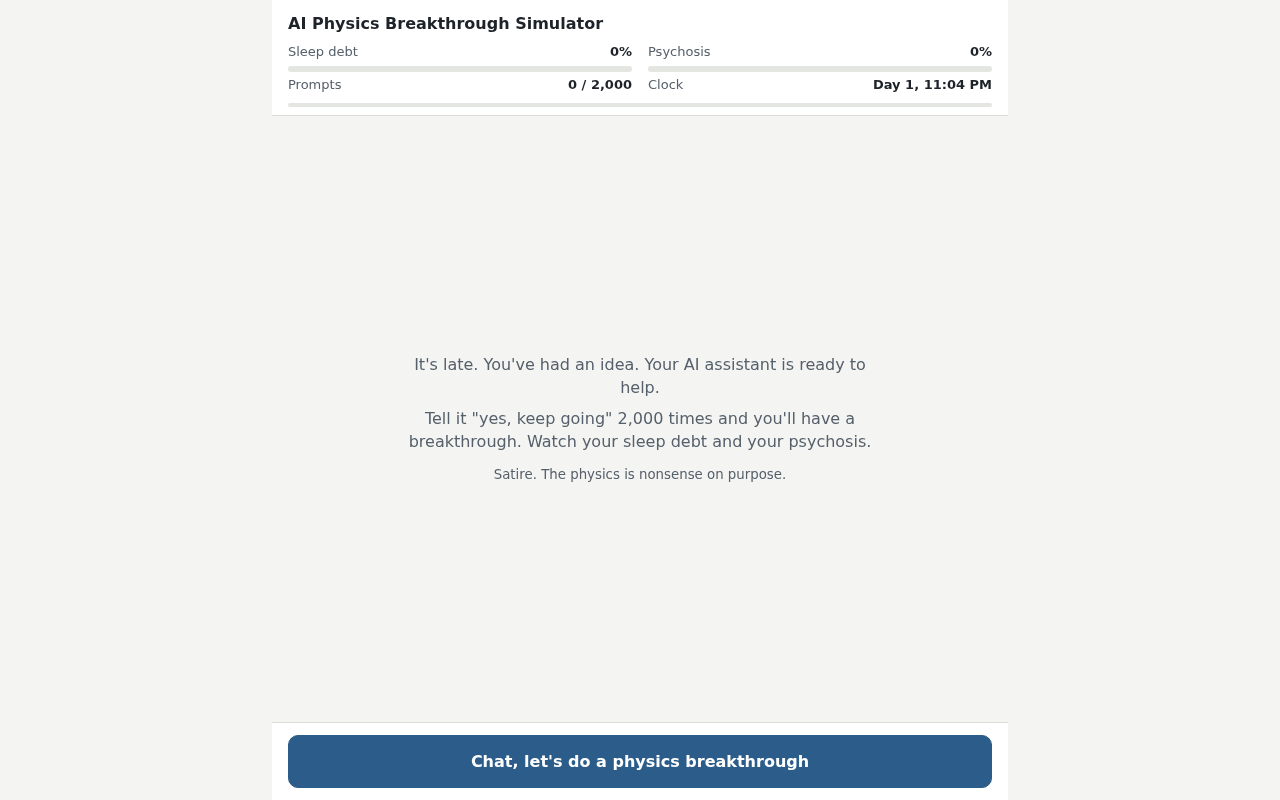
The Role of Simulators in Physics Research
Simulators are nothing new—from molecular dynamics to astrophysics, computational simulation is a standard tool. But a name like "Breakthrough Simulator" hints at a further ambition: not just reproducing known phenomena, but helping discover unknown laws.
Two technological trends are driving this. First, the maturation of differentiable physics and neural simulators allows simulation systems to learn physical laws from data rather than relying entirely on hand-written equations. Second, the spread of interactive simulation environments lets researchers adjust parameters like playing a game and observe changes in system behavior in real time, gaining intuitive inspiration.
It should be noted that public information about this project is extremely limited—no paper, no detailed documentation, and no community discussion. Its actual capabilities and implementation approach remain to be verified.
Differentiable Physics refers to implementing the physics simulation process as a computational graph that supports automatic differentiation, enabling the simulator's output to be differentiated with respect to input parameters or model parameters. Traditional simulators usually perform only forward computation, whereas differentiable simulators can use backpropagation to efficiently optimize physical parameters, perform system identification, or jointly train with control strategies. Neural Simulators, on the other hand, replace or augment traditional numerical integrators with neural networks, learning state transition laws from trajectory data and achieving faster inference while maintaining physical consistency. The combination of the two allows simulation systems to adaptively correct model errors in a data-driven manner—this is precisely the technical foundation of "learning physical laws from data."
Potential Value for Researchers
Even with limited information, the direction of such tools is worth watching. For physics researchers, the value of simulators is reflected at several levels: quickly screening theoretical hypotheses and ruling out clearly untenable directions before real experiments; visualizing complex systems to help understand many-body problems, nonlinear dynamics, and other phenomena that are difficult to solve analytically; and serving as a teaching tool that makes abstract concepts tangible.
For AI researchers, physics simulation is also a testing ground for evaluating the reasoning capabilities of machine learning models. Whether a model can induce conservation laws from observational data and predict unseen physical scenarios are indicators of whether it truly understands the world.
Conservation law induction is a classic task for testing the physical reasoning ability of machine learning models: given a system's observed states at multiple times, the model must discover invariants such as energy and momentum on its own, rather than merely fitting trajectories. Such tasks differ from pure prediction in that they require the model to capture the system's intrinsic symmetries and structure. Related benchmarks (such as using machine learning for symbolic regression to discover physical equations) show that existing models still tend to overfit under noisy data and limited samples, and their ability to generalize to unseen scenarios is limited. Therefore, using physics simulation as a testing ground for AI reasoning can both drive the design of more robust inductive biases and provide quantifiable criteria for whether a model "understands" the world.
Taking a Calm View of the Word "Breakthrough"
The word "Breakthrough" in the project name easily creates excessively high expectations. Breakthroughs in the history of physics often come from a deep combination of theory and experiment; simulators can accelerate exploration, but they can hardly accomplish breakthroughs on their own. Without peer review and reproducible experimental design, any simulation result is merely a hypothesis.
For researchers and developers who see such projects on Hacker News, the reasonable attitude is: stay curious, try it out hands-on, but don't be led astray by the grand narrative implied by the name. What is truly worth tracking is whether the project later releases its code, methods, and validation results.
Conclusion
"Physics Breakthrough Simulator" currently looks more like a signal than a mature product—it reflects the continuously heating exploratory enthusiasm at the intersection of AI and computational science. When information is insufficient, rather than rushing to judge, it is better to treat it as a reminder: the combination of physics simulation and machine learning is becoming a research direction worth watching.
Related articles

AI and Mathematicians Collaborate to Prove the Riemann Hypothesis? The Controversy Behind 1.7 Billion Lines of Lean Code
AI and mathematician Levent Alpoge used 17 million lines of Lean code to prove the Riemann Hypothesis? An AnyGeometry definition sparked controversy, yet an independent audit says the logic holds. This article explains the Riemann Hypothesis, the Yes machine controversy, and the real impact on RSA encryption.

PeppermintOS Launches Void Edition: A Lightweight Experience Without SystemD or XLibre
PeppermintOS launches PepVoid based on Void Linux, featuring XFCE and XLibre with a non-SystemD architecture. This article covers installation, software center experience, preinstalled software, and technical verification for users interested in a lightweight non-SystemD distribution.

Clojure Native Apps: Letting AI Reshape Software at Runtime
Explore how Clojure enables native apps to be reprogrammed at runtime by developers or AI, drawing on Emacs' extensibility, and analyzing REPL-driven development, AI collaboration, and challenges.