AI Art Creation: Using Prompts to Craft the Minimalist Mood of a Quiet Ocean and Giant Moon

How emotional prompt engineering creates compelling minimalist AI art from simple scenes of ocean and moon.
This article examines how AI art has evolved from object generation to mood expression, using a viral Reddit post of a quiet ocean and giant moon as a case study. It explores the technical mechanics of how emotional keywords influence diffusion models, the philosophy of minimalism in AI art, and provides practical prompt engineering tips for creating emotionally resonant works.
A New Trend in Mood Expression Through AI Art
Recently, an AI-generated artwork titled "A quiet ocean, a giant moon, and nowhere else to be." gained widespread attention on Reddit. This highly poetic description, paired with an image evoking a serene atmosphere, showcases the maturity of current AI image generation technology in expressing emotion and mood.

The popularity of such works reveals that AI art creation has evolved from the early stage of "what can it draw" to "how can it express a feeling." Users are no longer satisfied with simply piling objects together—they seek the emotional tension and narrative atmosphere conveyed by the image. Behind this shift is a qualitative leap in generative model capabilities. Today's mainstream diffusion models have absorbed the correspondences between billions of images and their text descriptions during training, enabling them not only to recognize concrete objects but also to capture the deep connections between abstract emotional atmospheres and visual styles.
Mood-Driven Prompt Engineering: From Describing Objects to Creating Atmosphere
The Power of Emotional Keywords
The title of this type of work is itself an advanced prompt engineering practice. "Quiet ocean," "giant moon," "nowhere else to be"—these words don't just describe visual elements; more importantly, they define an emotional tone: solitude, tranquility, escape from the noise.
Prompt Engineering has developed into a systematic technical practice. In diffusion model architectures, text encoders (such as OpenAI's CLIP model) convert prompts into embedding representations in high-dimensional vector spaces, after which the model generates images through an iterative denoising process based on these embeddings. Differences in position and weight of various words in the embedding space directly affect the style, composition, and mood of generated results. Emotional vocabulary is particularly effective because the annotations of abundant artworks in the training data already contain rich emotional descriptions—the model has learned the statistical correlations between "quiet" and soft lighting with low-saturation colors, and the visual correspondence between "giant" and upward-looking compositions with a sense of overwhelming scale.
In mainstream AI image generation tools (such as Midjourney, Stable Diffusion, DALL·E, etc.), successful creation often depends on precise control of lighting, color tone, composition, and atmosphere vocabulary. While all these tools are based on core diffusion model principles, each handles emotional vocabulary differently: Midjourney, built on its proprietary architecture, is known for artistic stylization and aesthetic quality, with a more subjective aesthetic interpretation of prompts that excels particularly in atmosphere creation; Stable Diffusion, as an open-source Latent Diffusion Model, allows users to finely control the generation process through plugins like LoRA fine-tuning and ControlNet; DALL·E 3 deeply integrates ChatGPT's language understanding capabilities, automatically expanding brief natural language descriptions into detailed image generation instructions.
A simple "moon and ocean" prompt might generate a bland image, but adding emotionally weighted words like "quiet," "giant," and "nowhere" can guide the model to produce more compelling results. This is because the diffusion model's denoising process is guided by text conditioning at every step—the model starts from pure random noise and progressively denoises under the constraints of text embeddings, moving toward "matching the description" at each step. The addition of emotional vocabulary essentially sets more specific aesthetic coordinates for this generation process.
The Visual Philosophy of Minimalism
This artwork embodies minimalist aesthetic pursuits: the visual elements are highly distilled to just two subjects—the ocean and the moon—yet through scale contrast (the giant moon) and negative space (the expansive sea surface), it creates a powerful sense of immersion and solitude. This "less is more" creative philosophy is one of the hallmarks of AI art's maturation.
Minimalism originated in the visual arts movement of the 1960s, with its core proposition being the use of the fewest formal elements to express the purest aesthetic experience. In the age of AI-assisted digital art, minimalism has gained unprecedented technical support. Through the Negative Prompt mechanism, creators can actively exclude unwanted elements from the image—such as "no clouds, no boats, no people"—thereby precisely controlling the degree of simplicity. This capacity for "subtractive creation" allows creators to focus all attention on the textural expression and spatial relationships of a few core elements, making each remaining visual element carry more emotional weight.
The Emotional Resonance Value of AI-Generated Art
The reason this type of work resonates within communities is that it touches on universally shared human emotional experiences. The title "nowhere else to be" implies a yearning for escape, solitude, and inner peace—something particularly attractive in the fast-paced modern world.
AI painting tools have lowered the barrier to creation, enabling people without traditional painting skills to transform the moods in their minds into visual works. This represents both the democratization of technology and sparks ongoing discussion about the nature of art—when machines can generate images so rich in emotion, where exactly does the creator's value lie?
This discussion traces back to the core concept of "Intentionality" in philosophy of art. Philosopher John Searle distinguished between "original intentionality" and "derived intentionality"—humans possess original intentionality, meaning genuine understanding and feeling, while tools only have derived intentionality bestowed by humans. In the context of AI creation, generative models don't "understand" the feeling of loneliness or tranquility; they merely reproduce, at a statistical level, visual patterns that humans have annotated with these words. What the model does is pattern matching and probabilistic sampling, not experiencing and expressing.
The answer perhaps lies here: AI is the tool, while humans provide the intent, aesthetic judgment, and emotional core. Choosing "tranquility" over "grandeur," choosing "solitude" over "liveliness"—these decisions still come from the creator themselves. The truly creative decisions—choosing what emotion to express in this moment, why this particular solitude rather than some other noise—remain unique products of human consciousness. AI expands the boundaries of expressive possibility without replacing the subject of expression.
Practical Tips and Insights for AI Art Creation
For users looking to create art with AI, this case offers several practical insights:
- Prioritize emotional keywords: Adding words that express atmosphere and emotion to your prompts often produces more moving works than simply describing objects. Research shows that adjectives and adverbs have significantly higher style-influencing weight in text embedding space on generated results than the simple accumulation of nouns.
- Leverage scale and contrast: Surreal scale settings like "giant moon" can instantly elevate the visual impact of an image. Diffusion models' understanding of scale relationships comes from perspective and proportion patterns in training data. When prompts break conventional proportions, the model generates images with a Surrealist style—visual effects that defy everyday perception often trigger stronger emotional responses.
- Embrace minimalist composition: You don't need to pile on complex elements; sometimes two or three carefully chosen subjects can create a purer mood. Combine this with negative prompts to eliminate distracting elements for cleaner visual results.
- The caption is part of the creation: A good title or description is itself part of the work, guiding the viewer's interpretation. The intertextual relationship between text and image is particularly important in AI art—the prompt serves both as the generation instruction and the viewing cue.
As generative AI technology continues to evolve, human-AI collaborative art creation will give rise to more forms of expression that transcend the limitations of traditional media. The transformation from text to image is becoming increasingly refined and controllable. Future directions may include: more precise emotional intensity control (such as adjusting the degree of "tranquility" through numerical weights), cross-modal mood transfer (converting the atmosphere of music into visual works), and adaptive generation based on users' emotional states. Throughout this process, human perception of beauty and the infusion of emotion remain irreplaceable at the core.
Related articles

M&M's Spent Millions Replacing Artificial Blue Dye — Why Is It So Hard?
Mars spent millions trying to replace artificial blue dye in M&M's with spirulina, but thick material clogs pipes and residue risks mold, forcing a full production-line rebuild. Here's the engineering behind the reformulation.

Teammate Wanted for Meta Global AI Developer Hackathon: Computer Vision & Medical AI
A Reddit developer seeks teammates for the Meta Global AI Developer Hackathon, focusing on computer vision and medical AI. This article analyzes the track logic, skills-complementarity needs, and topic selection strategy behind this teaming signal.
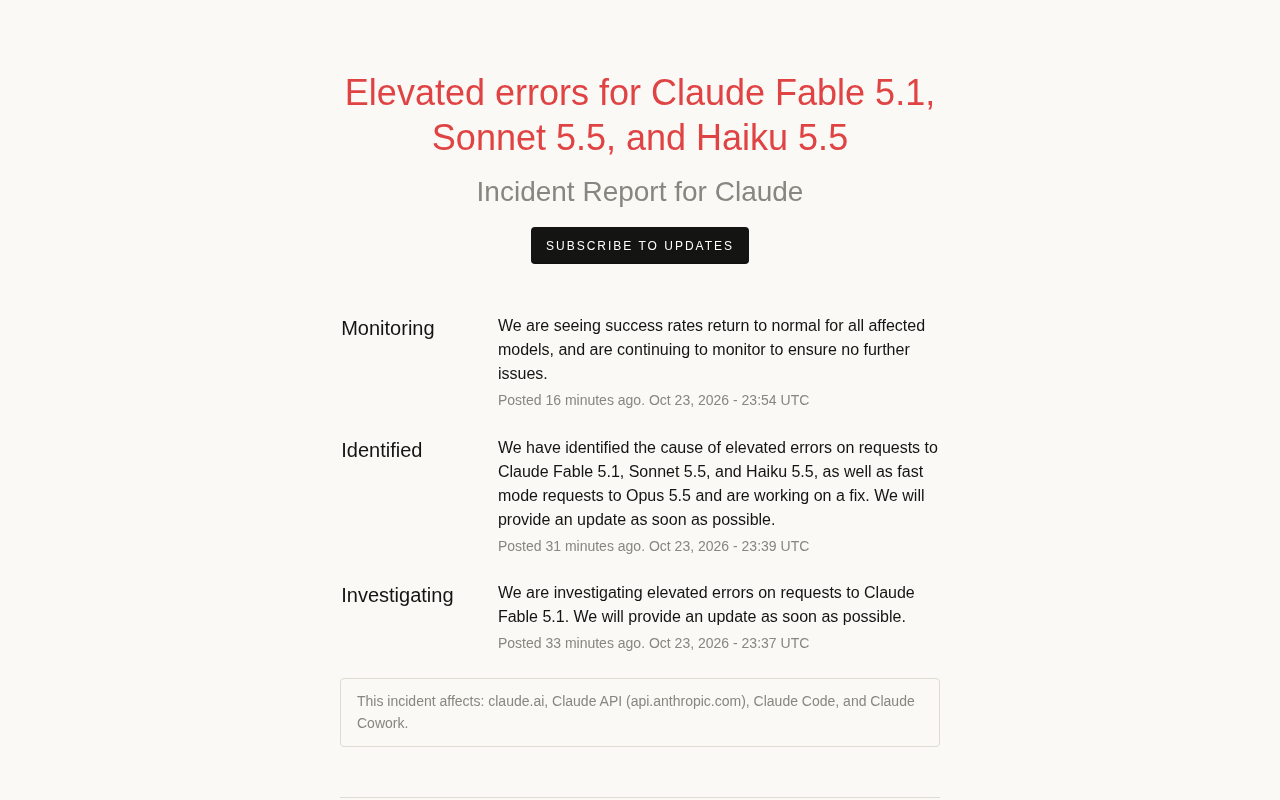
Multiple Claude Models Hit by Errors: A Postmortem of Fable 5.1, Sonnet 5.5, and Haiku 5.5
Claude Fable 5.1, Sonnet 5.5, Haiku 5.5, and Opus 5.5 fast mode saw elevated errors; Anthropic identified and resolved the issue in 17 minutes. This postmortem covers the timeline, the technical reasons for the multi-model cascading failure, and practical lessons for retry and degradation strategies.