AI Assistant 'dots' Real-World Test: It Automatically Saved Me $500/Year in Subscriptions
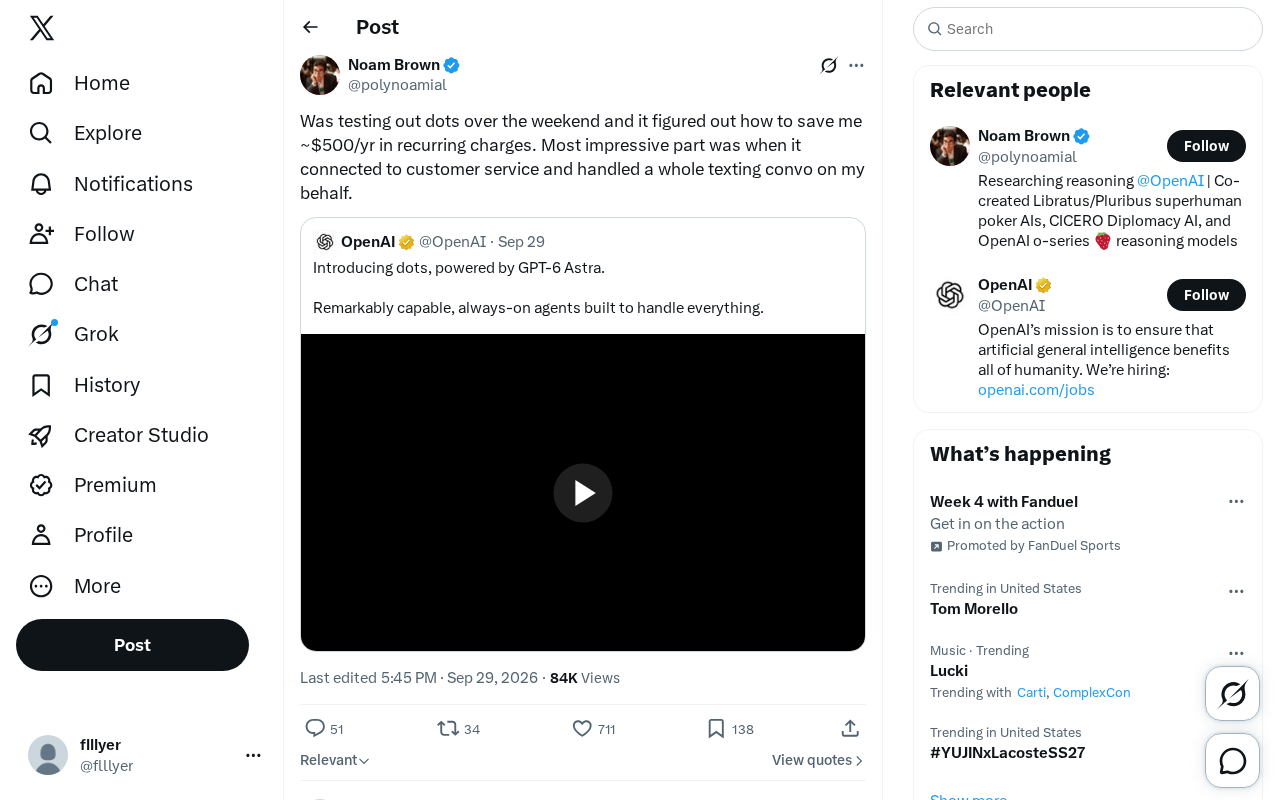
AI assistant dots identifies wasteful subscriptions and handles cancellation conversations autonomously on your behalf.
A user shared a weekend test of AI assistant dots: the tool identified roughly $500/year in redundant subscription charges and — crucially — connected directly to customer service and completed the entire SMS cancellation conversation without user involvement. This demonstrates AI's shift from advisory assistant to action-taking agent. The article also notes important caveats: authorization and privacy boundaries, the limits of individual case studies, and whether AI can reliably handle non-standardized cancellation workflows at scale.
A Weekend Test That Delivered a Surprise
A user shared their weekend experience testing AI assistant dots on social media — and the results were unexpected: within a short time, the tool identified roughly $500 per year in redundant subscription charges and offered recommendations for canceling or optimizing them.
For many people, various subscription services — streaming platforms, cloud storage, fitness apps, software memberships — quietly accumulate into a significant hidden expense. These charges often go unnoticed because individual amounts are small and renewals are automatic. That's exactly where dots delivers value: aggregating these scattered expenses and making it crystal clear where the money is going.
The Most Impressive Part: AI Talking to Customer Service on Your Behalf
What struck this user most wasn't discovering the savings opportunity itself — it was that dots proactively connected to a customer service system and completed an entire SMS conversation on his behalf.
In other words, dots isn't just an "analysis tool." It demonstrated genuine agentic execution capability — identifying a problem, initiating action, and carrying out multi-turn communication with third-party human or automated support until the task was complete. This kind of "handle it for you" capability is precisely the core direction AI is evolving toward: shifting from advisory assistants to action-taking agents.
From "Tell You What to Do" to "Do It for You"
Traditional personal finance or subscription management apps typically stop at reminders: "You have a subscription renewing soon." But the actual legwork of canceling — finding the right page, filling out forms, arguing with customer service — still falls on the user. Many companies deliberately exploit this "cancellation friction" to retain paying customers.
dots breaks that pattern by directly taking over the negotiation with customer support. This means the AI shoulders the repetitive, communication-heavy work that users dread most — and that's where its experiential value is highest.
The "agentic execution capability" referenced here is a technical term in AI referring to systems that can autonomously plan steps, invoke external tools or APIs, and dynamically adjust actions based on intermediate results — fundamentally different from traditional conversational models that only generate text recommendations. Common technical approaches include: Function Calling (enabling models to invoke predefined APIs), RPA (robotic process automation) and browser automation (simulating clicks and form-filling), and multi-step task planning frameworks (such as ReAct, AutoGPT, etc.). The fact that dots can initiate and complete SMS conversations suggests it likely integrates an SMS gateway API and dialogue state management — not simply text generation.
Why This Type of AI Agent Deserves Attention
This brief user report reflects an important trend in AI products: AI agents with real-world execution capability are arriving.
- They operate across systems: from bill analysis to customer service communication, spanning multiple services and interfaces
- They complete end-to-end tasks: not just outputting conclusions, but actually driving outcomes
- They deliver quantifiable, tangible value: roughly $500 saved per year is a real, measurable ROI
When AI can produce clear, measurable economic returns, user willingness to pay and retention both increase significantly. If the money saved exceeds the tool's own subscription cost, the product's value proposition becomes self-justifying.
A Few Things to Keep in Mind
As a single user's trial experience, this report is worth noting — but warrants some caution.
First, having AI communicate with customer service on your behalf raises authorization and privacy concerns. To perform these kinds of actions, an AI typically needs access to account information, communication permissions, and potentially payment-related data. Users need to understand exactly where the authorization boundaries lie.
Second, "saving $500" is an individual case — actual results will vary depending on how many redundant subscriptions you actually have. Users with fewer subscriptions will naturally see less benefit.
Finally, whether AI-automated customer service conversations can reliably handle complex, non-standardized cancellation flows still needs broader validation. A single positive review doesn't equal universal reliability.
On the authorization and privacy front, the risks are worth spelling out. For dots to access billing data and send SMS messages on your behalf, it typically requires read-only API access to your bank account (e.g., via financial data aggregation services like Plaid) and SMS sending permissions. The former is governed by Open Banking protocols, with data breach risk primarily tied to the aggregator's security posture. The latter means the AI can send communications externally as you — if the scope of authorization isn't clearly defined, there's potential for misuse. Before using tools like this, users should verify: what permissions are being granted, how data is stored and used by third parties, and whether authorization can be revoked at any time.
Takeaway
dots' real-world test offers a compelling case study in the practical value of AI agents: rather than stopping at analysis and advice, it actually completed cross-system communication and action on behalf of a user — delivering a quantifiable financial result. This is precisely the capability that distinguishes next-generation AI assistants from traditional tools. As more products like this mature, "let AI handle your errands" may well shift from concept to everyday reality.
Background
This "cancellation friction" is a deliberately engineered barrier in the subscription economy, commercially known as a dark pattern. Companies reduce churn by hiding cancellation options, requiring phone calls to cancel, imposing cooling-off periods, and exploiting users' time costs and psychological inertia. The FTC issued a "click-to-cancel" rule in 2023 requiring that subscription cancellations be as easy as sign-ups — but enforcement remains incomplete. The emergence of AI agents like dots essentially uses automation to counteract these artificial friction mechanisms, freeing users from the tedious back-and-forth they were designed to endure.
Related articles

Uber Deploys ChatGPT Work Company-Wide: AI in the Workplace Enters the Scaled Implementation Phase
Uber deploys ChatGPT Work to 30,000+ employees, extending it from engineering to all roles. We analyze its expert-engineer pairing, end-to-end automation, and questions of AI control and power concentration—insights for scaling AI in the workplace.

Shift at Midnight Hands-On: When "ID Verification" Becomes Alien Hunting
Shift at Midnight blends ID verification with horror survival in a four-player co-op game. We break down its inspection mechanics and chaotic humor.

Zelensky Recounts the Outbreak of War: I Need Ammunition, Not a Ride
Zelensky recalls the first day of war in a YouTube interview: farewell to family, rejecting Biden's evacuation offer with "I need ammunition, not a ride," and how Bucha shaped his stance on compromise and peace talks.