AI Assistant's New Usage Limits Spark Controversy: Users Report Consumption Far Exceeds Official Claims

Reddit users report an AI assistant's new limits consume far more quota than officially claimed, exposing transparency gaps.
An AI assistant platform's revised usage limits triggered strong backlash on Reddit, with one user finding that light tasks like trimming memory and creating a basic skill consumed a large share of their weekly quota — estimating real work could drain it in a single day. The deeper issue is a lack of metering transparency: users can't see per-operation costs, breeding distrust. The incident highlights how AI subscription products must balance cost control, honest communication, and usage visibility — or risk losing their most valuable heavy users.
New Usage Limits Fuel User Backlash
An AI assistant platform recently revised its usage limit policy, sparking discussion across Reddit communities. Some users have voiced clear frustration, arguing that the actual reduction in available usage is far greater than what the platform officially acknowledges.
This kind of adjustment is hardly unusual. With large language model operating costs running high, mainstream AI products are broadly exploring more granular usage management mechanisms — from per-request and per-token billing to daily or weekly usage caps. When limits tighten, heavy users are almost always the first to feel the impact.
A Single Casual Session Hits the Ceiling
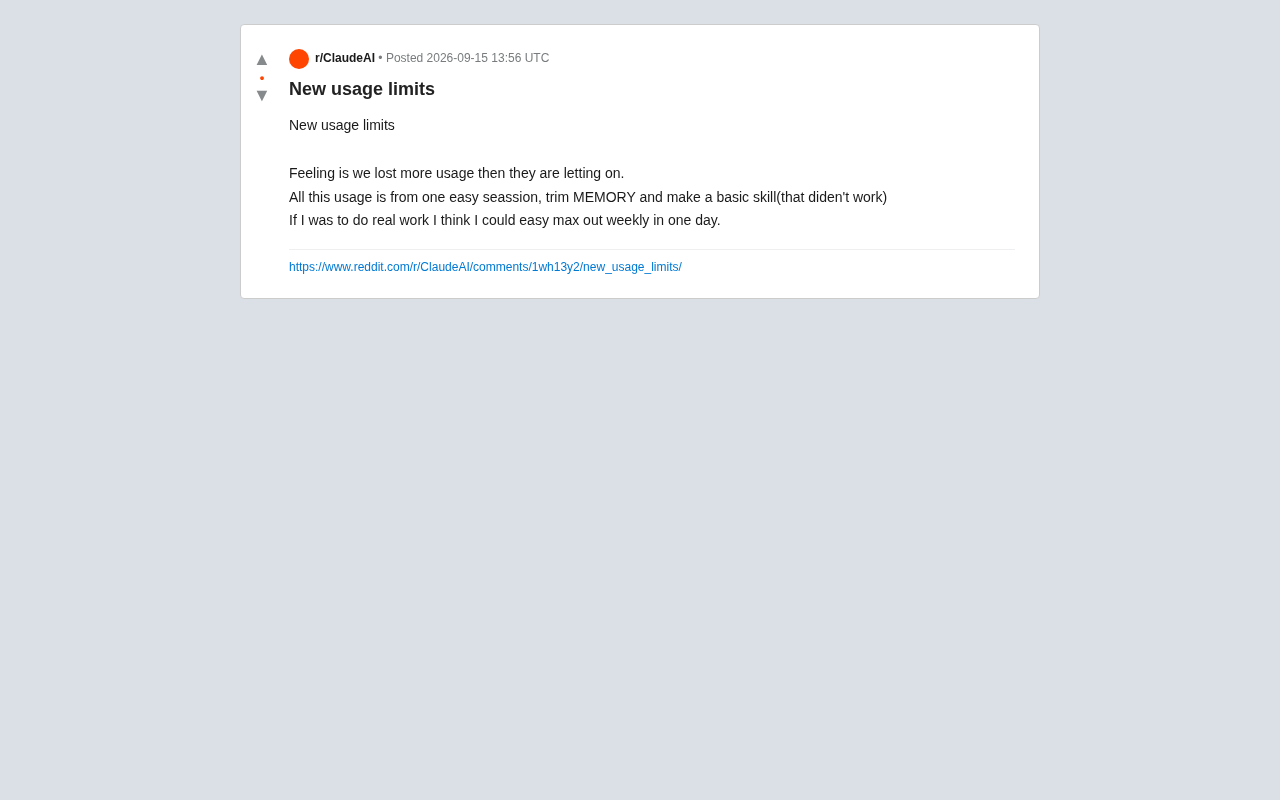
The original poster shared their firsthand experience: in what they described as a "light session" — trimming memory and attempting to create a basic skill (which ultimately failed to run) — they burned through a significant chunk of their usage quota.
The user's core complaint centers on the "value for money" of their allocation. If a session that light drains the meter that fast, real productivity work would only make things worse. By their estimate, "if I were doing actual work, I could easily burn through a week's quota in a single day."
This cuts to a sharp contradiction in the new limit structure: a nominally "weekly" allocation may not even survive a full day of genuine, intensive use.
Usage Transparency Takes Center Stage
Underlying this complaint is a broader industry pain point: the transparency of usage metering.
The feeling that "more was lost than officially admitted" stems largely from how opaque the consumption process is. When a platform doesn't clearly and in real time show how much quota each individual operation consumes — trimming memory, calling a tool, creating a skill — users have no way to form reasonable expectations about their allowance. That opacity breeds exactly the kind of distrust captured in phrases like "they're quietly cutting more than they're letting on."
For AI products, the computational cost of different operations varies enormously. A simple question-and-answer exchange versus a complex task involving long context windows, tool calls, and memory management can differ by several times — or even an order of magnitude — in compute consumed. Users typically only see their quota hit zero; they have no visibility into what each step actually cost.
On a technical level, large language models are typically billed in tokens — the basic units models use to process text. Roughly speaking, each Chinese character corresponds to 1–2 tokens, and each English word to about 1–1.5 tokens. When a user makes a request, the total tokens consumed include everything fed into the model (full context, conversation history, system prompts, tool definitions, etc.) as well as the model's generated response. Operations like "trimming memory" are disproportionately expensive because they require the model to read and process large volumes of historical information — meaning the input-side token count often far exceeds what users intuitively expect. "Calling a skill or tool" can trigger multiple rounds of model inference, each billed independently. This complexity in the billing mechanism is the fundamental reason users struggle to anticipate costs from experience alone.
Implications for AI Product Operations
While a single user's complaint represents a limited sample, it reflects several critical tensions AI subscription products must balance when designing usage policies:
The cost-versus-experience trade-off. Tightening limits controls costs, but doing so too aggressively directly damages the experience of heavy paying users — who happen to be the most valuable contributors to the product.
Honesty in communication. When usage policies change, whether the platform clearly and proactively communicates the extent of those changes has a direct impact on user trust. The phrasing "feels like more was cut than they're admitting" is itself a signal that communication has fallen short.
Visualizing consumption. Providing a real-time usage dashboard and per-operation cost breakdowns can significantly reduce user anxiety and misunderstanding.
It's worth noting that the source material here comes from a single Reddit user's subjective account, and does not include verifiable specifics such as the platform's name or exact limit figures. The analysis above is therefore more of an industry-level extension of the phenomenon than a verdict on any particular product.
From a business model perspective, the core tension facing AI subscription products stems from non-linear marginal costs: traditional software subscriptions have near-zero marginal costs, but every large language model inference consumes real GPU compute — making operating costs directly proportional to usage. This means "heavy users" may actually represent a net loss for the platform, even as they are precisely the users with the strongest product advocacy and willingness to pay. Some platforms have responded with "soft throttling" rather than hard cutoffs — degrading response priority or speed as users approach their limit, rather than outright rejecting requests — to soften the experiential impact. Achieving cost control without driving away high-value users is the central challenge in subscription pricing design for AI products today.
Closing Thoughts
As AI tools become increasingly embedded in everyday workflows, usage limits and pricing strategy are emerging as pivotal factors in user retention. This candid community complaint serves as a reminder to the industry: more than the limits themselves, what users care about is being treated fairly and informed transparently. Whoever finds the right balance between cost control and user trust will be best positioned to retain the most valuable users in an increasingly competitive market.
Related articles

LynnReal-Omni: 32B Unified Video Diffusion Model Goes Open Source with Multi-Task Coverage in Four Steps
LynnReal-Omni is a 32B unified video diffusion model on MiniMax H3, covering text-to-video, pose guidance, style transfer, restoration in 4 steps. Flash version generates 540p video in 377ms on one H100.

Anthropic Co-Founder: AI 'Kill Switch' May Need to Be Mandatory by Law
Anthropic's co-founder tells the BBC that AI 'kill switches' may need to be legally mandated. We analyze the industry logic, technical challenges, and the tension between regulation and innovation.

The AI Data Center Boom Is Colliding With Cities Scarred by Heavy Industry
The AI data center boom is clashing with post-industrial communities. Philadelphia's case reveals structural conflicts between AI growth, energy use, water, and environmental justice.