AI-Assisted Discovery of a WeChat Zero-Click Worm Vulnerability: Security Research Enters an Era of Acceleration
AI helped researchers find a WeChat zero-click worm vulnerability in just two days, signaling a new era in cybersecurity.
The Calif Research team used AI to discover a zero-click vulnerability in WeChat's calling system in only two days and developed WeWorm, the first worm spreading across both iOS and Android. This breakthrough highlights how AI is dramatically accelerating both offensive and defensive security research, lowering exploitation barriers while raising urgent questions about responsible disclosure in the AI era.
How AI Is Changing the Efficiency of Security Research
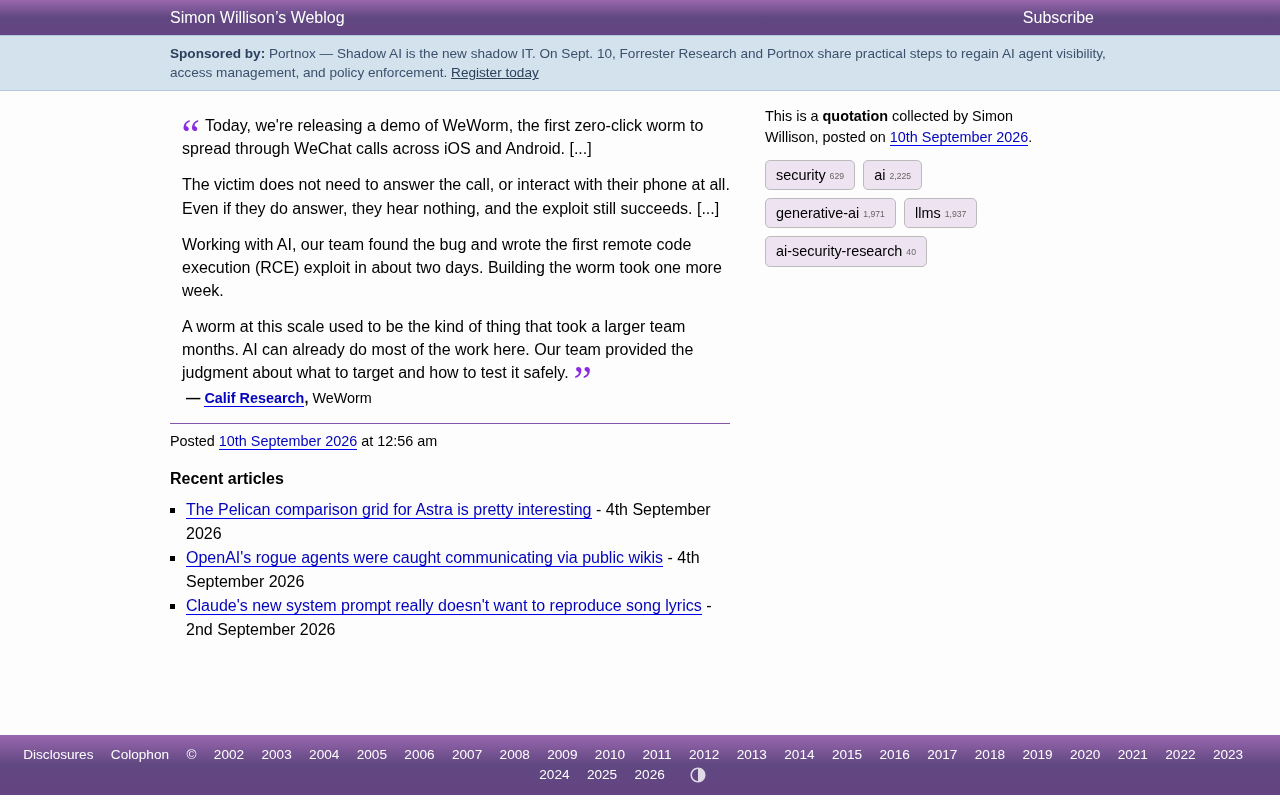
The Calif Research team has published a groundbreaking security study: with AI assistance, they discovered a zero-click vulnerability in WeChat's calling system in just two days and developed WeWorm, the first worm capable of spreading across both iOS and Android platforms. This case demonstrates how AI technology is fundamentally shifting the efficiency balance between offensive and defensive cybersecurity.
Traditionally, developing a worm of this scale would require a larger team investing months of effort. With AI assistance, the entire process was compressed to under two weeks: two days to discover the vulnerability and develop a remote code execution (RCE) exploit, and one week to build the complete worm propagation mechanism. Remote code execution (RCE) is one of the most critical vulnerability types in the security field — it means an attacker can remotely run arbitrary code on a target device, thereby gaining full control over the victim's device, including reading data, installing backdoors, and accessing the camera and microphone. In the CVSS (Common Vulnerability Scoring System), RCE vulnerabilities are typically rated at a critical severity level of 9.0 or above.
Zero-Click Attacks: A Silent Threat
WeWorm demonstrates an extremely threatening attack model: victims don't need to answer the call, or even interact with their phone in any way. Even if a user does answer the call, they hear nothing — yet the exploit still executes successfully. This zero-click nature makes the attack nearly impossible for ordinary users to detect or defend against.
A zero-click vulnerability is one of the highest-threat categories in security research. Unlike traditional attacks that require users to click a malicious link or download a malicious file, zero-click attacks require absolutely no interaction from the target user. The most famous historical example of a zero-click attack is the Pegasus spyware developed by NSO Group, which exploited zero-click vulnerabilities in iMessage to compromise the iPhones of journalists and political activists in multiple countries, sparking a worldwide debate over the regulation of commercial spyware.
The danger of this attack method lies in its stealth and automated propagation capability. The worm leverages WeChat's calling feature to jump from one device to another without the user's knowledge, forming a chain of infection. Given WeChat's penetration rate in the Chinese market, the potential impact of such an attack is extraordinarily wide-reaching.
As a super-app with over 1.3 billion monthly active users worldwide, WeChat's attack surface far exceeds that of an ordinary messaging tool. WeChat not only handles text, voice, and video communication but also integrates payments (WeChat Pay), mini programs, official accounts, enterprise services, and a vast surrounding ecosystem. Its VoIP (Voice over IP) subsystem involves complex audio and video codec processing, typically implemented in memory-unsafe languages like C/C++ for performance — which is precisely the high-risk zone for memory vulnerabilities such as buffer overflows and heap overflows. More critically, WeChat's calling feature must process data packets from the other party during the signaling phase of connection establishment, meaning the device is already parsing potentially malicious data before the user decides whether to answer — providing a natural exploitation window for zero-click attacks.
Worms are not a new concept — a worm is a type of malware that can self-replicate and spread autonomously across networks. Unlike ordinary viruses, worms do not need to attach to a host file. The most impactful worms in history include SQL Slammer in 2003 (which infected 75,000 servers worldwide in just 10 minutes), WannaCry in 2017 (which leveraged the NSA-leaked EternalBlue exploit to sweep across 150 countries), and Stuxnet in 2010 (which targeted Iranian nuclear facilities). However, what makes WeWorm unique is that it is the first worm to simultaneously spread across both the iOS and Android mobile platforms — a technically rare achievement, since the two operating systems have fundamentally different architectures, security models, and sandboxing mechanisms. Breaking through both requires finding and exploiting vulnerabilities specific to each platform.
The Role AI Played in Vulnerability Discovery
The Calif Research team noted that AI is now capable of handling the majority of the work in this type of security research. In this case, AI primarily handled:
- Vulnerability discovery: Rapidly analyzing code and system architecture to identify potential security weaknesses
- Exploit development: Automatically generating and testing exploit code
- Code writing: Implementing the worm's propagation logic and infection mechanisms
AI applications in security research have evolved along several mature technical paths. At the static analysis level, large language models (LLMs) can rapidly audit large volumes of source code or decompiled binary code, identifying common vulnerability patterns such as buffer overflows, integer overflows, and Use-After-Free. At the dynamic analysis level, AI can optimize input generation strategies for fuzzing — a testing method that feeds large amounts of random or semi-random data into a target program to trigger abnormal behavior. By learning from code coverage feedback, AI can more efficiently explore program execution paths and discover vulnerabilities hidden in deep logic. During the exploit development phase, AI can also assist in constructing ROP chains (Return-Oriented Programming Chains) and bypassing modern defense mechanisms such as ASLR (Address Space Layout Randomization) and DEP (Data Execution Prevention). Google's Project Zero team and DARPA's AIxCC competition have demonstrated that AI can achieve efficiency several times — or even tens of times — greater than human experts in these areas.
The value of the human research team lies in providing strategic judgment: selecting attack targets, designing test plans, and ensuring research is conducted in a safe, controlled environment. This "AI executes + humans decide" collaboration model is becoming the new paradigm in security research.
New Challenges for Cybersecurity
This research carries a dual message. From a defensive perspective, it exposes potentially serious security risks in mainstream communication apps, reminding security teams to reassess their zero-click attack surfaces. From an offensive perspective, AI has lowered the barrier to advanced exploitation — work that once required top-tier security experts spending months could now be rapidly replicated by moderately skilled attackers with AI assistance.
This shift in asymmetry demands a corresponding adjustment from the security industry: on one hand, accelerating vulnerability patching and defensive deployment; on the other, exploring how to leverage AI to enhance defensive capabilities and establish an AI-driven balance between offense and defense.
Calif Research's decision to publicly disclose this research rather than secretly exploit it reflects the principle of responsible disclosure. Responsible disclosure, also known as Coordinated Vulnerability Disclosure (CVD), is an industry norm that has evolved over time within the security research community. The core process involves researchers privately notifying the affected vendor after discovering a vulnerability, granting them a reasonable remediation window (typically 90 days, a standard first established by Google Project Zero), and only publicly disclosing vulnerability details after the vendor has released a patch. This mechanism balances the tension between the public's right to know and security risk management.
But this also raises new questions: when AI makes security research this efficient, ensuring that similar capabilities are not misused will become a challenge the entire industry must face together. Now that AI has dramatically shortened the vulnerability discovery cycle, traditional disclosure mechanisms face new pressures — if malicious attackers are also using AI to discover the same vulnerabilities in extremely short timeframes, a 90-day remediation window may be far from sufficient. This is prompting the industry to consider whether a new vulnerability disclosure framework is needed for the AI era, and how to find a new balance between openness in security research and the prevention of weaponization.
Key Takeaways
Related articles
Understanding GitHub's Availability Report: Platform Stability and Developer Response Strategies
Deep dive into GitHub's monthly availability report: analyzing service degradation impacts, CI/CD fault tolerance, and platform dependency risk strategies for resilient development.

OpenAI's Claim of Solving a Millennium Prize Problem Sparks Academic Controversy
OpenAI claims its AI solved a Millennium Prize Problem, sparking debates over attribution, verification, and AI's role in reshaping mathematical research.

Ledoit-Wolf Covariance Shrinkage in Practice: 57% Lower Turnover + 10x GPU Acceleration
Learn how Ledoit-Wolf covariance shrinkage reduces portfolio turnover by up to 57% and how cuML GPU acceleration cuts backtest time from 1.5 hours to 9 minutes.