AI-Assisted Mathematical Proofs: No More Hallucinations, Becoming a New Partner in Discovery
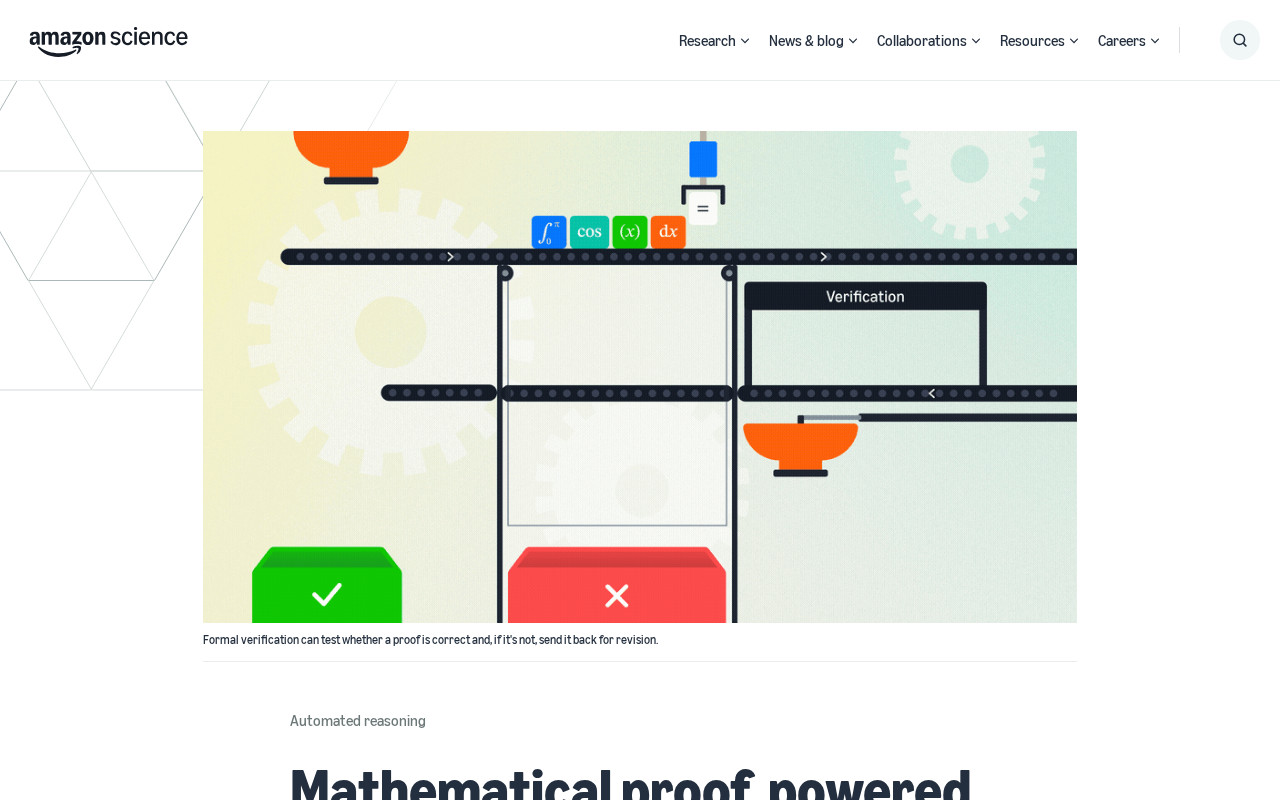
New AI tools check proofs in real time during construction, centering on verification to avoid hallucinations and become collaborators for mathematicians.
The article explores AI's new role in mathematical proofs: shifting from a potentially hallucinating generator to a real-time verification collaborator. New tools can instantly check logical validity during proof construction, reducing error accumulation risk and establishing trust. This "no hallucination" design does not guarantee AI never errs but places verification at the core to ensure output can be rigorously tested. AI is positioned as a collaborator for mathematicians, leveraging the strengths of human intuition and AI computation, with the potential to accelerate mathematical discovery and proof verification. In the future, AI may further participate in generating proof sketches and discovering literature connections, but rigorous verification remains a prerequisite.
Mathematical proofs have long been the exclusive domain of human intelligence, but AI is changing that. Recently emerged new tools make checking mathematical proofs easier—even verifying them in real time while the proof is being constructed—marking AI's emergence as a valuable partner in mathematical discovery.
From "Hallucination" to "Verifiability": The Shifting Role of AI in Mathematics
The "hallucination" problem of generative AI has long been criticized, especially in mathematics, a field demanding absolute rigor where a single erroneous step can collapse an entire proof. However, the core idea behind these new tools is not to have AI directly generate proofs, but to assist mathematicians in checking proofs—verifying them while they are being constructed. This amounts to adding a real-time error-correction mechanism to mathematical proofs, greatly reducing the risk of unreliable AI output.
According to the original report, these tools "make checking mathematical proofs easier—even while they are being built." This means AI is no longer a potentially babbling "black box," but a verification partner that can collaborate with mathematicians. By combining AI's computational power with human intuition, the efficiency of mathematical discovery is expected to improve significantly.
The "hallucination" of generative AI refers to the model generating content that appears plausible but contradicts facts or logic. In mathematics, this manifests as fabricating non-existent theorems, skipping critical steps, or incorrectly citing lemmas. Since large language models essentially generate text based on probability rather than performing symbolic reasoning, their output cannot guarantee logical correctness. Therefore, directly having AI generate complete proofs carries extremely high risk. Current tools instead focus on the "verification" stage: using formal proof assistants (such as Lean, Coq) or automated theorem provers to perform machine-checkable rigorous validation of proof steps. These systems are based on type theory or first-order logic, where every deductive step must conform to formal rules, thereby instantly detecting errors during construction and fundamentally avoiding the unreliability caused by hallucinations.
Why "No Hallucinations" Is Crucial in Mathematics
Mathematical proofs require every step to be logically rigorous, and any unproven leap can invalidate the entire proof. Traditionally, proof checking relies on peer review, a lengthy process that may miss errors. The intervention of AI tools—especially those capable of real-time checking during construction—can instantly identify logical gaps and prevent errors from accumulating.
This "no hallucination" characteristic does not mean AI never makes mistakes, but rather that the tools' design places verification at the core, ensuring output can be rigorously tested. This establishes a foundation of trust for AI's application in mathematics—mathematicians can confidently treat AI as a collaborator rather than worrying about being misled.
Formal verification is the key technical path to ensuring mathematical proofs are free of hallucinations. It translates mathematical proofs into machine-understandable code, with a kernel checking logical validity line by line. Common formal systems include Lean, Coq, and Isabelle, which are based on constructive type theory or higher-order logic, requiring every reasoning step to strictly follow axioms and inference rules. Unlike natural language proofs, formal proofs have no "obvious" or "easily proven" leaps—any omission causes the check to fail. In recent years, Lean's mathematical library mathlib has come to include a large body of modern mathematical results, providing infrastructure for AI-assisted verification. By translating AI-generated proof sketches into formal code, mathematicians can leverage machines to ensure every step is correct, thereby obtaining rigorous correctness guarantees while preserving creativity.
AI as a Partner in Mathematical Discovery: Collaboration, Not Replacement
The report notes that AI is becoming a "valuable partner" in mathematical discovery. This positioning emphasizes collaboration rather than replacement. Mathematicians propose conjectures and construct proof frameworks, while AI checks the logical validity of each step and may even suggest potential proof paths. This division of labor leverages each party's strengths: humans excel at creative thinking and intuition, while AI excels at rapid computation and pattern recognition.
As tools become more user-friendly, more mathematicians—including non-AI experts—can integrate AI into their daily workflows. This could accelerate the pace of mathematical research, especially in verifying complex proofs.
Future Outlook: Smarter Mathematical Assistants
Currently these tools focus mainly on proof checking, but it is foreseeable that AI's role in mathematics will deepen further. For example, AI might help generate proof sketches that humans then refine and verify, or discover potential connections across vast mathematical literature. The key is that any AI output requires rigorous verification, and the new tools are designed precisely for this purpose.
The era of AI-assisted mathematical proofs has begun, and the promise of "no hallucinations" makes this process more reliable. For mathematical researchers and those interested in AI applications, this is undoubtedly a trend worth watching.
One-line Summary
New AI tools check mathematical proofs in real time during construction, placing verification at the core to avoid hallucinations and become collaborators for mathematicians.
Paragraph Summary
The article explores AI's new role in mathematical proofs: shifting from a potentially hallucinating generator to a real-time verification collaborator. New tools can instantly check logical validity during proof construction, reducing the risk of error accumulation and establishing a foundation of trust. This "no hallucination" design does not guarantee AI never errs, but places verification at the core to ensure output can be rigorously tested. AI is positioned as a collaborator for mathematicians, leveraging the respective strengths of human intuition and AI computation, with the potential to accelerate mathematical discovery and proof verification. In the future, AI may further participate in generating proof sketches and discovering connections in literature, but rigorous verification remains a prerequisite.
Related articles
AI Cracks the Riemann Hypothesis? The Million-Dollar Prize Battle
The Riemann Hypothesis million-dollar prize sparks a debate over scientific discovery in the AI era: Levent Alpoj's Claude-assisted 17-million-line Lean proof passes independent verification, while the manual draft still has errors. The Clay Institute's rules do not explicitly ban AI, but the gap between verifiability and understandability has become the core controversy.
AI Solves the 167-Year-Old Riemann Hypothesis? Formal Proof Sets the Math World Ablaze
The 167-year-old Riemann Hypothesis gets a formal proof: Levent Alpoge and Claude release 17 million lines of Lean code, verified by independent checkers. This article explains the link between prime counting and zeta zeros, the limits of machine verification, and AI's role in mathematical discovery.
AI and Humans Team Up to Crack the Riemann Hypothesis? The Truth Behind a 167-Year-Old Math Problem
The Riemann Hypothesis remains unsolved, yet rumors claim AI and humans have proven it. This article examines the conjecture, the AI rumors, and what a real proof requires.