AI-Assisted Penetration Testing: A Complete Guide from Weak Password Discovery to SRC Monetization

A complete guide to using AI tools for weak password vulnerability discovery and SRC bounty submission.
This article covers the full workflow of AI-assisted penetration testing focused on weak password vulnerabilities, from distinguishing front-end and back-end login portals to locating admin panels using Google Dorking, directory scanning, and subdomain enumeration. It explores how AI tools like Claude Code enhance efficiency through automated script generation, code auditing, and SRC report standardization, while emphasizing legal compliance and ethical boundaries.
Introduction: AI Is Transforming Vulnerability Discovery Efficiency
In the cybersecurity field, vulnerability discovery has long relied on security researchers' accumulated experience and manual operations. With the introduction of AI tools (such as Claude Code), the entire chain from information gathering and admin panel discovery to vulnerability verification is being redefined. This article uses the most fundamental yet classic vulnerability type—weak passwords—as an entry point to outline the complete methodology of vulnerability discovery and explore how AI can enhance efficiency in penetration testing.
It's important to emphasize that all technical discussions in this article are premised on legally authorized penetration testing and compliant submission to SRCs (Security Response Centers). SRCs are official channels established by enterprises to receive vulnerability reports from external security researchers. Major Chinese internet companies such as Tencent (TSRC), Alibaba (ASRC), and ByteDance (BSRC) all maintain independent security response centers, and there are also third-party aggregation platforms like Butian and Vulbox. SRCs typically classify vulnerabilities into four severity levels: Low, Medium, High, and Critical. The rating of a weak password vulnerability depends on the importance of the affected system and the scope of accessible privileges—a front-end weak password on an ordinary business system might only be rated as Low, while a weak password on a core administrative backend could be classified as High or even Critical. Researchers must strictly follow the principle of minimal verification when submitting—meaning they only need to prove the vulnerability exists and must not further exploit it to access, modify, or delete data. Unauthorized attacks constitute criminal offenses. This article aims to help security professionals understand offensive and defensive principles.
Basic Concepts of Weak Passwords and Brute Force Attacks
Weak passwords, also known as password brute force guessing, represent one of the oldest yet most effective attack methods. The core logic is straightforward: if an administrator sets a password that's too simple (e.g., admin/123456), an attacker can guess the correct password through dictionary or exhaustive enumeration methods.
While this sounds low-threshold, its actual impact is extremely significant. Once an admin backend account is compromised, attackers often gain the highest level of system privileges.
From a technical implementation perspective, weak password attacks can be divided into three main approaches: Dictionary Attack, which uses pre-compiled lists of common passwords for attempts—efficient but dependent on dictionary quality; Brute Force, which traverses all possible character combinations—theoretically capable of cracking any password but extremely time-consuming; and Credential Stuffing, which uses username-password pairs leaked from other platforms to attempt login, exploiting users' habit of reusing passwords across platforms. According to Verizon's 2024 Data Breach Investigations Report, over 80% of hacking incidents are related to weak passwords or stolen credentials, making weak passwords a consistently high-priority risk item in the OWASP Top 10 and various security baselines.
The Essential Difference Between Front-End and Back-End Login
To understand the value of weak password vulnerabilities, you first need to distinguish between two types of login entry points:
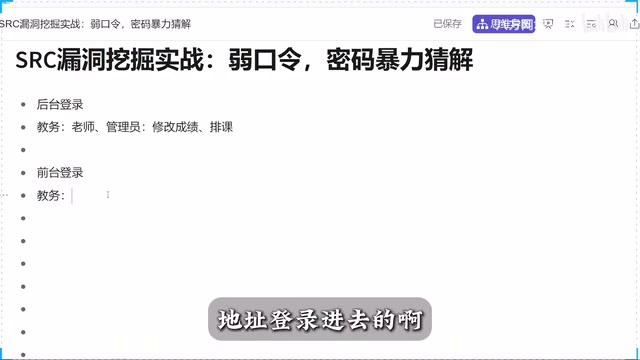
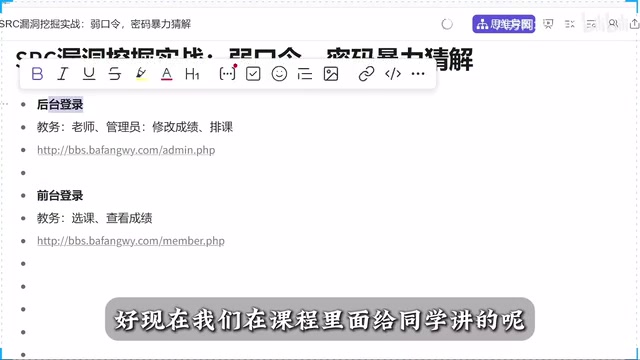
- Front-end login: Designed for regular users. Taking an academic management system as an example, after students log in through the front-end, they can only select courses and check grades—permissions are limited.
- Back-end login: Designed for administrators. After teachers or admins log in, they can modify grades, schedule courses, and configure system settings—permissions are extensive.
Taking an internal vulnerability discussion forum as an example, the login page in the upper right corner corresponds to member.php, which is clearly a front-end login address—all users enter through here. After logging in, regular users can only post, browse, and comment.
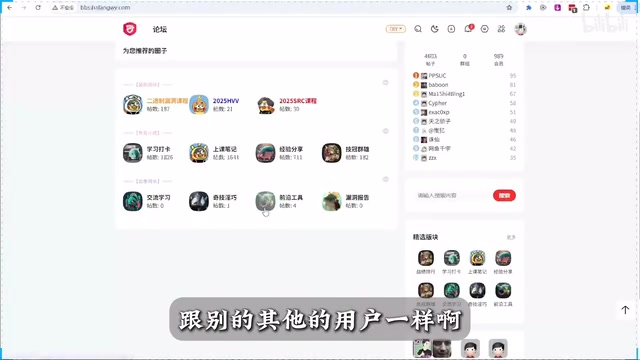
However, this system also contains a hidden entry point invisible to regular users—admin.php. This is a login address exclusively for backend administrators. One detail worth noting: when accessing the backend in an unauthenticated state, both username and password are required; but when entering the backend while already logged into the front-end, only the password is needed.
Why Finding Backend Login Addresses Is Critical in Penetration Testing
From an attacker's perspective, the backend is far more valuable than the front-end, for straightforward reasons:
- More functionality: Backend menus are rich, covering user auditing, website management, system configuration, and more.
- Higher privileges: Access to more sensitive data, and even the ability to upload shells, control, or download server files.
- More compelling proof of impact: For penetration testing and SRC submissions, demonstrating greater impact means higher vulnerability ratings and larger bounties.
In other words, never underestimate an administrator setting an overly simple password—the impact and business value behind it are extremely high. A single weak password vulnerability could be the leverage point that compromises an entire system.
Main Methods for Locating Backend Login Addresses
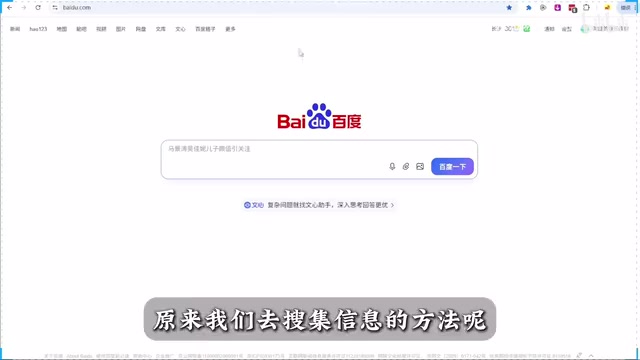
Finding the backend entry point is a prerequisite for weak password attacks. Here are several mainstream information gathering methods, the most basic being search engine advanced syntax.
Method 1: Using Search Engine Advanced Syntax to Locate Backends
Many people simply type keywords when using search engines, but major search engines actually support advanced filtering syntax. In the security field, this technique is commonly called Google Dorking or Google Hacking, first systematically organized and published by security researcher Johnny Long in 2002. The principle leverages search engine indexing mechanisms to precisely filter results using specific search operators. For example:
intitle:后台登录
Here, title refers to the webpage title. After using this syntax, the returned results are no longer introductory pages containing the keyword in the body text, but actual login pages with terms like "backend management" or "backend login" directly in their titles.
Beyond intitle, other commonly used search operators include: inurl (restricts URLs to contain specific paths, e.g., inurl:admin/login.php can locate login pages developed in PHP with admin in the backend path), site (restricts search to a specific domain), filetype (restricts file type), and more. GHDB (Google Hacking Database) is a public collection of Dork statements containing thousands of search syntax entries targeting different systems and vulnerability types. It's worth noting that Chinese platforms like Fofa and Hunter (鹰图) also support similar advanced syntax and can provide richer asset dimension information such as open ports, component fingerprints, and certificate details—often proving more efficient than general search engines in actual penetration testing.
Through this approach, you can batch-filter large numbers of backend login addresses, far more efficiently than manual inspection one by one.
Method 2: Directory Scanning and Subdomain Brute Forcing
In the systematic study of cybersecurity, you'll encounter multiple methods for locating entry points:
- Directory scanning: When the system's directories or entry points are unknown, hidden paths can be discovered through directory brute forcing. The core principle involves probing potential paths on the target web server via HTTP requests one by one, determining whether directories or files are accessible based on returned status codes (e.g., 200 means exists, 403 means forbidden, 404 means not found). Common tools include dirsearch, gobuster, feroxbuster, and ffuf, which typically rely on pre-built path dictionaries (such as common backend path lists from the SecLists project).
- JS file analysis: Extracting API endpoints and hidden entry points from front-end JavaScript files. Tools like LinkFinder and JSFinder can automatically extract API endpoints and hidden URLs from JavaScript files—information that often reveals management interfaces that developers didn't intentionally expose but are actually accessible.
- Subdomain brute forcing: Some companies bind separate domains for login entry points, and subdomain enumeration can discover these independent entry points. Subdomain discovery techniques include DNS dictionary brute forcing and Certificate Transparency Logs queries, with common tools being subfinder, amass, and OneForAll.
These tools collectively form the automated arsenal for the information gathering phase of penetration testing. In practice, they often need to be used in combination to obtain a relatively complete attack surface view, laying the groundwork for subsequent vulnerability verification.
How AI Tools Enhance Vulnerability Discovery Efficiency
In traditional workflows, every step from information gathering to backend discovery to weak password verification requires researchers to execute manually and make judgments. AI coding assistants represented by Claude Code are bringing significant efficiency improvements to this chain. The essence is grafting large language models' code generation, semantic understanding, and text organization capabilities onto security workflows:
- Automated script generation: AI can quickly generate scripts for directory scanning, dictionary building, and batch verification based on target characteristics, reducing repetitive labor. For example, researchers need only describe requirements in natural language (such as "write a Python script that reads a URL list, attempts common backend paths, and logs results returning 200 status codes"), and AI can generate usable scripts within minutes, dramatically compressing development work that would otherwise take hours.
- Assisted code auditing: When authorized source code is available, AI can help quickly locate code segments that may contain weak password logic or authentication flaws. AI excels at pattern recognition—for example, identifying hardcoded default passwords, unsalted hash storage, missing Rate Limiting on login attempts, and other common security defects.
- SRC report standardization: SRC submissions require clear vulnerability descriptions, reproduction steps, and proof of impact. AI can help organize these into standards-compliant reports, improving approval rates.
It's important to maintain a clear-eyed understanding that AI is an efficiency multiplier, not a replacement. AI's limitations are equally apparent: it lacks deep understanding of the target's business context, cannot independently determine which assets fall within the authorized scope, and struggles to accurately assess a vulnerability's actual impact in specific business scenarios. Additionally, attack scripts generated by AI may contain false positive logic or trigger characteristics of the target's WAF (Web Application Firewall), still requiring manual review and tuning. Therefore, at the current stage, AI's most appropriate positioning in security is as an "intelligent co-pilot," with human security researchers maintaining decision-making authority and compliance boundaries. It cannot replace researchers' understanding of business logic, judgment of impact boundaries, and most importantly—compliance awareness.
Conclusion: Technology as Shield, Compliance as Boundary
Although weak passwords are an entry-level vulnerability, they embody the complete vulnerability discovery methodology: distinguishing entry points, locating backends, verifying passwords, and assessing impact. The addition of AI multiplies the execution efficiency of this penetration testing process, but also raises higher demands for practitioners' compliance standards.
Regardless of how tools evolve, the value of security research always lies in discovering problems, fixing problems, and protecting systems. All technical capabilities should be exercised within the framework of authorized testing and compliant submission. Only in this way can AI-assisted vulnerability discovery truly become a force driving the healthy development of the cybersecurity ecosystem.
Related articles

Uber Deploys ChatGPT Work Company-Wide: AI in the Workplace Enters the Scaled Implementation Phase
Uber deploys ChatGPT Work to 30,000+ employees, extending it from engineering to all roles. We analyze its expert-engineer pairing, end-to-end automation, and questions of AI control and power concentration—insights for scaling AI in the workplace.

Shift at Midnight Hands-On: When "ID Verification" Becomes Alien Hunting
Shift at Midnight blends ID verification with horror survival in a four-player co-op game. We break down its inspection mechanics and chaotic humor.

Zelensky Recounts the Outbreak of War: I Need Ammunition, Not a Ride
Zelensky recalls the first day of war in a YouTube interview: farewell to family, rejecting Biden's evacuation offer with "I need ammunition, not a ride," and how Bucha shaped his stance on compromise and peace talks.