AI-Assisted Proof of Crouzeix's Conjecture: A Doctor Uses GPT to Crack a 20-Year-Old Math Problem

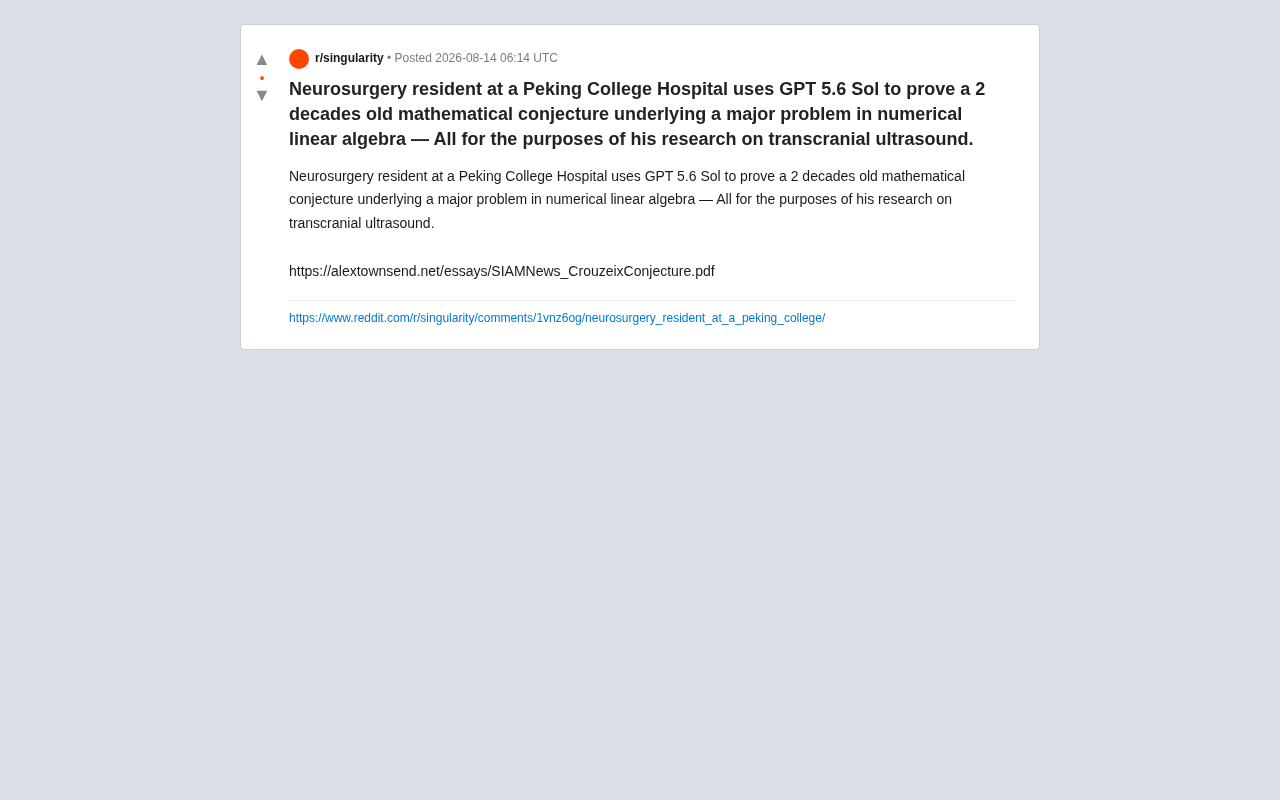
A neurosurgeon used GPT during ultrasound research and accidentally tackled a 20-year-old math conjecture.
A neurosurgery resident in Beijing, while researching transcranial ultrasound, used a GPT model to address a computational challenge and unexpectedly provided a proof approach for Crouzeix's Conjecture — a 20-year unsolved problem in numerical linear algebra. This cross-disciplinary case highlights how AI tools are democratizing advanced research, enabling non-specialists to engage with frontier mathematics and accelerating knowledge flow across fields.
An Unexpected Cross-Disciplinary Breakthrough
Amid the wave of AI-assisted scientific research, a case from the medical field has attracted widespread attention: a neurosurgery resident at a prestigious hospital in Beijing, while conducting research on transcranial ultrasound, used a GPT large language model tool and unexpectedly provided a proof strategy for a mathematical conjecture in numerical linear algebra that had remained unsolved for twenty years.
The dramatic appeal of this story lies in its cross-disciplinary nature — a clinician focused on brain surgery originally set out to solve a specific computational problem in his own research, only to inadvertently touch upon a long-standing core proposition in mathematics. This also reflects how today's AI tools are breaking down disciplinary barriers, enabling non-specialist researchers to engage with the frontiers of advanced mathematics.
Crouzeix's Conjecture: A Core Proposition That Has Puzzled Mathematicians for 20 Years
According to an article published by Alex Townsend in SIAM News, the mathematical proposition in question is very likely the famous Crouzeix's Conjecture. This conjecture was formally proposed by French mathematician Michel Crouzeix around 2004 and sits at the intersection of matrix analysis and numerical linear algebra.
To appreciate the significance of this conjecture, one must first understand the mathematical context in which it resides. Matrix analysis is one of the cornerstones of modern mathematics and applied science, and norm estimates for matrix functions — that is, "how the 'size' of a matrix is controlled after applying some functional transformation" — constitute one of the most central families of problems in this field. As early as 1951, John von Neumann proved the famous von Neumann inequality: for any contraction operator T (i.e., an operator with norm not exceeding 1) and any polynomial p, we have ‖p(T)‖ ≤ sup{|p(z)| : |z| ≤ 1}. This result can be viewed as a precursor to Crouzeix's conjecture in a special case — the version where the numerical range of the matrix degenerates to the unit disk and the constant is 1. Crouzeix's conjecture attempts to generalize this idea to arbitrary matrices and arbitrary analytic functions, but at the cost of increasing the constant from 1 to 2.
The Core Content of the Conjecture
Crouzeix's conjecture can be roughly stated as follows: for any complex matrix A and any complex analytic function f defined on its numerical range, there exists a constant upper bound such that the operator norm satisfies:
‖f(A)‖ ≤ 2 · sup{|f(z)| : z ∈ W(A)}
where W(A) denotes the numerical range of matrix A. The numerical range is defined as the set W(A) = {x*Ax : x ∈ Cⁿ, ‖x‖ = 1}, i.e., the region in the complex plane spanned by the quadratic forms of all unit vectors through matrix A. A key property of the numerical range, guaranteed by the Toeplitz-Hausdorff theorem, is that it is always a convex compact set in the complex plane. This means the numerical range contains more information about the "geometric behavior" of a matrix than the set of its eigenvalues (spectrum): the spectrum only tells us about scaling along eigenvector directions, while the numerical range also encodes how the matrix acts in all directions, including the "off-diagonal" effects unique to non-normal matrices.
The crucial point is the constant 2 — Crouzeix conjectured that this upper bound constant is exactly 2, neither larger nor smaller.
This seemingly concise inequality is fundamentally connected to the stability of matrix function approximation in numerical computation, directly affecting the precision analysis of a vast number of scientific computing and engineering simulation tasks. Over twenty years, mathematicians proved that the constant does not exceed 1+√2 (approximately 2.414), but were never able to tighten it to the theoretical value of 2. This result was proven by Crouzeix himself in 2007, and in the decade-plus that followed, although Crouzeix and Palencia completely resolved the 2×2 matrix case in 2017, progress on the general case remained stalled. This state of being "tantalizingly close to the finish line yet unable to cross it" is a typical predicament for many deep mathematical conjectures — existing tools are just barely insufficient, and a new breakthrough requires some yet-to-be-discovered structural insight.
How Medical Research Encountered a Pure Math Problem
Transcranial ultrasound is a technology that uses ultrasonic waves to penetrate the skull for brain tissue imaging or treatment. In recent years, the clinical applications of transcranial ultrasound have been rapidly expanding — from traditional transcranial Doppler blood flow detection to emerging Low-Intensity Focused Ultrasound (LIFU) neuromodulation and blood-brain barrier opening techniques. However, the skull presents an extremely challenging medium for ultrasound: the human skull consists of a three-layer structure alternating between compact bone and cancellous bone, producing strong acoustic wave attenuation, refraction, and phase aberration effects. This means that to accurately predict the focal position and energy distribution of ultrasound waves in brain tissue after penetrating the skull, one must rely on high-precision numerical simulation.
In such research, investigators typically use Finite Element Methods (FEM) or pseudospectral methods to discretize and solve the partial differential equations governing acoustic wave propagation (such as the Helmholtz equation or full-wave equation). The discretization process transforms the continuous wave equation into large-scale linear systems or matrix eigenvalue problems, and the convergence speed and numerical stability of iterative algorithms used to solve these systems — such as Krylov subspace methods (GMRES, Arnoldi iteration, etc.) — depend precisely on accurate estimates of matrix function norms. More specifically, when the system matrix is highly non-normal — which is extremely common in simulations of acoustic wave propagation through inhomogeneous media — traditional eigenvalue-based analysis methods can severely underestimate transient growth effects, while analysis based on the numerical range (i.e., the framework addressed by Crouzeix's conjecture) provides more reliable estimates.
It was precisely while dealing with these numerical stability issues that the resident encountered a mathematical barrier related to Crouzeix's conjecture. He input the problem into an AI model for assisted reasoning, and the model's analysis happened to touch upon the core structure of this classic conjecture.
This process reveals a thought-provoking phenomenon: the underlying mathematical structures of modern scientific problems are often universal. A medical imaging problem may share the exact same mathematical core as an abstract proposition that has been debated in pure mathematics for years. In fact, this phenomenon is not uncommon in the history of science — Fourier analysis was born from the study of heat conduction, Ramanujan's theory of modular forms was discovered a century later to be intimately related to black hole entropy calculations in string theory, and the mathematical foundation of modern compressed sensing (the RIP condition) simultaneously connects signal processing, statistics, and high-dimensional geometry. The value of AI tools lies precisely in helping researchers quickly identify these deep connections and bridge knowledge gaps across disciplines.
What Role Does AI Play in Mathematical Proofs?
In recent years, AI-assisted mathematical research is no longer headline news. From DeepMind's AlphaProof achieving silver-medal-level performance at the International Mathematical Olympiad to Terence Tao publicly discussing the use of GPT-type models to assist with formal proofs, AI is gradually entering the workflow of serious mathematical research.
It's worth elaborating that AI-assisted mathematical research has now formed a multi-layered technical ecosystem. At the lowest level, formal proof assistants such as Lean 4, Coq, and Isabelle/HOL provide rigorous logical verification frameworks — they don't "discover" theorems, but can confirm in a machine-verifiable way whether each step of a proof is valid. In 2023, Terence Tao and collaborators used Lean 4 to formalize his proof of the Polynomial Freiman-Ruzsa Conjecture, demonstrating a mature model of collaboration between human mathematicians and formalization tools. At the middle level, specialized mathematical AI systems such as DeepMind's AlphaProof and AlphaGeometry represent another approach: AlphaProof combines AlphaZero-style reinforcement learning with the Lean formal language, solving 4 problems at the 2024 IMO (including an extremely difficult combinatorics problem) with a total score reaching the silver medal threshold; AlphaGeometry, through a neuro-symbolic hybrid architecture, achieved geometry olympiad gold-medal level performance without using human training data. At the top level, general-purpose large language models (such as GPT-4, Claude, etc.), while still having obvious shortcomings in strict logical reasoning — they can "hallucinate" proof steps that seem plausible but are actually incorrect — demonstrate unique value in pattern recognition, cross-domain analogies, literature synthesis, and proof strategy inspiration. The doctor in this case used precisely this tier of tools.
The Need for a Cautious Perspective
However, we should remain rational about reports of "AI proving mathematical problems":
- Rigor of verification: The value of a mathematical proof lies in its rigor. AI-generated reasoning chains must undergo rigorous review by human mathematicians and peer review before being formally accepted by the mathematical community. Historically, many seemingly complete proofs have been found to contain critical gaps during the review process — for example, Mochizuki's proposed "proof" of the ABC conjecture has still not gained broad acceptance in the mathematical community after more than a decade. AI-generated reasoning chains, due to their statistical nature, may contain arguments that appear logically coherent on the surface but actually skip critical steps, requiring extra caution during review.
- Boundaries of contribution: AI more often plays the role of an "inspiration catalyst" and "reasoning assistant" rather than an independent agent completing proofs on its own. True breakthroughs still typically require the researcher's judgment and verification. As Terence Tao has remarked, current AI is more like "an unreliable but occasionally stunningly insightful graduate student" — you can't fully trust every step of its derivation, but the unconventional perspectives it occasionally offers might be precisely the blind spots in human experts' habitual thinking.
- Accuracy of information: Specific details mentioned in the original reports, such as the exact model version used, should be treated with caution. Proof details should be verified against formally published academic literature.
What Does This Case Mean for the Future of Research?
Regardless of whether the final mathematical proof fully holds up, this case reveals profound changes in the research paradigm of the AI era:
Tools are democratizing high-end research capabilities. The fact that a clinical physician could engage with the frontiers of pure mathematics demonstrates that AI has significantly lowered the barrier to cross-disciplinary exploration. Problems that previously required mathematicians years of accumulated expertise to understand can now be approached by ordinary researchers with AI assistance. This "democratization of tools" is not without historical precedent — the Open Access movement of the internet era broke down paywalls around academic papers, the arXiv preprint server accelerated the dissemination of research results, and open-source programming ecosystems like Python/R made statistical analysis and machine learning accessible beyond computer scientists. AI large language models represent the latest stage of this democratization process, and the most dramatic leap yet: they lower not only the barrier to accessing knowledge but also the barrier to using knowledge for creative reasoning.
Cross-disciplinary intersection will give rise to more unexpected discoveries. When researchers in medicine, physics, computer science, and other fields can all conveniently access foundational mathematical tools, the flow of knowledge between different domains will accelerate, producing more "unexpected" breakthroughs. The most profound advances in the history of science have often occurred at disciplinary boundaries: physicist Witten's interpretation of the Jones polynomial through topological quantum field theory completely transformed low-dimensional topology, biologists Hodgkin and Huxley's neuron model catalyzed the development of nonlinear dynamical systems theory, and Shannon's information theory simultaneously rewrote the landscapes of communications engineering and statistical mechanics. AI tools have the potential to dramatically increase the frequency and density of such cross-disciplinary "collisions."
Human-AI collaboration is the future paradigm of research. The protagonist of this story is neither pure AI nor a solitary human, but the synergy between the two. AI provides breadth and speed of reasoning, while humans provide domain judgment and rigorous verification. This collaborative model may evolve into the standard workflow for future research: researchers pose questions and constraints, AI generates candidate solutions and reasoning paths, researchers filter, refine, and verify — forming an iterative "human-AI dialogue" loop.
Conclusion
The story of a neurosurgeon using AI to engage with a twenty-year-old mathematical conjecture, regardless of the specifics, is a vivid microcosm of the transformation in the research ecosystem of our era. It reminds us that perhaps the most exciting value of AI lies not in replacing human experts, but in enabling every curious researcher to stand on the shoulders of giants and see further.
Of course, true scientific rigor will not be diminished by advances in tools — any major breakthrough must ultimately withstand the test of peer review and time.
Related articles

Build an AI Super Employee System at Zero Cost: A Full Breakdown of Automated Agent Workflows
A deep breakdown of the AI super employee system demoed on Bilibili: agent orchestration, digital human voiceovers, map and enterprise lead generation, 24/7 customer service, and legal modules. We analyze the business logic and compliance risks behind zero-cost signup to help entrepreneurs judge the real ROI of this AI digital employee system.

The Essential Difference Between Chatbots and AI Agents: Crossing from Conversation to Execution
What's the difference between a chatbot and an AI agent? Based on the MCP series on the Learn Tech channel, this article uses examples like booking flights and summarizing notes to explain: a chatbot only gives answers, while an agent actually completes tasks through a think-act-observe loop. It breaks down the four core components—model, tools, memory, and goal—as well as MCP's role as a bridge, and discusses agents' applicable boundaries and permission risks.

Free GitHub Repo: 342 Hours of AI Courses, from Math to MCP Servers
A free GitHub repo offers 342 hours of AI courses: 523 lessons across 20 phases, from math fundamentals to agent building and MCP servers. Nearly 100,000 learners have started.