AI Beyond Q&A: OpenAI and Databricks Join Forces to Transform Enterprise Workflows

Databricks and OpenAI partner to move AI from Q&A to governed execution of code, data, and business processes.
Databricks and OpenAI have announced a collaboration arguing that frontier models must connect to enterprise data, business context, and governance to truly deliver. It spans three paths: ChatGPT with Genie for business-user data exploration; Codex with Unity Gateway for governed enterprise coding; and GPT models with Databricks Apps to embed AI into business processes. The article notes the enterprise AI bottleneck has shifted from model capability to data access and compliance governance, with effectiveness depending on real-workflow implementation depth.
AI Beyond Q&A: OpenAI and Databricks Join Forces to Transform Enterprise Workflows
AI is moving beyond the boundaries of "Q&A." It's starting to write code, analyze data, and even take over complete business processes. But one repeatedly validated fact remains: powerful models alone aren't enough—they need access to the right enterprise data, business context, and governance mechanisms. That's exactly the question Databricks and OpenAI's latest collaboration aims to answer.
According to Databricks' official announcement on social media, the collaboration centers on three directions to bring frontier AI into enterprises, built on the data and control systems enterprises already rely on.
From "Answering Questions" to "Executing Work"
Over the past two years, the primary interaction mode for large models has been conversation: users ask, models answer. This mode performs well for knowledge retrieval and content generation, but real enterprise workflows go far beyond that. Code needs to be written and maintained, data needs to be cleaned and analyzed, and business processes need to coordinate across systems. What these all have in common is that they depend on internal enterprise data, permissions, and business rules.
Databricks' statement highlights the key contradiction: no matter how capable a model is, if it can't access the right company data, doesn't understand business context, and doesn't meet governance requirements, it can't truly take on production-grade tasks. In other words, the bottleneck for enterprise AI has shifted from "is the model smart enough" to "can the model securely and compliantly connect to the enterprise environment."
Three Implementation Paths: ChatGPT+Genie, Codex+Unity Gateway, GPT+Databricks Apps
This collaboration offers three concrete directions, each corresponding to different types of users.
Business Users: ChatGPT + Genie Accelerates Daily Work
Genie is Databricks' product for data exploration. Combined with ChatGPT's interaction capabilities, its target audience is business users. Business people often don't write SQL or know table structures, but they have countless questions that need answers from data. Connecting a natural language interface with the underlying data platform can shorten the path from "posing a business question" to "getting a data conclusion."
Genie is a natural language data exploration and visualization product launched by Databricks, an extension of what was formerly Databricks Assistant. It allows users to query the data warehouse directly in natural language, with the system automatically generating SQL, executing it, and returning charts or conclusions—no manual query writing required. Genie relies on metadata, table structures, and semantic information provided by Unity Catalog, so it answers within permission boundaries and avoids unauthorized access. For enterprises, Genie's value lies in lowering the barrier to data consumption from data analysts down to frontline business users, while retaining centralized governance and audit capabilities.
Developers: Codex + Unity Gateway Enables Enterprise-Grade Governed Coding
Coding is one of the fastest areas for AI adoption, but also where governance risk concentrates most. Code touches sensitive data, gets deployed to production, and introduces third-party dependencies. Databricks mentions achieving enterprise-grade governed coding through Codex and Unity Gateway. Unity Gateway's role can be understood as establishing a controlled channel between code generation and enterprise data assets, so AI-assisted coding doesn't bypass existing permission and audit systems.
Unity Gateway can be understood as a gating component of Databricks' data governance layer, Unity Catalog, for AI and external tools. It acts as an intermediary between code generation tools (such as Codex) and enterprise data assets: on one hand, it exposes table metadata, access policies, and lineage to AI-assisted tools so the code they generate conforms to real data structures; on the other hand, it enforces permission checks and operation audits on every access, preventing AI from bypassing existing access controls. Compared with handing database credentials directly to coding models, this gateway design turns "what AI can see and change" into centrally configurable policies—a key prerequisite for enterprise-grade coding assistants.
Business Processes: GPT Models + Databricks Apps Transform Workflows
The third direction points to broader process transformation. Databricks Apps provides application-building capabilities. Combined with GPT models, enterprises can embed AI capabilities into specific business processes rather than stopping at single-point tools. The value at this layer is that AI is no longer a standalone window but an execution step within the process.
Databricks Apps is Databricks' one-stop application hosting service that allows developers to build, deploy, and run web applications directly within the data platform without separately maintaining servers or frontend infrastructure. Apps can natively call Databricks' data, model services, and permission systems, with built-in data boundaries and audit capabilities. Combined with GPT models, enterprises can package AI-driven approvals, reporting, customer support, and other processes into internal applications, letting model outputs connect directly to business systems rather than manually moving results from external chat windows. This is the technical foundation for moving from "single-point tools" to "process execution steps."
Governance Is Not an Add-On, But a Prerequisite
Across all three directions, the recurring keywords are "governance" and "the data and controls enterprises already rely on." This reveals an industry trend: when enterprises purchase AI, model performance is only one evaluation dimension—data boundaries, permission systems, and audit capabilities are equally decisive.
Databricks emphasizes that the collaboration is "built on the data and controls enterprises already rely on," meaning enterprises don't need to rebuild their data infrastructure just to use AI. For organizations already using Databricks, this path has lower migration costs and is easier to pass internal compliance reviews.
From a broader perspective, the combination of frontier model vendors and data platforms is becoming a common form of enterprise AI. Models provide reasoning capabilities, platforms provide data and governance—neither can be missing. The Databricks-OpenAI collaboration is another example of this model, and its actual effectiveness depends on how deeply these three directions are implemented in real enterprise workflows.
To learn more about how they work together, see the official link: https://t.co/8RH6XDvst5
One-line Summary
Databricks and OpenAI partner to move AI from Q&A to governed execution of code, data, and business processes.
Paragraph Summary
Databricks and OpenAI have announced a collaboration asserting that frontier models must connect to enterprise data, business context, and governance mechanisms to truly deliver. The collaboration spans three paths: ChatGPT combined with Genie for business-user data exploration; Codex combined with Unity Gateway for controlled enterprise-grade coding; and GPT models combined with Databricks Apps to embed AI into specific business processes. The article notes that the enterprise AI bottleneck has shifted from model capability to data access and compliance governance, and that the collaboration builds on existing enterprise data and control systems to reduce migration and compliance costs—with actual effectiveness depending on how deeply these paths are implemented in real workflows.
Related articles
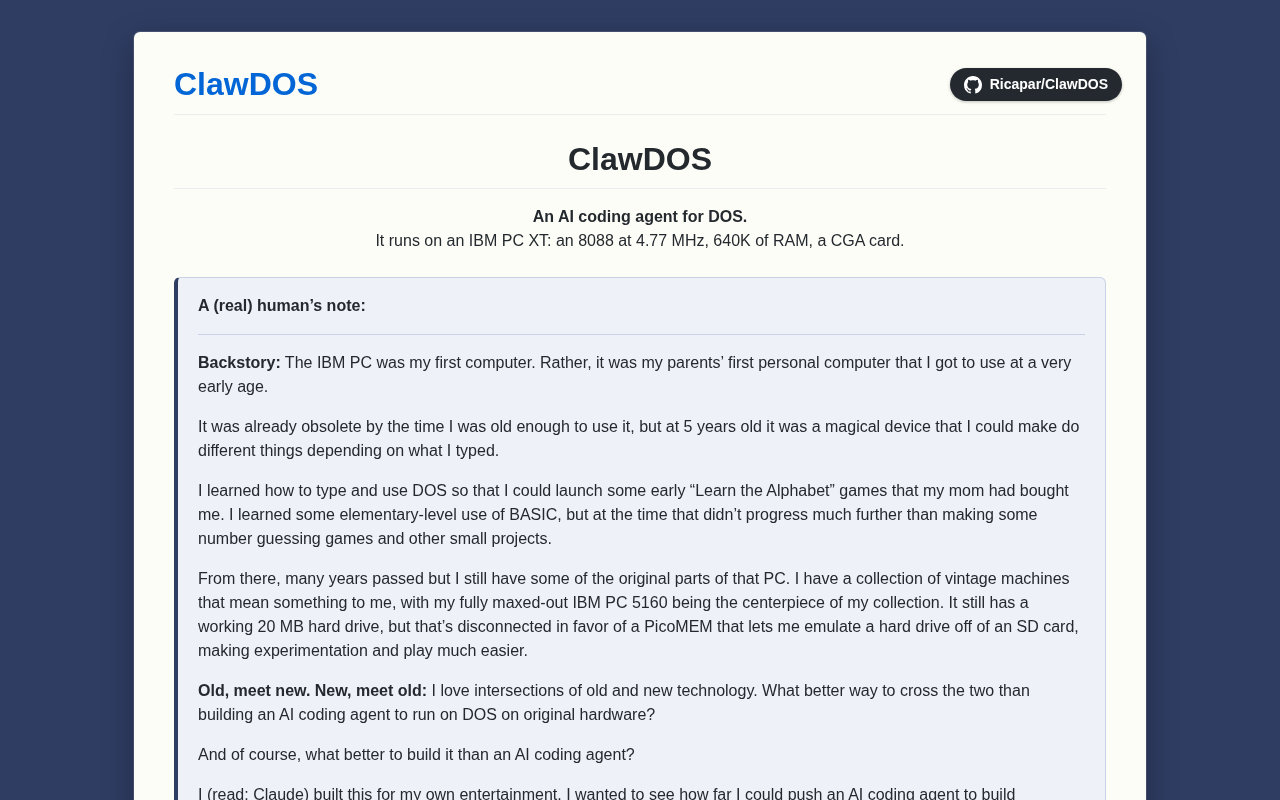
ClawDOS: Bringing AI Coding Capabilities to DOS
ClawDOS is an AI coding agent project for DOS, exploring the possibility of bringing AI coding assistance into resource-constrained retro computing environments. This article analyzes its positioning, use cases, and community response.

Baseten Releases Bison-1 and Groundhog-1, Topping the Decision Model Leaderboard
Baseten releases open-weight decision models bison-1 and groundhog-1 built on Gemma 4; bison-1 scores 76 on the AA Decision Index v2.1 to top the leaderboard. Both support 128k context and image input—here we analyze their capability combination, benchmark significance, and selection advice for developers.

Cline CLI v3.0.75 Released: Yolo Mode Now Default for One-Shot Runs
Cline CLI v3.0.75: one-shot runs now default to yolo mode, --timeout and Ctrl+C can interrupt the first round, read_files is no longer truncated to 8k chars, plus reasoning parameter fixes and 94 new providers.