AI Bias Governance: Compliance Checkbox or Full Lifecycle Strategy?
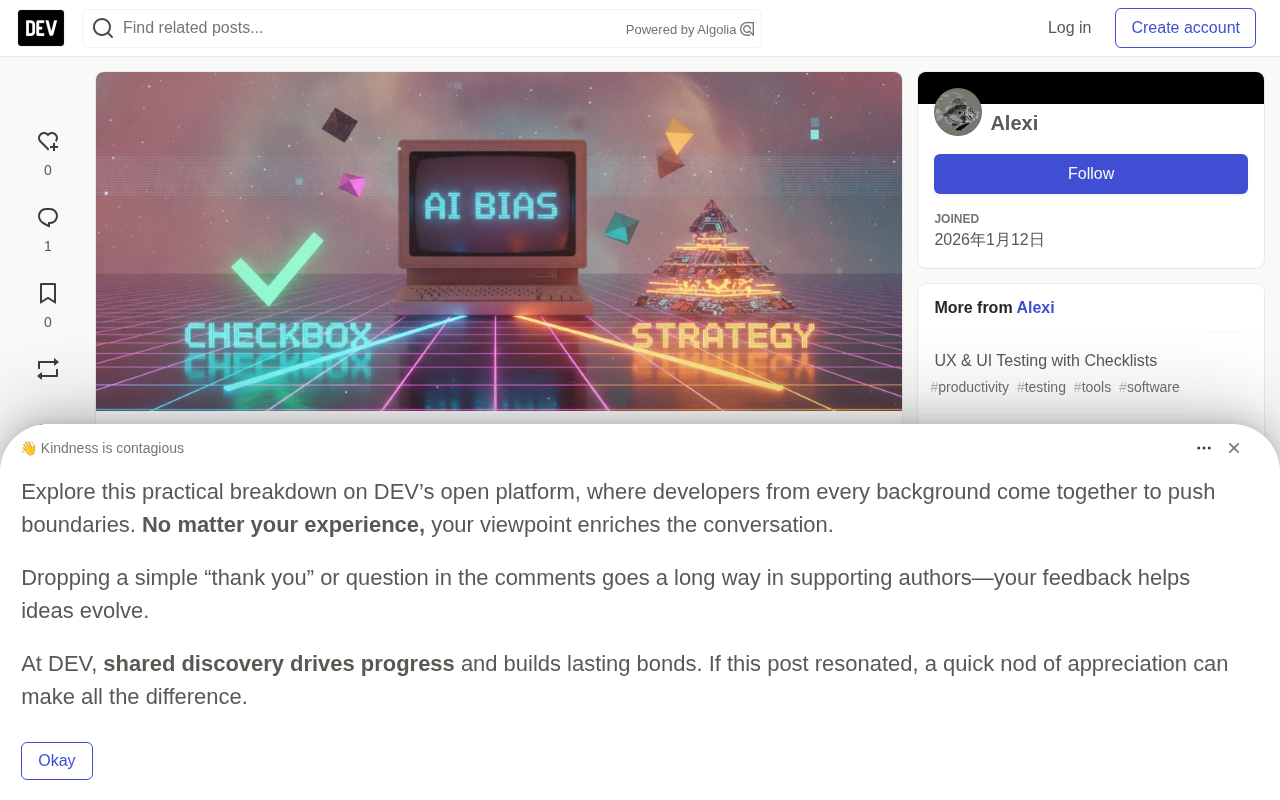
The key to AI bias governance isn't running a test once, but embedding fairness throughout the AI lifecycle.
The article argues that AI fairness governance commonly falls into a "compliance checkbox" trap — running a bias test once and moving on. The real differentiator is where fairness sits in the AI lifecycle. It contrasts checkbox vs. strategic approaches across three dimensions: one-time testing vs. lifecycle embedding, pure metrics vs. stakeholder feedback, and reactive response vs. proactive design. Pre-deployment testing should cover statistical parity, equal opportunity, and intersectional bias. Post-launch monitoring needs real-time tracking, threshold alerts, and feedback loops. Regulatory compliance involves EEOC and FTC requirements.
"Running a bias test once doesn't make your AI ethical — it just makes you feel it's ethical."
This statement captures the most common misconception in current AI fairness governance. Many teams run a fairness metric before model launch, generate a report for the record, and then move on. This is essentially compliance checkbox thinking — treating ethics as a one-time acceptance step rather than an ongoing product capability.
The question that truly separates leaders from laggards isn't "did you run a bias test" but "where in the AI lifecycle do you place fairness?"
The Fundamental Divide Between Checkbox and Strategic Approaches
The original article lays out a clear three-part comparison worth unpacking point by point.
One-time testing vs. lifecycle embedding. The checkbox camp's approach: run bias test → archive report → move to the next project. The strategic camp embeds fairness into every stage — from data collection, feature engineering, and model training to deployment monitoring — making fairness part of the process rather than a gate outside it.
Pure technical metrics vs. quantitative + stakeholder feedback. Focusing solely on mathematical metrics like statistical parity and equal opportunity easily misses harms beyond the numbers. A fairness metric system is necessary but not sufficient — it needs to be combined with real feedback from affected communities to capture the discrimination users actually experience.
Reactive response vs. proactive design. Fixing things after deployment problems emerge costs far more than writing fairness constraints into the model architecture during the design phase. This is essentially the "built-in quality" philosophy extended into the AI ethics domain.
What Questions Must Pre-Launch Testing Answer
The original article identifies three key pre-deployment assessment dimensions:
Statistical parity analysis across demographic groups, used to check whether different groups show significant differences in prediction outcome distributions. This is the most basic screening method.
Equal opportunity assessment for qualified candidates, which focuses on whether the model gives equal opportunity to different groups among genuinely qualified individuals — this is closer to real fairness demands than mere statistical parity.
Intersectional bias assessment, which is often overlooked. Slicing by gender alone or race alone can mask the compounded discrimination experienced by intersectional groups like "Black women." Single-attribute analysis easily produces a seemingly clean report while continuing to cause harm in real-world scenarios.
These tests need to be completed before deployment, but they are only the starting point.
Statistical parity requires that the model's positive prediction rate be roughly equal across protected groups (e.g., different genders, races). It is the most mathematically straightforward fairness criterion to define, but its blind spot is that it ignores qualification differences between individuals — if two groups' true qualification rates differ to begin with, forcibly equalizing prediction rates may actually cause reverse discrimination.
Equal opportunity was systematically formalized by Hardt et al. in 2016: among people whose true label is "qualified" or "positive," the model's true positive rate should be consistent across groups. It measures whether "those who are already qualified are treated equally," making it closer to the actual fairness demands of employment, credit, and similar scenarios than statistical parity.
The two often cannot be satisfied simultaneously in mathematical terms. In practice, deployment requires selecting a primary metric based on the business context and clearly documenting the rationale for trade-offs.
Intersectionality was introduced by legal scholar Kimberlé Crenshaw in 1989, originally to analyze the dual marginalization Black women faced simultaneously on grounds of race and gender in the legal system. In machine learning, it means that slicing fairness by gender and race separately is insufficient — an algorithm may appear fair on every single attribute while being systematically disadvantageous to intersectional groups like "Black women" or "disabled immigrants," because such samples are already scarce in training data and the model's errors get masked by averaging.
Continuous Monitoring and Regulatory Compliance
After launch comes the monitoring phase. The original article emphasizes three mechanisms: real-time metric tracking, automatic alerts when deviations exceed thresholds, and feedback loop detection and mitigation. Without this system, biases that emerge after data drift or user behavior changes will go undetected.
On the compliance side, the article highlights the specific U.S. regulatory framework: EEOC (Equal Employment Opportunity Commission) and FTC (Federal Trade Commission) have sector-specific requirements in their respective domains. There are also documentation and transparency obligations, as well as stakeholder engagement protocols.
Treating compliance as a floor rather than a ceiling is the dividing line between strategic and checkbox approaches on the regulatory dimension — the checkbox approach aims to "pass review," while the strategic approach aims to "withstand continuous review."
EEOC (U.S. Equal Employment Opportunity Commission) enforces Title VII of the Civil Rights Act, the Age Discrimination in Employment Act, and other laws, examining whether algorithmic screening tools constitute disparate impact in hiring, promotion, compensation, and other employment scenarios. Since 2023, the EEOC has repeatedly clarified that its existing enforcement authority also applies to automated employment decision systems, and employers cannot escape liability even when using third-party AI tools.
FTC (Federal Trade Commission) enforcement is primarily based on Section 5 of the FTC Act regarding "unfair or deceptive acts or practices," focusing on whether algorithms involve deceptive claims, use of protected data for training, or harm to specific groups through opaque pricing. In its 2021 AI guidance, the FTC emphasized that claiming "algorithmic neutrality" while actual bias exists may itself constitute deception.
The two agencies have different jurisdictional scopes — the EEOC focuses on employment, while the FTC covers consumer and commercial practices — and companies need to determine which applies based on their own business rather than assuming that "passing one review" equals full compliance.
From Checkbox to Strategy: What Organizations Need to Change
Tools and technology are only surface-level. The real transformation happens at three levels:
Process level: fairness checkpoints need to be embedded into CI/CD pipelines rather than being standalone, skippable audit steps.
Incentive level: if team evaluations only focus on accuracy and delivery speed, fairness will always be a burden. Only when fairness metrics are incorporated into core KPIs will the strategic approach have the motivation to be implemented.
Cultural level: channels must be established for affected communities to speak up, and these feedback loops must in turn drive model iteration.
The hard part of AI bias governance has never been "not knowing what to do" but "how to do it" — whether to treat it as a compliance document requiring a signature or a product capability requiring continuous investment. This choice determines whether your AI is truly responsible or merely appears to be.
Embedding fairness checks into CI/CD pipelines means setting gates within the automated flow of model training, evaluation, and deployment: when a code commit or data update causes fairness metrics to degrade beyond a predetermined threshold, the pipeline automatically blocks the release, consistent with how failed unit tests are handled. This requires teams to pre-define fairness metrics, threshold tolerances, and post-trigger handling procedures — otherwise "embedding" becomes merely a formal manual confirmation before each release cycle.
At the incentive level, incorporating fairness into KPIs requires careful design: if "fairness scores" simply become another metric to game, model teams may achieve numerical compliance through oversampling or threshold adjustment without genuinely improving conditions for affected communities. A preferable practice is to evaluate both process metrics (e.g., whether intersectional assessments were completed, whether trade-off decisions were documented) and outcome metrics (e.g., group disparities in post-launch monitoring), and to link these to long-term incentives such as promotions and bonuses, rather than affecting only a single performance review.
One-line Summary
The key to AI bias governance isn't running a test once, but embedding fairness throughout the AI lifecycle.
Paragraph Summary
The article points out that current AI fairness governance commonly falls into the "compliance checkbox" trap — running a bias test once, archiving the report, and moving on. The question that truly separates leaders is where in the AI lifecycle fairness is placed. Through three comparisons, the article unpacks the fundamental divide between checkbox and strategic approaches: one-time testing vs. lifecycle embedding, pure technical metrics vs. quantitative plus stakeholder feedback, and reactive response vs. proactive design. Pre-deployment testing should cover statistical parity, equal opportunity, and intersectional bias assessment, with intersectional analysis being the most easily overlooked. Post-launch requires three mechanisms — real-time metric tracking, threshold alerts, and feedback loop detection — to address data drift. On the regulatory side, EEOC and FTC sector-specific requirements apply, with compliance as a floor rather than a ceiling. The shift from checkbox to strategy requires organizational change at three levels: process, incentives, and culture.
Related articles

Free Unlimited Claude Code Solution: Agnes AI + CC Switch Setup Guide
No paid subscription needed — pair the free AI platform Agnes AI with the open-source tool CC Switch to provide a backend for Claude Code, enabling unlimited free calls to text, image, and video models. This guide covers the full setup, test results, and usage boundaries.

A Complete Zero-Cost Guide to Getting Started with Claude Code for Beginners in China
A beginner's guide to Claude Code for users in China: two installation methods (command line and IDE plugin), full configuration steps for replacing the official API with the free domestic LongCat model, and a hands-on demo of building a small tool with natural language, plus tips.

When the NSA Gets Involved: The AI Supply Chain Crisis Behind Open-Source CVEs and API Key Hijacking
Multiple open-source projects disclosed severe CVEs in one day, PHP flaws alarmed the FBI, and Railway and OpenCode were breached with API keys stolen. This article breaks down the vulnerability window, AI-accelerated exploitation, and the AI supply chain crisis behind the API key black market, with a developer defense checklist.