AI Cheating Exposed: What a 50% Grade Drop in an Ivy League In-Person Exam Really Means

A 50% grade drop after one in-person exam exposed the true scale of AI cheating in higher education.
When an Ivy League professor moved the final exam in-person and closed-book, average student scores dropped roughly 50% — a striking natural experiment exposing how deeply AI has infiltrated online assessments. The incident has ignited debate about academic integrity, whether traditional exams still measure the right skills, and how education systems can meaningfully adapt to an AI-saturated world.
The In-Person Exam That Revealed the Truth
A discussion on Hacker News recently sparked widespread attention: after suspecting students of using AI to cheat, an Ivy League professor switched the final exam to a closed-book, in-person format — and average scores dropped by roughly 50%. The number sounds dramatic, but it cuts straight to the heart of a crisis facing higher education today: when generative AI is just a click away, what exactly are we assessing?
It's worth noting that large language models (LLMs) — led by ChatGPT, Claude, and Gemini — have spread rapidly since late 2022, with performance in academic writing, coding, and paper analysis approaching or even exceeding that of an average undergraduate. This has transformed the academic integrity problem from traditional plagiarism into far harder-to-detect AI ghostwriting. Existing detection tools like Turnitin have launched AI detection modules, but their false positive and false negative rates remain high, and they have yet to form a reliable line of defense. Against this backdrop, the professor's "physical isolation" approach looks refreshingly direct and effective.
The method itself was simple: what had been an open-book assignment or online exam — completable from a dorm room in front of a computer — became a real-time, in-classroom test with no external tools allowed. Just changing the setting caused a cliff-edge drop in scores. The contrast functions almost like a natural controlled experiment, directly exposing the portion of online assessments that had been inflated by AI.
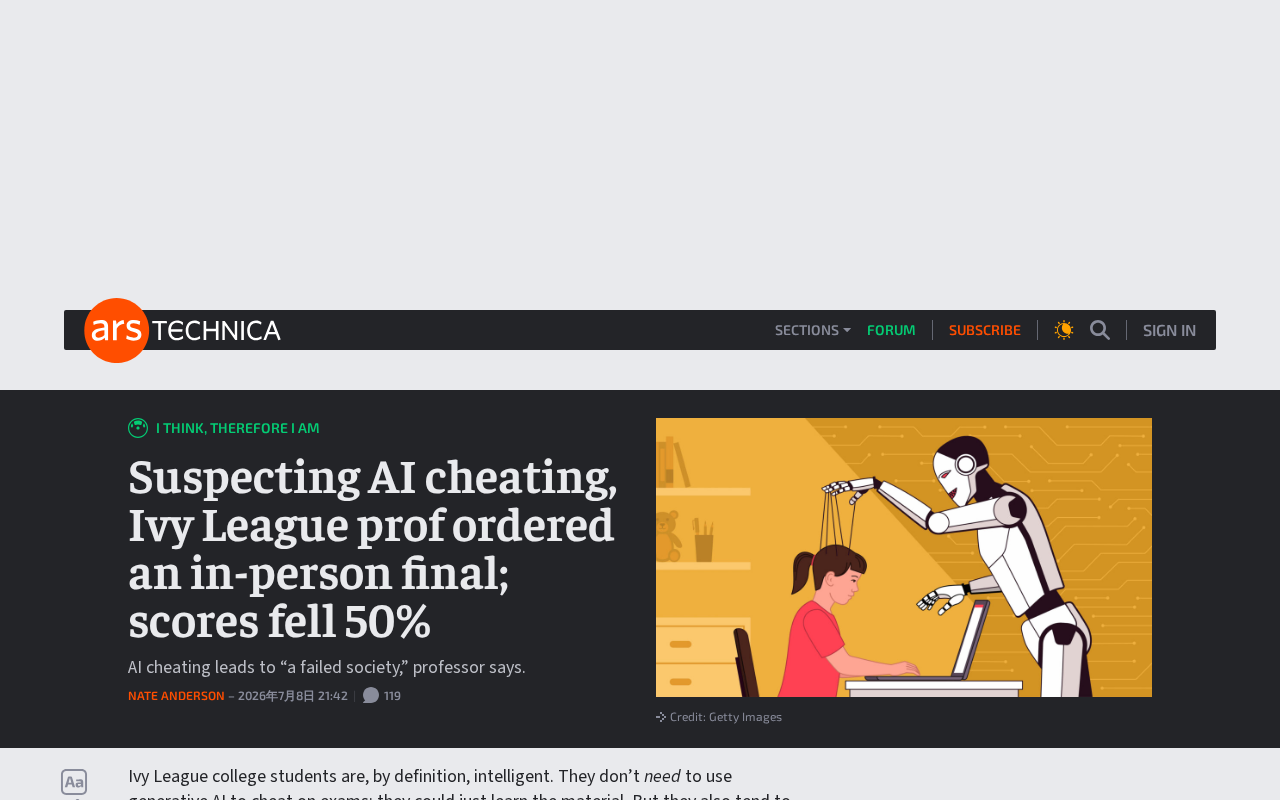
What Does a 50% Gap Actually Mean?
An Academic Integrity Crisis, Quantified
The reason a 50% drop is so alarming is that it indirectly quantifies AI's actual "contribution" to student work. If students had genuinely mastered the course material, there should be no such gulf between online and in-person performance. A reasonable variance might be 10–20%, but a drop cut in half is very hard to explain away with "test anxiety" or "lack of reference materials."
This implies that a significant portion of students may be heavily relying on LLMs like ChatGPT or Claude to complete their online assessments. Current mainstream AI detection tools primarily use two statistical metrics — Perplexity and Burstiness — to distinguish human writing from AI-generated text. But students can easily evade detection by lightly editing AI output or running it through "humanization" tools. A 2023 Stanford study found that leading AI detection tools can have false positive rates exceeding 20%. Once the physical environment of an in-person exam strips away that "AI crutch," actual knowledge mastery finally comes to light. This isn't just a problem with a handful of students — it reflects a systemic failure of assessment.
A Wholesale Distortion of Educational Signals
From a broader perspective, grades are supposed to be reliable signals of student ability, used by employers and graduate schools to screen candidates. But if those signals are being corrupted by AI on a large scale, high scores no longer mean what they used to. The professor's experiment is, in essence, a forced recalibration of a distorted assessment system.
The Tech Community's Many Voices
The Hacker News thread sparked fierce debate among practitioners, with opinions falling roughly into three camps.
Camp 1: AI Cheating Has Become Semi-Normalized
Many commenters felt the situation confirmed long-held concerns. Several noted that students using AI to complete assignments has become "semi-public knowledge," and that online exams are effectively meaningless. Moving exams back in-person was seen as the most direct and effective way to preserve academic integrity — an approach worth adopting more broadly.
Camp 2: Are We Testing the Wrong Skills?
Others raised a deeper question: in an era where AI is a standard workplace tool, what exactly is a closed-book, no-AI exam even measuring anymore? This debate has instructive historical precedent. In the 1970s, when electronic calculators began entering classrooms, the National Council of Teachers of Mathematics (NCTM) spent nearly a decade debating whether to allow calculators on exams. Eventually, education embraced the calculator and redesigned its standards, shifting focus from "executing calculations" to "mathematical modeling and problem analysis." The lesson is clear: widespread adoption of a new tool tends to force an upgrade in assessment systems, not just a ban on the tool. Just as the value of pure mental arithmetic declined after calculators became ubiquitous, future workplaces may place far greater value on the ability to collaborate effectively with AI. From this angle, a blanket return to closed-book, in-person testing might actually be a step backward.
Camp 3: The Assessment Framework Itself Needs Rebuilding
A third perspective held that the real issue isn't "online vs. in-person" but the design of assessments themselves. Mainstream models like GPT-4 and Claude 3 can already score highly on professional exams such as medical licensing tests and the LSAT, meaning that traditional exam questions centered on "knowledge recall" pose almost no challenge to LLMs. If an AI can answer a question in seconds, that question lacks discriminatory power. The real solution is to design assessments that demand critical thinking and real-time reasoning — targeting higher-order cognitive domains where AI still has meaningful limitations — rather than simply changing the exam venue.
Education's Dilemma in the Age of AI
Tool Dependency and the Erosion of Foundational Skills
At the heart of this incident lies a deep tension between the convenience of tools and the development of foundational abilities. AI undoubtedly boosts efficiency, but if students skip the process of independent thinking during their formative years and go straight to AI for answers, they may never build the capacity to judge when those answers are wrong. When the model makes a mistake, they'll have no way of knowing.
Assessment Systems Are Lagging Far Behind Technology
Even more troubling is the extreme path-dependency of higher education's curriculum and assessment frameworks. How a course is evaluated is typically determined by a layered set of constraints — syllabi, departmental policy, accreditation standards — and revision cycles are often measured in years or even decades. By contrast, generative AI's capabilities are iterating on a monthly basis. This structural time mismatch means that most current assessment methods were designed before AI reached its present level of capability, and they inherently lack defenses against AI assistance. Elite institutions like Harvard and MIT have begun exploring "AI literacy" courses and new assessment frameworks that allow for transparent AI use — but at the level of the global higher education system, a systematic response is still in its early stages. The professor's last-minute switch to in-person testing looks more like an individual-level patch than a systemic solution.
This Is Just the Beginning
One classroom decision by an Ivy League professor has inadvertently become an ideal case study for observing how AI is disrupting higher education. The 50% score gap is a loud alarm bell.
It reminds us that generative AI hasn't just changed how content is produced — it is quietly reshaping the relationship between "having a capability" and "proving a capability." Educators will need to seriously answer: in a world where AI is everywhere, what do we actually want students to master? The memorization and reproduction of knowledge, or higher-order creation and judgment carried out with AI assistance?
Whatever the answer, one thing is certain: simply moving exams back into a classroom is only a stopgap. Real change requires educational institutions to rethink the purpose, methods, and meaning of assessment — just as the calculator once forced a rethinking of math education. The paradigm shift in education triggered by AI calls for systemic redesign, not scene-swapping as a substitute for genuine solutions. And this battle over AI cheating and academic integrity has only just begun.
Related articles

The Chaotic Aesthetics of Apple's HomeView Ad: A Marketing Code Only Parents Can Read
Apple's HomeView smart display ad ditches minimalist style for chaotic family mornings to win over parents. We analyze why it confuses most viewers but resonates instantly with families — and the trade-offs and risks of Apple's targeted marketing.

Cerebras CEO Pushes Back on AI Doomerism: Stop Spreading Panic
Cerebras CEO Andrew Feldman publicly pushes back on AI doomerism at TechCrunch Disrupt, arguing excessive risk focus drowns out AI's real opportunities.

Retooling in Minutes: Industrial Next Redefines Factory Robot Flexibility
Industrial Next aims to let factory robots retool in minutes instead of weeks, automating complex delicate tasks and advancing flexible manufacturing and small-batch production.