Cerebras CEO Pushes Back on AI Doomerism: Stop Spreading Panic

Cerebras CEO Feldman criticizes AI doomerism at TechCrunch Disrupt, urging focus on AI's real benefits.
Cerebras CEO Andrew Feldman publicly criticized AI doomerism at TechCrunch Disrupt, arguing the industry's excessive focus on existential risk is drowning out AI's real opportunities. His stance reflects the long-standing tension between safety and acceleration camps: frontier labs like OpenAI and Anthropic emphasize alignment and governance, while Feldman's chip industry perspective highlights practical gains in healthcare, science, and productivity. The article notes that behind this debate lie more tangible risks — algorithmic bias, job displacement, data privacy, and compute monopolies — as well as the potential impact of fear narratives on investment confidence and talent flows. Though Feldman's position aligns with his commercial interests, it does bring a marginalized voice back into the spotlight.
At a time when AI industry executives frequently discuss "existential risk," Cerebras CEO Andrew Feldman has chosen a different path — telling those spreading doomer narratives to "shut up."
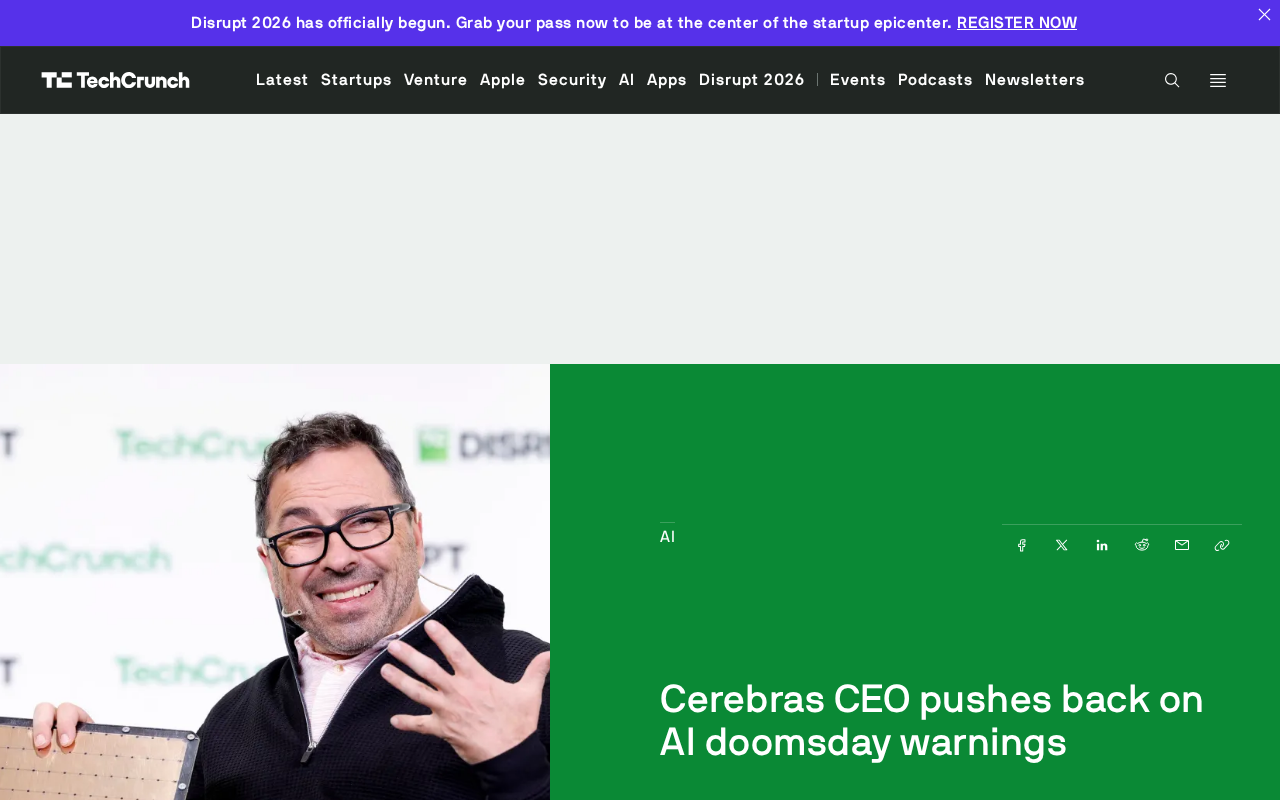
Speaking at TechCrunch Disrupt, Feldman publicly expressed his frustration with AI doomerism. He argued that the industry's excessive focus on AI risks is drowning out the enormous opportunities the technology can genuinely deliver.
"Maybe It's Time to Stop Talking"
Feldman's remarks directly target a prevailing narrative in the AI world: from "AI could cause human extinction" to "superintelligence running out of control," these concerns appear frequently in public statements from leading AI labs, safety initiatives, and even policy hearings.
His position is clear — these discussions aren't without value, but when they occupy nearly all of the public discourse, they distort how the public and policymakers perceive AI. In Feldman's view, overstating risks not only fails to solve real problems but may also slow the pace of technological progress and industrial deployment.
This isn't the first time Feldman has publicly advocated for AI's positive potential. As the head of a company focused on wafer-scale AI compute chips, his stance aligns closely with his business practice: Cerebras's core business is built on the premise that "AI will generate enormous compute demand."
The Disconnect Between Doom Narratives and Industry Reality
Feldman's views have drawn attention because they touch on a long-standing tension within the AI industry: the rivalry between the safety camp and the acceleration camp.
Frontier labs like OpenAI and Anthropic have in recent years repeatedly emphasized the urgency of AI alignment research and safety governance. OpenAI CEO Sam Altman has testified before Congress multiple times about AI's potential dangers, and Anthropic has enshrined "responsible scaling of AI" in its company mission.
Feldman represents a different voice — the medical breakthroughs, scientific discoveries, and productivity gains that AI enables are the topics that deserve more discussion and amplification right now. He worries that if the public and regulators hear only the "extinction risk" story, what ultimately suffers is society's ability to benefit from AI.
This concern is not isolated. In Silicon Valley, a growing number of entrepreneurs and tech executives are voicing wariness about the commercial and political consequences of the "AI safety narrative," arguing it could be used as a tool by large companies to erect regulatory barriers and suppress competition.
AI Alignment: This term was popularized by AI safety researchers such as Stuart Russell. Its core goal is not to enhance model capabilities but to ensure that AI systems' objectives and behaviors remain consistent with human values and intentions. It spans a wide range — from reinforcement learning from human feedback (RLHF) during training, to interpretability and red-teaming, to more frontier efforts like "superalignment" programs. Anthropic's "responsible scaling" policy and OpenAI's alignment team both fall under this framework. What Feldman criticizes as "doomerism" is actually the public expression of the "existential risk" branch within alignment research — the branch that holds that once a misaligned superintelligence emerges, the consequences could be irreversible. It's worth distinguishing, however, that alignment research itself is not synonymous with doomerism; many researchers focus more on practical issues like bias, misuse, and controllability.
The Real Issues Behind the Controversy
While Feldman's remarks are clearly stated, they can't simply be reduced to being "anti-safety."
From an industry perspective, the questions he raises deserve serious consideration: when AI risk discussions are heavily concentrated on science-fiction-style existential threats, the more practical risks — algorithmic bias, job displacement, data privacy, compute monopolies — tend to be overlooked instead.
That said, the spread of doomerism does affect investment confidence and talent flows. If the brightest young researchers are scared off by the narrative that "AI could destroy humanity," the pace of innovation across the field will inevitably slow.
Of course, critics will point out that Feldman, as the CEO of a chip company, naturally leans toward "accelerating development" — which is itself an interest-driven narrative. Safety advocates would counter that it's precisely because the risks are so large that they need to be emphasized repeatedly.
This debate has no simple answer. But Feldman's remarks at TechCrunch Disrupt at least brought a marginalized voice back into the spotlight — when discussing AI's future, fear shouldn't be the only language.
Existential Risk (x-risk): This is the most controversial concept in AI discussions, referring to the possibility that a technology could cause human extinction or permanent civilizational regression. In the AI context, it's typically tied to the "runaway superintelligence" hypothesis: if a system's capabilities vastly exceed human levels and its goals are misaligned, it could theoretically produce uncontrollable consequences. Supporters argue that even if the probability is extremely low, the severity of the outcome warrants prioritizing prevention — a position known as "Pascal's mugging." Opponents point out that such narratives rely heavily on thought experiments and speculation, lack verifiable engineering pathways, and tend to crowd out attention to quantifiable risks like algorithmic bias, job displacement, and compute concentration. Feldman's remarks are a typical representation of the latter position.
Background
Cerebras and Wafer-Scale AI Compute Chips: Cerebras Systems' core product is the Wafer-Scale Engine (WSE), which turns an entire silicon wafer into a single chip rather than cutting it into hundreds of small chips for packaging. This approach dramatically reduces inter-chip communication overhead, giving it a unique memory bandwidth advantage when training large models. Cerebras's business model is built on the assumption that "AI models will keep getting larger and compute demand will grow exponentially," making the company a natural beneficiary of AI acceleration. Understanding this makes it clear why Feldman keeps his distance from "deceleration" and "pause" narratives — both his technology roadmap and business prospects are bets on AI demand continuing to expand.
Related articles

Apple HomeView Hands-On Review: Is the $300 Smart Home Hub Worth It?
Apple HomeView hands-on: a $300 smart home hub with facial recognition for quick account switching, but no App Store or voice recognition. Is the wall-mounted version worth it? Should you buy the first generation?

Meta Muse Wonder Launch: What It Means for Meta's Return to the Frontier AI Race
Meta releases Muse Wonder and WonderFull, benchmarks reach the frontier, community feedback is polarized. An in-depth look at Meta's return to the frontier AI race, its personal agent strategy, and Zuckerberg's different path.

Apple Home Smart Home Lineup Leaked: LG and Schneider Team Up, UWB Door Lock on Board
Apple Home ecosystem gains new LG and Schneider devices: UWB smart lock with proximity unlock, 2.5K dual-camera doorbell, privacy indoor camera, and AirPods-like seamless pairing.