AI Clones Your Voice in 3 Seconds? How Voice Fraud Has Evolved — And How to Protect Yourself

AI can clone your voice from 3 seconds of audio — here's how the scams work and how to stop them.
Zero-shot voice cloning technology can replicate anyone's voice from just 3 seconds of audio, turning everyday social media posts into scam fuel. This article breaks down the three escalating tiers of AI voice fraud — from pre-recorded playback to real-time voice conversion to full audio-visual deepfakes — and offers simple, tech-free defenses like family code words and occlusion tests to protect yourself and your loved ones.
3 Seconds of Audio Is All It Takes to Copy Your Voice
Hard to believe, right? That casual "hello" or "hey" you posted online could be used right now to scam your parents. And all it takes is 3 seconds of audio.
Not long ago, cloning someone's voice required hours of recorded material — feeding data and retraining models in a slow, painstaking process. But the technology has completely changed. A technique known as Zero-shot Voice Cloning can extract your voice's "signature" from just a 3-second reference clip — instantly.
What is Zero-shot Voice Cloning? It's one of the most disruptive breakthroughs in voice AI in recent years. Traditional methods required tens of minutes or even hours of target audio to fine-tune a model. The key innovation behind zero-shot synthesis is that by pre-training on massive multi-speaker datasets, the model learns the universal rules of "voice space" — allowing it to generalize a new speaker's acoustic characteristics from an extremely short reference clip. Notable implementations include Microsoft's VALL-E (released in 2023, requiring only 3 seconds), OpenAI's Voice Engine, and widely-used open-source tools like XTTS and CosyVoice. This fundamental shift has lowered the barrier for voice cloning from "specialized equipment and large datasets" to "a single voice message is enough."

That "signature" includes your vocal timbre, the rise and fall of your speech, and your unique pronunciation habits. These characteristics get compressed into a string of numbers — technically called a Speaker Embedding Vector — think of it as your personal "voice skin."
What is a Speaker Embedding Vector? It's a core component of modern voice AI systems — essentially a method of compressing human vocal characteristics into a high-dimensional mathematical space. Technically, it's generated by a dedicated speaker encoder network (such as d-vector or x-vector architectures), which takes a few seconds of voice spectrogram as input and outputs a fixed-dimension (typically 128–512) floating-point vector. This vector captures identity-related information independent of speech content: vocal tract resonance frequencies (timbre), fundamental frequency range (pitch habits), and articulation style (accent, rhythm). In cloning scenarios, this vector is injected into the conditional control module of a speech synthesis model, so that when generating audio for any text, the model always "wears" the target person's vocal characteristics. Audio recordings of the same person made at different times produce embedding vectors that sit very close together in high-dimensional space — which is the mathematical foundation that allows the system to reliably identify a speaker from a short sample.
Once a scammer has that "skin," they can make you say anything — even words you've never spoken in your life — with convincing authenticity.
Where Does the Voice Data Come From? You Might Be Providing It Yourself
Here's the uncomfortable truth: the raw material for building that "voice skin" is hiding in plain sight in our everyday lives.
Short videos you've posted, a voice message casually dropped into a group chat, even a call you thought was spam where you just said "hello" before hanging up — all of it is more than enough. You think you're just living your life online, but you're unknowingly providing scammers with an endless supply of voice training data.
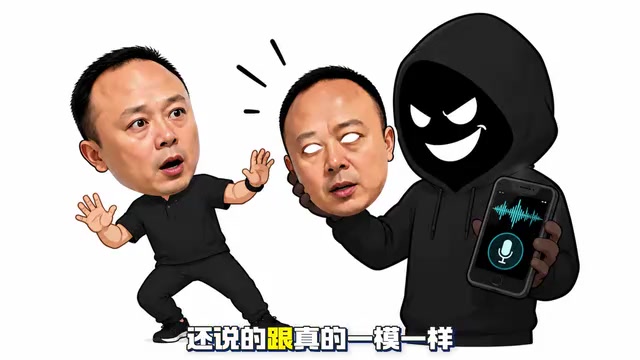
This means that in today's hyper-connected social media world, almost everyone's voice is effectively "exposed." The more transparent our information, the higher the risk. This isn't meant to make you paranoid — it's a reminder that in this era, your voice is no longer a reliable form of identity verification.
The Three Evolutionary Tiers of AI Voice Fraud
AI voice cloning scams haven't stood still. They've developed into a clear "evolution ladder," with each level more deceptive than the last.
Tier 1: Pre-Recorded Audio Playback
This is the most basic entry-level approach. Scammers synthesize an audio clip in advance and simply play the recording during a call. Since there's no real-time interaction, the flaws are relatively easier to spot.
Tier 2: Real-Time Voice Conversion Calls
This is where things get unsettling. The scammer speaks, and the system instantly converts their voice into the target person's voice in real time — enabling live, interactive conversations. This interactivity dramatically increases the success rate of voice scams.
How does real-time voice conversion work? Real-time Voice Conversion is fundamentally different from Text-to-Speech (TTS): TTS generates audio from text, while voice conversion "re-skins" Person A's voice as Person B's voice in real time, with end-to-end latency kept under 200 milliseconds to avoid detectable lag. Current mainstream approaches use streaming architectures based on neural vocoders (such as HiFi-GAN), replacing the speaker embedding vector in real time and re-synthesizing the audio waveform. The emergence of open-source projects like FreeVC and RVC (Retrieval-based Voice Conversion) has made deployment extremely accessible — near-real-time voice conversion can run on an ordinary gaming PC. This means the spread of these tools can no longer be contained by technical barriers alone.
Tier 3: Face Swap + Voice Swap — "Audio-Visual Double Fake"
This is the most advanced and dangerous form yet. The face in the video is fabricated. The voice is fabricated. Both are fake simultaneously. You see a familiar face, you hear a loved one's voice, and it's nearly impossible to tell the difference.
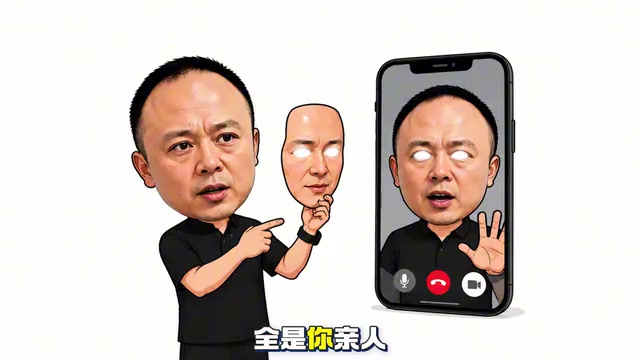
From pre-recorded audio to real-time conversion, and now to synchronized audio-visual synthesis — the technical barrier for AI face-and-voice swap scams keeps falling while their deceptive power keeps rising. This explains why such cases have been making headlines with increasing frequency.
The Defense: Memories Are Something AI Can't Steal
At this point you might feel hopeless — are we completely powerless? Quite the opposite. The solution is surprisingly simple, and requires absolutely no technology.
Strategy 1: Establish a Secret Family Code Word
Agree in advance on a phrase only your family members know, or a shared private memory. Why does this work? Because AI can steal your voice and copy your face — but it cannot steal the shared history between you and your family. It wasn't there when you grew up. It doesn't know your childhood nickname. It can't answer questions about those private memories that belong only to you.

Strategy 2: Ask for a Hand-Over-Face Gesture During Video Calls
If you're on a video call, ask the other person to wave their hand in front of their face or turn to show their profile. Current mainstream AI face-swap models tend to break down when faced with occlusion or sharp-angle profile views — the image will show warping, twitching, or misalignment. A real person turns naturally and smoothly; a fake face often "glitches out" on the spot.
Why does occlusion expose a fake face? Existing face-swapping models (such as GAN-based DeepFaceLab or the latest diffusion-based approaches) are primarily trained on frontal or near-frontal face data, meaning their output quality drops significantly for sharp profile angles and partial occlusion. More fundamentally, these models need to first detect and align facial landmarks, then composite the synthesized face back into the original frame. When a hand blocks the face or the head turns quickly, landmark tracking fails — causing "ghosting," stretching, or visible breaks in the composite. Of course, as next-generation video generation models continue to advance, this vulnerability window may not last long. That's why non-technical defenses like code words are more reliably durable in the long run.
Final Thoughts: Identity Verification Was Never About the Voice
The next time you receive a "help me" phone call, take three seconds to pause. These days, a voice is not evidence, and seeing is not necessarily believing.
Technology is meant to serve humanity — but when it's weaponized for harm, the only thing we can rely on is precisely what technology cannot replicate: genuine emotional connection and shared memory.
What truly verifies someone's identity was never how much they sound like themselves — it's whether they remember the road you walked together. And that road is something AI can never steal.
Key Takeaways
Related articles

PGP-Clinical-TimeKAN: A Detailed Guide to the Multivariate Physiological Indicator Joint Prediction Framework
An in-depth analysis of the PGP-Clinical-TimeKAN framework for joint probabilistic prediction of multivariate physiological indicators, covering trajectory-first paradigm, KAN message passing, MIMIC-IV validation, and ablation studies.
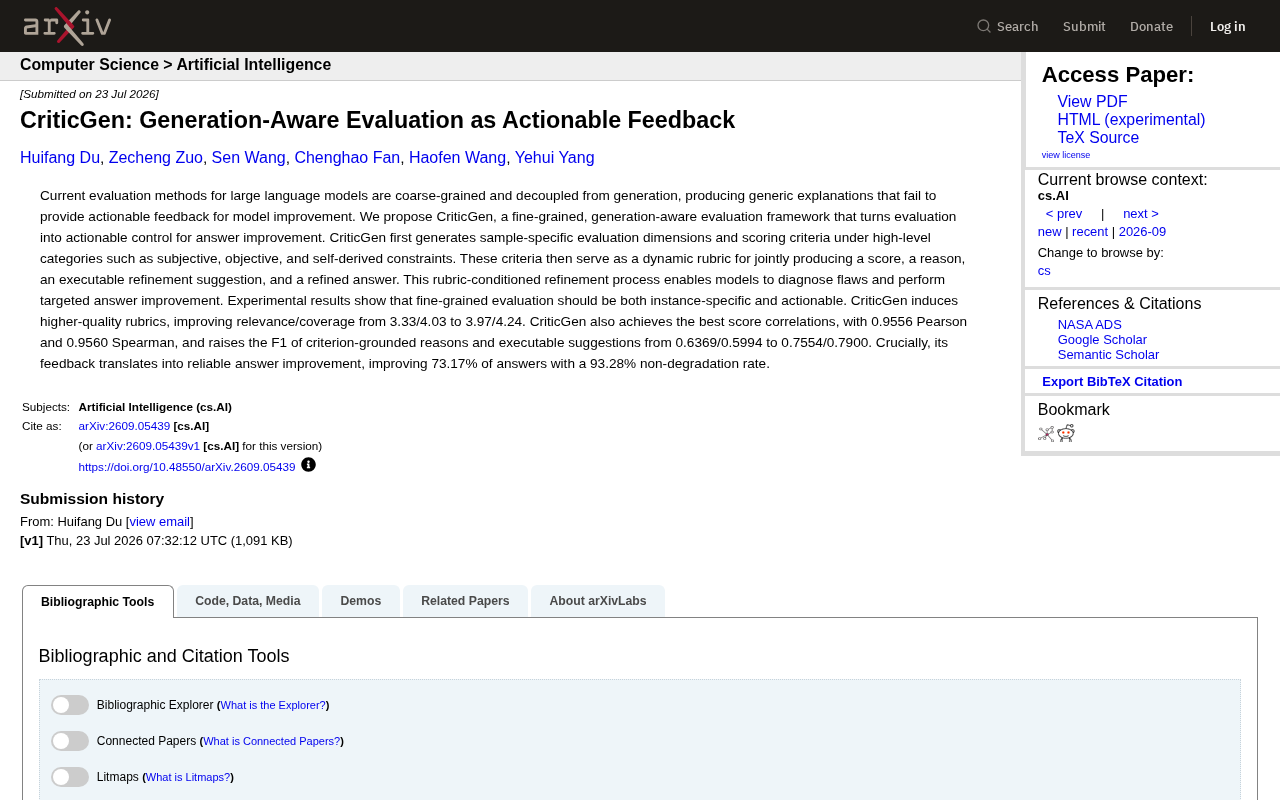
CriticGen: A New Framework That Transforms AI Evaluation into Actionable Improvement Feedback
CriticGen proposes a generation-aware evaluation framework that transforms AI assessment from passive scoring to an active optimization loop, achieving 73.17% answer improvement and 93.28% non-degradation rate.

Vercel AI SDK workflow-harness Update Analysis
Deep analysis of Vercel AI SDK workflow-harness 1.0.107 update: architecture design, engineering practices, and developer value for building reliable AI apps.