AI Coding Agent Sandbox Solutions: The Technical Evolution from eval to Secure Runtimes
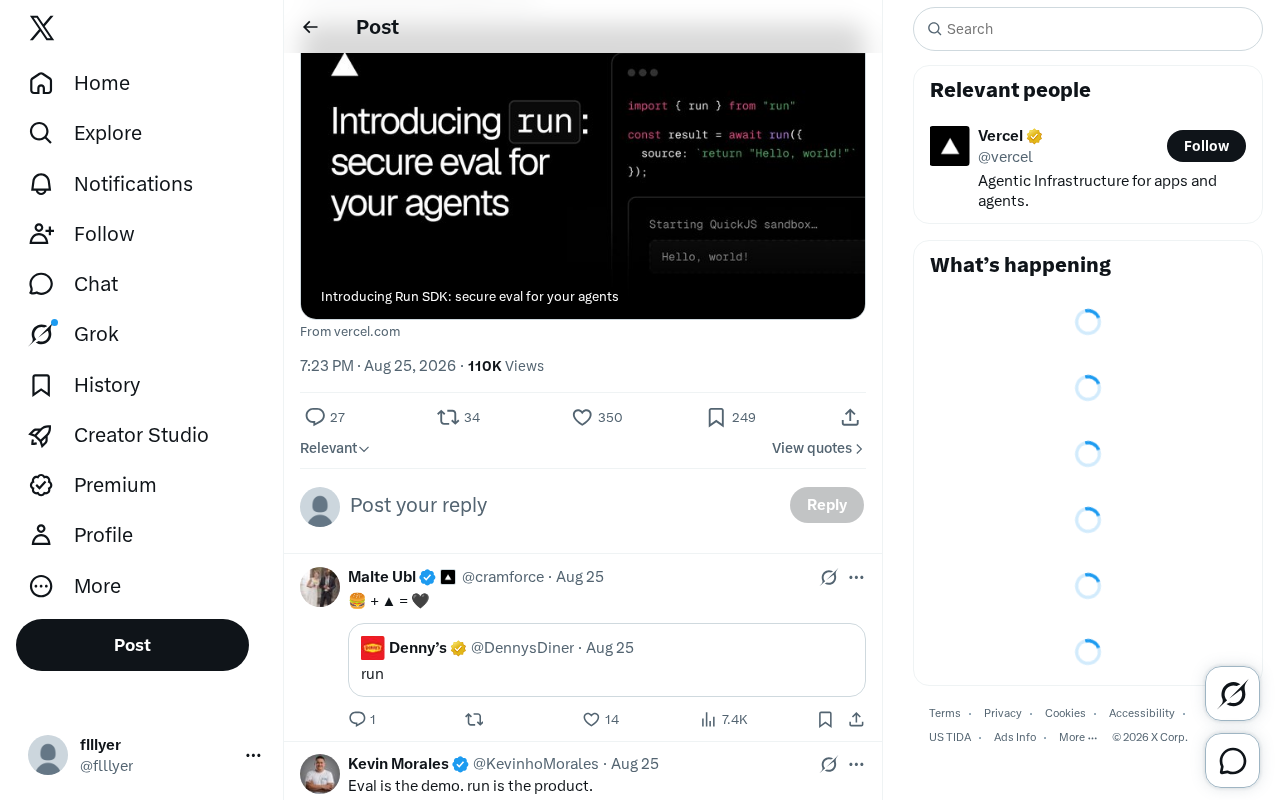
A QuickJS-based sandbox gives AI coding agents safe, controlled code execution without the overhead of Docker.
This article examines a new secure runtime solution for AI coding agents that replaces unconstrained `eval` with a QuickJS-powered sandbox. Built around the Principle of Least Privilege, it uses default isolation, whitelist-only API access, and a Human-in-the-Loop approval flow for risky operations. Compared to Docker, it starts in milliseconds and runs anywhere Node.js does — enabling the "generate → execute → feedback → fix" loop that moves AI coding from suggestion to autonomous execution.
The Dilemma of Code Execution for AI Agents
When an AI coding assistant needs to execute code dynamically, the traditional eval function becomes a double-edged sword. eval is a built-in JavaScript function that executes a string as code — a concept in programming language design known as "metaprogramming." On one hand, it gives agents the flexibility to test code snippets and verify logical correctness. On the other, unconstrained eval can introduce serious security vulnerabilities — malicious code could access the file system, make network requests, or even delete critical data. The real danger of eval is that it erases the boundary between code and data: in a Node.js environment, a maliciously crafted string passed to eval can invoke the fs module to read and write files, use child_process to execute system commands, or open arbitrary network connections via the net module. OWASP (the Open Web Application Security Project) ranks code injection among its top ten security risks, and unconstrained eval is a textbook entry point for exactly that kind of attack.
This tension has become especially pronounced as LLM-powered AI coding tools have exploded in popularity. Code execution is widely seen as the critical leap that transforms an AI Agent from a "suggester" into an "executor" — tools like GitHub Copilot, Cursor, and Devin are all exploring code execution integration to varying degrees. According to a 2024 industry survey, more than 60% of developers said they want AI coding assistants to automatically run test cases and iteratively fix code based on the results. But unlike pure text generation, code execution can cause irreversible damage when something goes wrong — deleted data, runaway resource consumption. Developers want the efficiency of autonomous execution, but they don't want to lose control of the process. Traditional solutions either ban code execution outright or rely on complex containerization — the former cripples the agent's capabilities, while the latter adds significant deployment overhead.
A Hardened Sandbox Built on QuickJS
The newly released runtime solution uses QuickJS as its underlying JavaScript engine. QuickJS was developed in 2019 by Fabrice Bellard — the creator of FFmpeg — and is a lightweight, embeddable JavaScript engine with full ES2023 compliance, compiling down to just a few hundred kilobytes. Compared to Google's V8 engine (which powers Chrome and Node.js), V8 uses JIT (just-in-time) compilation to translate JavaScript into machine code for maximum performance, but that architecture is complex and carries a larger attack surface. QuickJS uses a bytecode interpreter model — slower than V8, but its compact codebase (around 80,000 lines of C) makes security auditing and permission control genuinely feasible. This "trade performance for security" tradeoff is well-justified in a sandbox context, since the code snippets an AI Agent executes tend to be short and don't need JIT-level performance.
The core design of this sandbox follows the Principle of Least Privilege (PoLP) — one of the foundational principles in information security, first articulated by Jerome Saltzer in 1975. The idea is simple: every module in a system should have only the minimum set of permissions necessary to perform its legitimate function. At the operating system level, this shows up as Linux's user permission model and Android's app permission system; in containerization, it manifests as Docker's seccomp policies and Kubernetes Pod security policies. Applied to AI Agent code execution, this principle translates into:
- Default isolation: The sandbox environment is fully isolated from the host process — code cannot directly access Node.js global objects or the module system.
- Whitelist mechanism: Only pre-approved host functions are exposed. Agents can only call a predefined set of safe APIs. Whitelisting is the classic implementation of least privilege — deny everything by default, and explicitly allow only what has been reviewed.
- Human approval workflow: Critical operations can pause execution and wait for human confirmation before continuing, creating a human-machine safety gate.
That last point — the human approval workflow — is what AI system designers call the "Human-in-the-Loop" (HITL) pattern, and it's a major focus of current AI safety research. OpenAI, Anthropic, and other frontier AI labs all emphasize human oversight in their safety frameworks. The key challenge with HITL is finding the right "interruption granularity." Too many approval requests cause "approval fatigue" and kill efficiency; too few checkpoints risk missing genuinely dangerous operations. The ideal design dynamically adjusts approval frequency based on risk level: pure computation passes through automatically, data reads are logged, and writes or deletes require explicit human sign-off.
This architecture strikes a balance between flexibility and security. The AI Agent gets the code execution capabilities it needs, but every operation stays within controllable bounds.
Deployment Advantages Across Platforms
Another strength of this solution is how easy it is to deploy — it runs in any environment that supports Node.js. Whether you're on a local development machine, a CI/CD pipeline, or a cloud server, you can integrate this sandbox mechanism without friction.
Compared to traditional Docker-based approaches, this lightweight code sandbox has clear advantages. Docker containers use Linux kernel namespaces and cgroups to achieve process-level isolation, providing an OS-level security boundary for code execution. But Docker was designed to isolate full application services, not lightweight code snippet execution. Spinning up a Docker container means creating a separate filesystem layer, network stack, and process space every time — that overhead in startup latency and resource consumption isn't trivial. And in some environments (browser-side, serverless functions, embedded devices), Docker simply isn't an option.
| Dimension | QuickJS Sandbox | Docker Container |
|---|---|---|
| Startup time | Milliseconds | Typically several seconds |
| Memory footprint | A few MB | Tens to hundreds of MB |
| Integration | Direct npm package import | Requires additional ops configuration |
| Isolation level | Application layer (language runtime) | System layer (OS kernel) |
| Deployment constraints | Any Node.js environment | Requires Linux kernel support |
The QuickJS-based sandbox runs inside the process and achieves its security boundary through language-runtime-level isolation. This "application-layer sandbox" and Docker's "system-layer sandbox" represent two distinct philosophies of security isolation. Notably, WebAssembly (Wasm) follows a similar application-layer isolation model — and this is becoming the mainstream direction for lightweight secure execution environments.
These characteristics make this approach especially well-suited for scenarios that require frequent creation and teardown of execution environments, such as online code editors and the code validation modules in AI coding assistants.
Broader Implications for the AI Coding Tool Ecosystem
This secure runtime solution could fundamentally change how AI coding tools are built. Until now, many AI Agents could only generate code without verifying execution results, leading to the all-too-common problem of code that "looks right but doesn't actually run." Anthropic's research on AI Agents introduced the "Tool Use" framework, which positions code execution as one of the most important tools an Agent can have. With a secure sandbox, an Agent can actually run code snippets in an isolated environment and get real-time execution feedback, significantly improving the quality and reliability of generated code. This "generate → execute → feedback → fix" closed-loop workflow is the critical infrastructure that moves AI coding from "code completion" to "autonomous programming."
Equally important, the human approval mechanism provides a flexible middle ground between full automation and manual oversight. When handling sensitive operations — file deletion, API calls — the system can pause and request human confirmation, then let the Agent continue once it has approval. This model of supervised autonomy may well become the standard design pattern for AI Agent systems going forward. It speaks directly to a core question in AI safety: how do you unlock AI capabilities while keeping humans in ultimate control of critical decisions?
From a technical evolution perspective, this represents a pivotal shift from "ban code execution entirely" to "controlled, safe execution." As sandbox technology matures and security policies become more refined, more AI Agents will gain stronger autonomous execution capabilities while maintaining sufficient safety boundaries. For the broader AI-assisted programming space, that's a genuinely encouraging signal worth watching.
Related articles

How Short-Form Video Creators Are Using AI Video Generation Tools
Exploring the real-world application of AI video generation tools in short-form video creation. From Seedance to Runway, how do creators integrate AI assets? Revealing the gap between demos and production use.

Home Data Center Setup Guide: A Complete Self-Hosted Private Cloud Implementation
Deep dive into building a home data center: hardware selection, software architecture, cost analysis, and operational challenges. From data sovereignty to technical implementation, build your private cloud infrastructure and control your digital assets.
Engrim: A Local Memory Engine Solution for AI CLI Tools
Engrim is an open-source, local-first SQLite memory engine built for AI CLI tools like Claude Code and Aider, solving context loss while keeping data private.