AI Coding Verification Debt: The Productivity Trap and How to Break It
AI coding's 3-month productivity surge masks accumulating verification debt—requiring zero-trust validation.
AI coding tools boost productivity for about three months before static analysis warnings and code complexity sustainably increase, creating verification debt. Carnegie Mellon research reveals this productivity trap stems from gaps between AI's default output and production requirements. Effective solutions require zero-trust, multilayered verification embedded in agent development cycles.
At the AI Engineer conference, Anirban Chatterjee, Head of Product Marketing at code quality platform Sonar, raised a critical point every AI engineer should consider: AI-powered coding is transitioning from the "experimentation phase" to the "engineering phase." Yet at this pivotal turning point, a hidden cost known as Verification Debt is quietly accumulating—potentially consuming all the productivity gains AI has delivered.
The AI Productivity Trap: The Three-Month Productivity Decline
The most compelling evidence comes from a Carnegie Mellon University study. Researchers scraped open-source projects from GitHub and used metadata to categorize them into two groups: projects developed with traditional tools and those built with AI assistance (in this case, Cursor).
The results were revealing. Projects using AI tools did experience a temporary productivity surge, but this boost lasted only about three months before returning to baseline levels. What's truly concerning is that in stark contrast to the productivity decline, static analysis warnings and code complexity showed sustained growth—far exceeding the three-month window and continuing to impact development efficiency long after.
Static analysis refers to a technique that identifies potential defects, security vulnerabilities, and code smells by scanning source code without actually executing the program. Unlike dynamic testing (runtime detection), static analysis catches problems early in development and is a cornerstone of modern software quality assurance. SonarQube is the most representative open-source platform in this field, capable of detecting thousands of rule violations across more than 30 programming languages. The research team used SonarQube to collect this quality data.
In other words, AI helps you write code quickly, but the quality issues buried in that code compound like interest, slowing development velocity over the long term. This phenomenon closely aligns with Ward Cunningham's 1992 concept of "Technical Debt"—he used a financial metaphor to describe compromises made in code quality for short-term delivery speed, compromises that must be repaid in the future with higher maintenance costs and slower iteration. AI coding is now creating this debt at an unprecedented rate. This is the core mechanism of the "AI coding productivity trap": short-term acceleration, long-term deceleration.
The Quality Gap: Why AI's Default Code Quality Falls Short
Why does this happen? Chatterjee points out that the issue fundamentally stems from a gap between the code quality AI delivers by default and the quality level the application actually requires, with the size of this gap determined by the application's criticality.
If you're doing personal experiments, proof-of-concepts, or building an internal tool with few users and a short lifecycle, the gap is small and entirely tolerable. But when the scenario escalates—large codebases, frequent changes, numerous users, or even adversarial users actively attempting to breach the system—the quality level you need far exceeds what AI outputs by default.
This gap is the root cause of Verification Debt. You must bring human engineers back into the process to bridge this gap and ensure code reaches acceptable quality standards before entering production.
So why does AI leave this gap? Chatterjee identifies three core reasons:
- Models still make mistakes: Due to underlying technical principles, even as models continue improving, they remain error-prone. Large language models are fundamentally probabilistic next-token prediction systems—they don't truly "understand" the runtime semantics of code but rather search for the most likely continuation based on statistical patterns in training data. This means models can generate code that is syntactically perfect yet contains subtle logical flaws—errors often harder to detect than obvious syntax mistakes. Once erroneous code reaches production, it can cause catastrophic organizational impact.
- Missing context: AI only knows what you tell it. It doesn't understand other modules in your codebase, your business logic, or the architectural decisions you and colleagues made in a meeting two weeks ago.
- Significant variation between models: No two models are identical; each has different types of quality shortcomings.
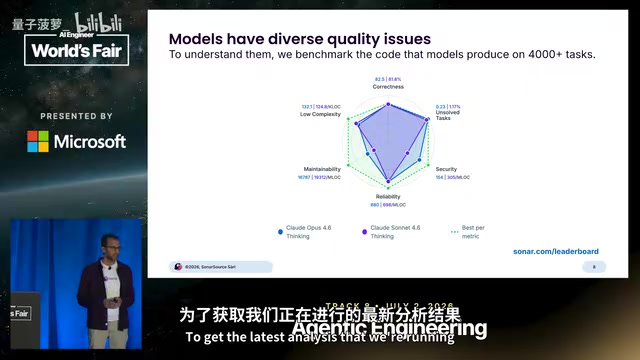
To quantify this third point, Sonar established a public LLM Code Quality Leaderboard. They assigned approximately 4,000 coding tasks to mainstream models and used SonarQube's metrics (correctness, complexity, task completion rate, plus maintainability, reliability, and security) for comprehensive evaluation.
Take Claude Opus and Claude Sonnet as examples—many developers switch between them to balance token consumption. The data shows Sonnet excels in correctness, task completion rate, and reliability; but if you have higher requirements for maintainability and security, or need lower code complexity, Opus may be the better choice. The core value of such data is clear: no model is perfect, and verification steps cannot be skipped.
The Limits of Human Review: 80% Blind Trust
Some might say: just have humans review AI code, problem solved? Chatterjee references a University of Pennsylvania Wharton School study with a sobering answer.
Researchers assigned tasks to numerous participants, allowing them to use AI tools for assistance. What participants didn't know: the AI was configured to confidently provide incorrect suggestions in certain cases. The data showed that when AI gave correct suggestions, participants adopted them 92.7% of the time; but when AI made mistakes, participants still followed the erroneous advice nearly 80% of the time.
This phenomenon is known in cognitive psychology as Automation Bias, first systematically documented in aviation. It describes the human tendency to over-trust and reduce independent judgment when facing automated system recommendations. This bias is particularly severe under two conditions: when the automated system performs well in most cases (establishing a trust baseline), and when operators are under high cognitive load (lacking energy for deep verification). In AI coding scenarios, both conditions are simultaneously met—most LLM-generated code looks reasonable or even elegant, and developers reviewing large volumes of AI-generated code often experience review fatigue.
Chatterjee believes this bias almost inevitably occurs in code review scenarios—especially when the volume of AI-generated code surges, multiple agents simultaneously write code, and you must integrate these fragments into a complete application. Multi-agent coding represents a significant evolution in AI programming during 2024-2025: unlike single AI assistants providing line-by-line help, multi-agent architectures enable parallel work by multiple AI agents—one handling frontend components, another backend logic, another writing test cases, and yet another coordinating overall architecture. Tools like OpenAI's Codex, Anthropic's Claude Code, and Cursor are all evolving in this direction. While this architecture dramatically increases code output speed, it introduces unprecedented integration challenges: agents lack shared implicit knowledge, and generated code fragments may have subtle inconsistencies in interface contracts, error handling styles, and performance assumptions—inconsistencies often difficult to detect through simple unit tests. The review burden is simply too great; there are only so many hours in a day, and teams must deliver on schedule. Thus "rubber-stamp" approvals are emerging across organizations.
The human review line of defense will also be breached, which is why we need automated verification tools to build a more reliable quality assurance system.
Two Core Principles of Automated Verification: Zero Trust and Multilayered
Chatterjee emphasizes a crucial distinction: code is provable—if written correctly, it runs the same way every time; but software is not. Software is written by humans with various requirements, code accumulates and interacts in unpredictable ways, and users behave in unexpected ways. As you use AI to write more and more software to solve increasingly large problems, you'll encounter these boundaries more frequently.
Effective automated verification requires two core elements:
Zero Trust
Zero Trust originated as an architecture concept in network security, proposed by Forrester Research's John Kindervag in 2010, with the core principle "Never Trust, Always Verify." Traditional security models assume entities inside the network perimeter are trustworthy, whereas Zero Trust requires authentication and authorization for every access request. Chatterjee transplants this concept to the code quality domain: code can come from anywhere—written by humans or generated by AI. The key principle: you cannot use the same AI that wrote the code to verify it. You need tool diversity to catch various issues. Regardless of code origin, apply a unified, comprehensive verification mechanism—using different methodologies than code generation, fully auditable, explainable, algorithmic, and repeatable. Just as you shouldn't trust any traffic inside your network, you shouldn't trust code from any source; you must avoid the logical loop of "having the same AI serve as both player and referee."
Multilayered
You can never find all potential software issues with just one or two methods. You need computational review (rule-based and static analysis), LLM-driven semantic review, and various technical approaches in between. Computational review excels at catching known pattern defects like null pointer references, resource leaks, SQL injection, and other deterministic rule violations; while LLM-driven semantic review understands code intent and business context, identifying high-level issues such as "this code has no syntax errors, but its logic contradicts the behavior implied by the function name." Only the layering of multilevel verification can maximize coverage of quality blind spots.
The ACDC Framework: Embedding Verification in Agent Development Cycles
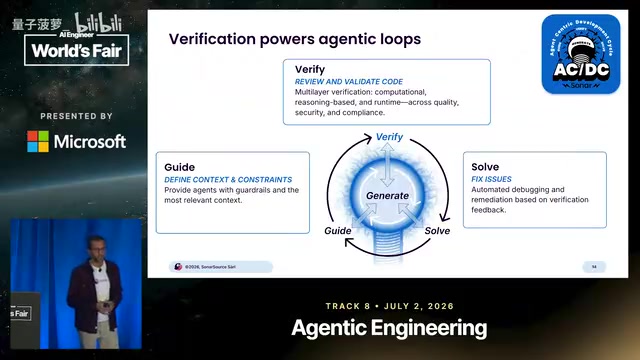
Sonar proposed a practice framework called ACDC (Agent-Centric Development Cycle), consisting of three core phases:
- Guidance: Before agents begin work, provide guardrails, context, and constraints to ensure they have all the information needed to write good code from the start, increasing the probability of "getting it right the first time."
- Verification: This is the most core and currently most actionable phase. Verification must be multilayered and reasoning-based, spanning code quality, security, and compliance to ensure delivered code withstands scrutiny.
- Solve: Fix issues discovered during verification. Ideally, grant agents sufficient autonomy to locate and fix problems themselves, then repeat the entire cycle.
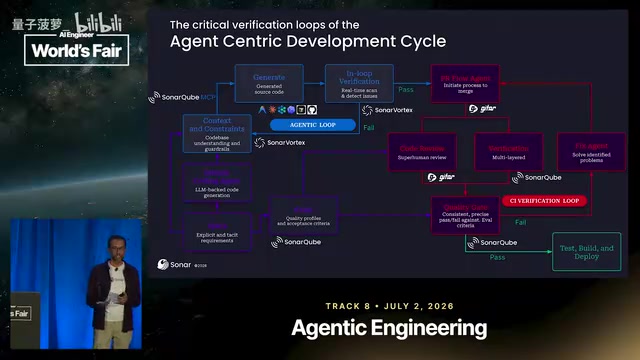
You might not have noticed, but verification needs to run simultaneously in both the inner loop (agent coding cycle) and outer loop (CI/CD pipeline):
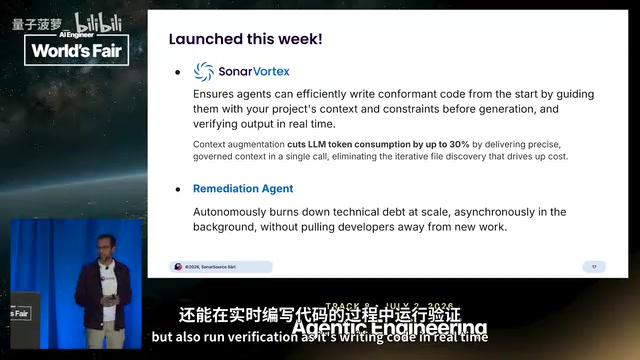
- Inner loop verification: Sonar's newly released SonarVortex enables mainstream AI coding tools like Cursor, Claude Code, and Codex to invoke its context tools to obtain constraints, and run verification while writing code—fixing issues immediately to prevent defects from propagating to subsequent phases. This "write-and-verify" mode significantly shortens the feedback loop—developers don't have to wait until submitting a PR to discover problems but receive quality feedback the instant code is generated.
- Outer loop verification: In the PR process, Sonar provides dual review—LLM-driven semantic-level review from Guitar (an acquired AI code review company), plus computational review from SonarQube with scores across three dimensions: quality, security, and maintainability. Only PRs meeting scoring standards are allowed to merge into production branches. This quality gate mechanism ensures that even if inner loop verification is skipped, the outer loop remains an insurmountable quality checkpoint.
Additionally, Sonar released a Remediation Agent that can batch-process technical debt and legacy code issues in the background, allowing developers to focus energy on more valuable innovation work.
Four Drivers for Enterprise-Standardized Verification
After extensive conversations with enterprise clients, Chatterjee found that the factors driving comprehensive adoption of standardized verification are highly consistent:
- Consistent verification: Organizations don't want different projects and teams using different verification standards; they want to establish a unified rulebook applicable to all tools and teams. In large organizations, dozens of teams may simultaneously use different AI coding tools (Cursor, Copilot, Claude Code, etc.). If quality standards vary across teams, the entire system's reliability depends on the weakest link.
- Efficient use of AI tools: Focus on token efficiency and overall development efficiency, ensuring each model is used in scenarios where it excels. Combined with LLM code quality leaderboard data mentioned earlier, enterprises can select the most suitable model for different types of coding tasks rather than using one model for everything.
- Shift Left security: Discover security issues as early as possible in the development cycle. Shift Left is a core tenet of the DevSecOps movement, referring to moving security testing from traditional late-stage development to early stages. CVE (Common Vulnerabilities and Exposures) is a global vulnerability numbering system maintained by MITRE Corporation. In recent years, the time window from vulnerability disclosure to weaponized exploitation has shrunk dramatically—according to Mandiant research, average zero-day exploitation time has dropped from weeks to under 24 hours. Against the backdrop of AI generating massive amounts of code, if security detection remains at the last checkpoint before deployment, vulnerabilities will lurk in the codebase much longer, expanding the attack surface. Front-loading security detection is therefore critical.
- Compliance auditing: For regulated industries (finance, healthcare, government, etc.), organizations need to prove verification is consistently executed and maintain complete audit trail records. This is especially critical in AI-generated code scenarios, as regulators may ask "who wrote this code, what verification did it undergo, who approved the merge"—and automated verification platforms can provide complete digital evidence chains.
For reference, SonarQube currently has over 7 million developer users globally, analyzes nearly 750 billion lines of code daily, and is recognized as a leader in the Gartner Magic Quadrant.
Governance and Verification Are Key to Scaling AI Coding
Chatterjee's core conclusion is concise and powerful: a comprehensive governance and verification engine is key to unlocking the next phase of scaled success in AI coding. His key action recommendations include:
- Establish bounded autonomy for AI agents—granting freedom to generate code while enforcing centralized verification and constraints. This concept borrows from organizational management's "autonomy with accountability" balance—agents have execution space, but their outputs must pass independent quality gates.
- Implement the ACDC framework: provide ample context, verify outputs with independent metrics, and enable agents to fix errors themselves.
- Equip developers with orchestration tools enabling them to design efficient contextual frameworks and workflows.
- Standardize on a single, independent, multilayered verification platform spanning all projects, teams, and AI coding tools, eliminating quality blind spots caused by tool silos.
For all teams embracing AI coding, the most crucial insight from this talk may be: AI enables you to write code faster, but only systematic verification mechanisms allow you to confidently deploy that code to production. Speed is not the goal—trustworthy speed is.
Related articles

Perplexity Hybrid Compute Tested: Privacy Data Never Leaves the Mac
Perplexity Hybrid Compute tested: how PrivacyGate intercepts sensitive data, how local and cloud models divide work, model differences on 16GB vs 32GB Macs, and privacy protection in real scenarios like bank statements and medical records.

Big Fat Fish Roasts Mainstream LLMs at Home and Abroad: Doubao Takes the Crown, DeepSeek Tied for First
Bilibili creator Big Fat Fish roasts mainstream LLMs: Doubao tops for emotional value, DeepSeek ties first for open-source value, with ERNIE, Hailuo, Yuanbao, Kimi, Qwen, Kling, Claude, Gemini, and Grok each branded with a distinct persona.

How to Truly Test AI Agents Before Production? A Practical Testing and Monitoring Framework
BotGage founder Pramin Pradeep shares a three-step framework for testing AI Agents before production: Agent registration visibility, red teaming, and production observability — plus a real case cutting QA costs from $180K to $80K and an analysis of IT roles shifting to Agent supervisors.