AI Cracks 50-Year Physics Problem: Breakthrough in Lattice Definition of the Standard Model

AI-led proof of convergence for the Standard Model lattice definition breaks a 25-year mathematical rigor bottleneck.
The Standard Model precisely describes strong, weak, and electromagnetic interactions but lacks a rigorous mathematical definition. The lattice method succeeded for strong interactions, but weak interactions were stuck for 25+ years due to chiral symmetry breaking. Physicist Craig proposed a layer-by-layer lattice refinement strategy; GPT-6 Astra solved fermion placement on lattices and proved convergence, with AI leading the proof, reviewed by three experts. The preprint remains a candidate definition but shows AI's growing core role in fundamental physics proofs.
The Standard Model of physics precisely describes the strong, weak, and electromagnetic interactions and agrees with experimental data to extremely high precision—yet for over fifty years it has lacked a rigorous mathematical definition that doesn't rely on approximations. This foundational gap has recently been pushed forward by an AI-led proof.
The "Foundation" Gap in the Standard Model
The Standard Model is the pillar of particle physics. It unifies the strong, weak, and electromagnetic interactions, and its description of known fundamental particles agrees with experimental measurements across an enormous range of energy scales. But the theory is not mathematically complete—it lacks a rigorous definition, so physicists cannot solve it completely from first principles.
To work around this difficulty, physicists developed the lattice method: discretizing spacetime into a grid and computing quantum field theory on the lattice. Strong interactions were long ago used to calculate the proton mass with lattice QCD, validating the power of the method. However, weak interactions run into a special problem on the lattice: they couple only to left-handed particles, and placing left-handed particles on the lattice "spontaneously" generates right-handed partners, breaking chiral symmetry.

This obstacle left the lattice definition of the Standard Model unresolved. Generations of physicists worked through simplified cases, but the final step has been stuck for over 25 years.
Lattice Field Theory is a non-perturbative numerical method for quantum field theory. Its core idea is to discretize continuous spacetime into a grid of finite spacing, converting the path integral into a high-dimensional sum on the lattice, which can then be computed via Monte Carlo simulation. The lattice spacing acts as an ultraviolet cutoff, eliminating infinities; by taking the continuum limit where the lattice spacing goes to zero, the continuous theory can be recovered. Since its development in the 1970s, lattice QCD has been able to calculate the proton mass, hadron spectrum, and more from first principles—it is the most successful non-perturbative tool for strong interactions. But the lattice method comes at a cost: continuous symmetries such as chiral symmetry and Lorentz invariance are partially broken on the lattice and must be restored through fine-tuning or special fermion formulations.
Chiral Symmetry refers to the symmetry in massless fermion theories where left- and right-handed components can be rotated independently. Weak interactions couple only to left-handed fermions, so chiral symmetry is crucial to them. However, naive lattice fermions generate an equal number of right-handed partners out of nowhere due to the "doubler" problem, breaking chiral symmetry. The Nielsen-Ninomiya theorem further states that under mild conditions such as translational invariance and Hermiticity, chiral symmetry and the correct number of fermions cannot be simultaneously realized on the lattice. Physicists developed schemes such as Domain Wall fermions and Overlap fermions to circumvent this, but they are computationally expensive, and rigorously proving the existence of chiral gauge theories in the continuum limit remains a difficult problem.
The AI-Led Proof Strategy
The turning point came with AI's involvement. Physicist Craig proposed a strategy: comparing by successively replacing with finer lattices, thereby approaching the continuum limit. GPT-6 Astra (the model mentioned in the original) figured out how to place fermion fields (the original text's "立场" should be fermion fields) onto finer lattices, and proved that this layer-by-layer refinement comparison process converges.
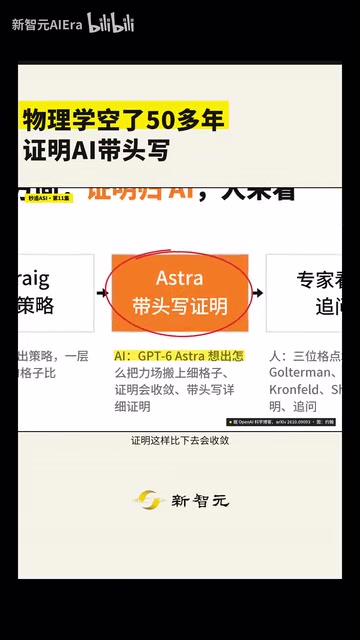
The detailed proof was completed under AI's leadership. Three experts in lattice theory reviewed the proof and pressed for details throughout. The paper was posted on a preprint website in October; it is currently only a candidate definition and requires further discussion within the field.

Interestingly, the core contribution of this breakthrough is that AI proposed the key technical steps and completed the writing of the proof. Human researchers provided direction and strategy, while AI handled the derivation and the implementation of the proof.
Continuum Limit is the key step in lattice field theory for recovering continuous physics from a discrete lattice. The basic operation is to take the lattice spacing a→0 while adjusting bare parameters so that physical quantities (such as mass and coupling constants) remain finite, thereby obtaining a quantum field theory in continuous spacetime. Mathematically, this requires proving that the lattice model converges to a continuous theory satisfying the OS axioms (Osterwalder-Schrader axioms) as a→0. The layer-by-layer refinement (renormalization group flow) strategy constructs a series of increasingly finer lattices and proves that the effective theories between adjacent lattices converge consistently, providing a rigorously arguable path to the existence of the continuum limit.
Shifting Division of Labor and the Future
This case shows that in highly abstract mathematical physics proofs, AI can take on the role of "executor" or even "co-discoverer." Humans provide direction, AI writes proofs, and humans review—this collaborative model is changing the workflow of fundamental research.

Of course, this lattice definition is still a candidate and needs peer review and community scrutiny. But it at least shows that long-standing mathematical rigor problems in physics may find new ways forward with the help of AI. Which field will be the next "foundation" to get its turn? The answer may come sooner than expected.
One-line Summary
AI-led proof of convergence for the Standard Model lattice definition breaks a 25-year mathematical rigor bottleneck.
Paragraph Summary
Although the Standard Model precisely describes strong, weak, and electromagnetic interactions, it lacks a rigorous mathematical definition that doesn't rely on approximations. The lattice method succeeded for strong interactions, but weak interactions have been stuck for over 25 years due to chiral symmetry breaking. Physicist Craig proposed a layer-by-layer lattice refinement comparison strategy; GPT-6 Astra solved how to place fermion fields on lattices and proved convergence, with AI leading the detailed proof, reviewed by three experts. The paper is on a preprint server and remains a candidate definition, but it demonstrates the trend of AI taking a core role in fundamental physics proofs.
Related articles

Gemini 4 Neon Review: Benchmark Scores Rival Carbon, API Pricing and Quota Breakdown
Google Gemini 4 Neon is now live, benchmark scores closely tracking Carbon, API pricing 3/15 at twice Hydrogen's rate. This article compiles Bilibili creator testing: Neon can replace 90% of Carbon scenarios, AntiGravity quota consumption is only one-third of Carbon, plus subscription channel restrictions and 2API ban risks.

Gemini 4 Helium Coming Soon? Signals of Google Loosening Subscription Restrictions
Google team member hints releases will continue; community speculates Gemini 4 Helium (Flash Lite) may be next. Subscription ban controversy gets a response as product lead says "Soon," suggesting restrictions may be lifted. This article covers Gemini developments, OpenAI Coding Agent and risk management, Doubao real-time audio-video API, and compute business dynamics.

AI-Assisted React Development in Practice: Optimizing a Video App and Handling Errors
A 14-year veteran developer demonstrates AI-assisted React video app optimization: compressing video from 80MB to 5MB (~94%) via ImageKit, plus reliable error handling and retry mechanisms. Includes planning, code understanding, and verification methods for working with AI.