AI Cracks a Physics Puzzle: 1967 Fusion Conjecture Refuted

AI finds an explicit counterexample to a 1967 fusion conjecture in physics, marking its evolution from assisting tool to scientific discovery agent.
Starting from a Reddit discussion, this article reports that AI has found an explicit counterexample to a fusion conjecture proposed in 1967. An explicit counterexample means AI not only proved the conjecture false but also constructed a concrete counterexample object, which has methodological significance at the intersection of mathematics and physics. The article outlines the plasma stability and confinement issues potentially involved in the conjecture, noting that the discovery of a counterexample will clarify theoretical boundaries and affect related model construction. This event continues the shift in AI's role in scientific discovery: from data analysis and simulation acceleration to proactively proposing counterexamples and constructing proofs. However, the article also cautions that a single counterexample does not equal a technological breakthrough; its value depends on whether it sparks follow-up research, and there is still a gap between theoretical correction and practical application.
From Math to Physics: AI's Cross-Disciplinary Breakthrough
After making waves in mathematics, AI has now set its sights on physics. A recent Reddit discussion has drawn attention: AI has found an explicit counterexample to a fusion conjecture proposed in 1967. This marks AI's capabilities in formal reasoning and scientific discovery extending from pure mathematics into applied physics.
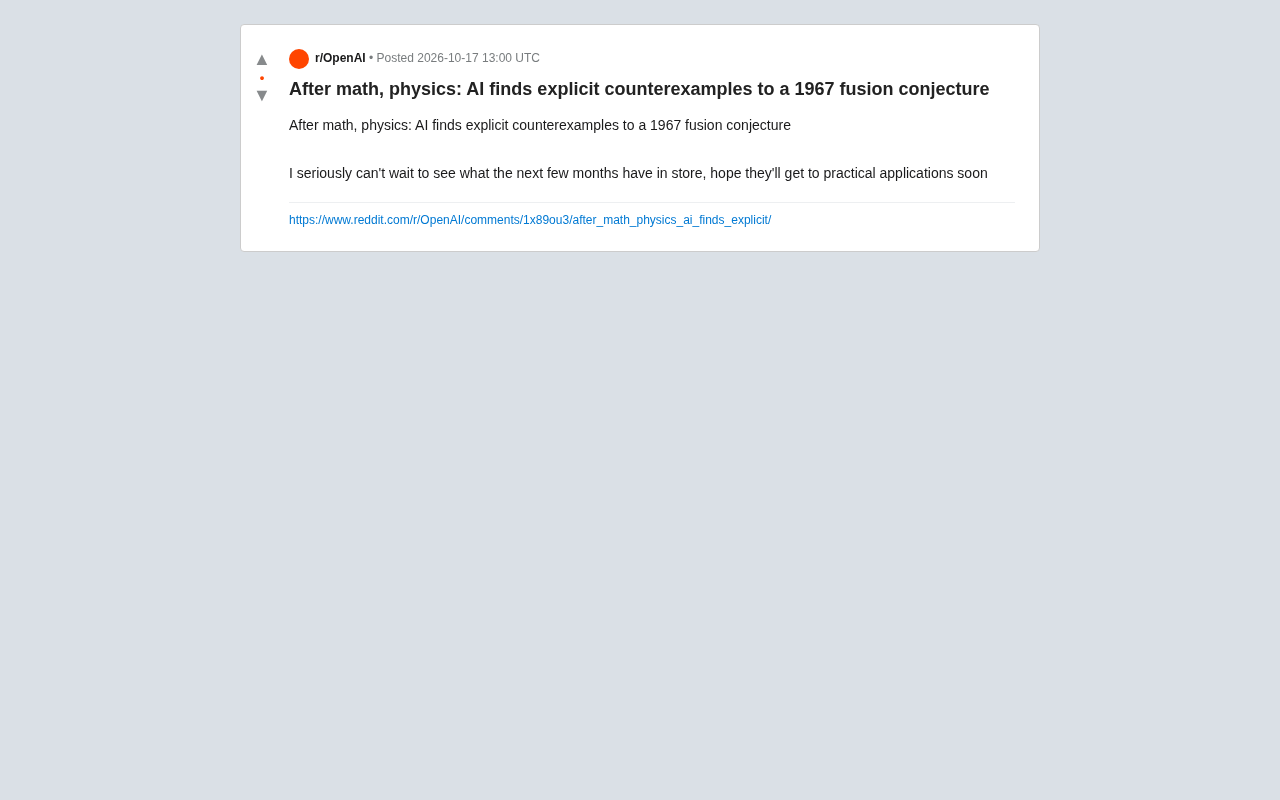
According to the Reddit community, this result was achieved independently or with AI system assistance. While specific details have not been elaborated in the discussion, the phrase "explicit counterexample" implies that AI not only provided an existence proof but also constructed a concrete counterexample object—a development with methodological significance at the intersection of mathematics and physics.
What Is the 1967 Fusion Conjecture?
Fusion conjectures typically involve stability or confinement issues in plasma physics. 1967 was a critical period in controlled nuclear fusion research, when scientists proposed several theoretical conjectures about plasma behavior, some of which remain neither fully proven nor disproven. AI's discovery of an explicit counterexample means the conjecture does not hold under general conditions, which could affect the construction of related theoretical models.
Although the original discussion did not disclose the specific content of the conjecture, the discovery of an "explicit counterexample" often clarifies theoretical boundaries and may even spawn new revised conjectures. For fusion research, the precision of theoretical models directly affects the efficiency of experimental design.
Explicit counterexample is a concept contrasted with existential counterexample. An existential counterexample only proves that "some object exists that makes the conjecture false," typically through non-constructive logical argumentation; an explicit counterexample, by contrast, requires that this object be concretely constructed or computed, yielding testable parameters, expressions, or numerical values. The methodological value of an explicit counterexample lies in the fact that it not only negates the original proposition but also provides an instance that can be further analyzed. Researchers can use it to pinpoint under which additional conditions the conjecture might still hold, and propose revised versions accordingly. In plasma physics, constructing explicit counterexamples often requires solving complex nonlinear equations or performing high-precision numerical searches, making the computational cost very high.
Stability and confinement of fusion plasmas are core theoretical problems in controlled nuclear fusion. Plasma in a magnetic field may rapidly lose confinement due to magnetohydrodynamic instabilities (such as kink modes and interchange modes), leading to energy leakage or even device damage. In the 1960s, with the proposal of magnetic confinement configurations such as tokamaks and stellarators, theoretical physicists sought to characterize the equilibrium and stability conditions of plasmas using simplified mathematical models, and thereby proposed a series of conjectures to define which parameter ranges are safe. These conjectures are usually built on idealized assumptions, such as neglecting resistive effects or assuming specific pressure profiles or magnetic field configurations. Once a conjecture is overturned by a counterexample, it means the original simplified assumptions fail in more general situations, and experimental design needs to treat the relevant parameter ranges more cautiously.
AI for Science: From Assisting Tool to Discovery Agent
This event continues the shift in AI's role in scientific discovery. In the past, AI was mostly used for data analysis and simulation acceleration; now, it is beginning to proactively propose counterexamples and construct proofs. Mathematics has already seen precedents of AI discovering counterexamples to new conjectures, and physics is following close behind.
A Reddit user commented: "I'm really looking forward to what happens in the next few months, hope they can get into practical applications soon." This reflects the community's optimism and anticipation for AI-driven scientific discovery. However, there is still a gap between counterexamples and practical applications, requiring experimental validation and theoretical integration.
AI for Science (AI4Science) refers to the systematic application of machine learning and artificial intelligence methods to scientific discovery, rather than merely as data processing tools. Its typical paradigms include: using neural networks as surrogate models to accelerate physical simulations, using symbolic regression to extract analytical laws from data, using large language models to assist literature reasoning and hypothesis generation, and using search and reinforcement learning to find counterexamples or construct proofs in vast hypothesis spaces. In recent years, AI's assistance in discovering counterexamples in mathematics, predicting new structures in materials science, and generating candidate molecules in biomedicine all belong to extensions of this paradigm. Their common challenge is that AI outputs must undergo formal verification and experimental testing by domain experts before they can be incorporated into the scientific knowledge system.
Potential Impact on Fusion Research
Fusion energy is regarded as one of the ultimate goals of clean energy, but plasma instability has always been a bottleneck. If a long-accepted conjecture is disproven, researchers may need to re-examine certain simplified assumptions and adjust experimental plans accordingly. AI's involvement may accelerate this error-correction process.
Of course, a single counterexample does not directly equate to a technological breakthrough. It is more of a theoretical correction, but theoretical corrections are often the precursor to technological progress.
Outlook: The Integration of AI and the Scientific Method
AI's ability to discover counterexamples suggests that the process of scientific discovery may be being redefined. Human researchers can use AI to rapidly explore hypothesis spaces, while AI relies on humans to provide problem frameworks and validation standards. This collaborative model has already shown initial success in both mathematics and physics.
In the coming months, if similar results continue to emerge, we may see AI making its mark in more fundamental science fields. But we should also guard against overhype—the value of a counterexample depends on whether it sparks follow-up research, not on news headlines.
Related articles

Free Unlimited Claude Code Solution: Agnes AI + CC Switch Setup Guide
No paid subscription needed — pair the free AI platform Agnes AI with the open-source tool CC Switch to provide a backend for Claude Code, enabling unlimited free calls to text, image, and video models. This guide covers the full setup, test results, and usage boundaries.

A Complete Zero-Cost Guide to Getting Started with Claude Code for Beginners in China
A beginner's guide to Claude Code for users in China: two installation methods (command line and IDE plugin), full configuration steps for replacing the official API with the free domestic LongCat model, and a hands-on demo of building a small tool with natural language, plus tips.

When the NSA Gets Involved: The AI Supply Chain Crisis Behind Open-Source CVEs and API Key Hijacking
Multiple open-source projects disclosed severe CVEs in one day, PHP flaws alarmed the FBI, and Railway and OpenCode were breached with API keys stolen. This article breaks down the vulnerability window, AI-accelerated exploitation, and the AI supply chain crisis behind the API key black market, with a developer defense checklist.