AI Creative Insights: The AI Tool That Predicts Ad Performance Before You Spend

Entropik's AI Creative Insights predicts ad performance before launch using heatmaps, emotion curves, and synthetic audiences.
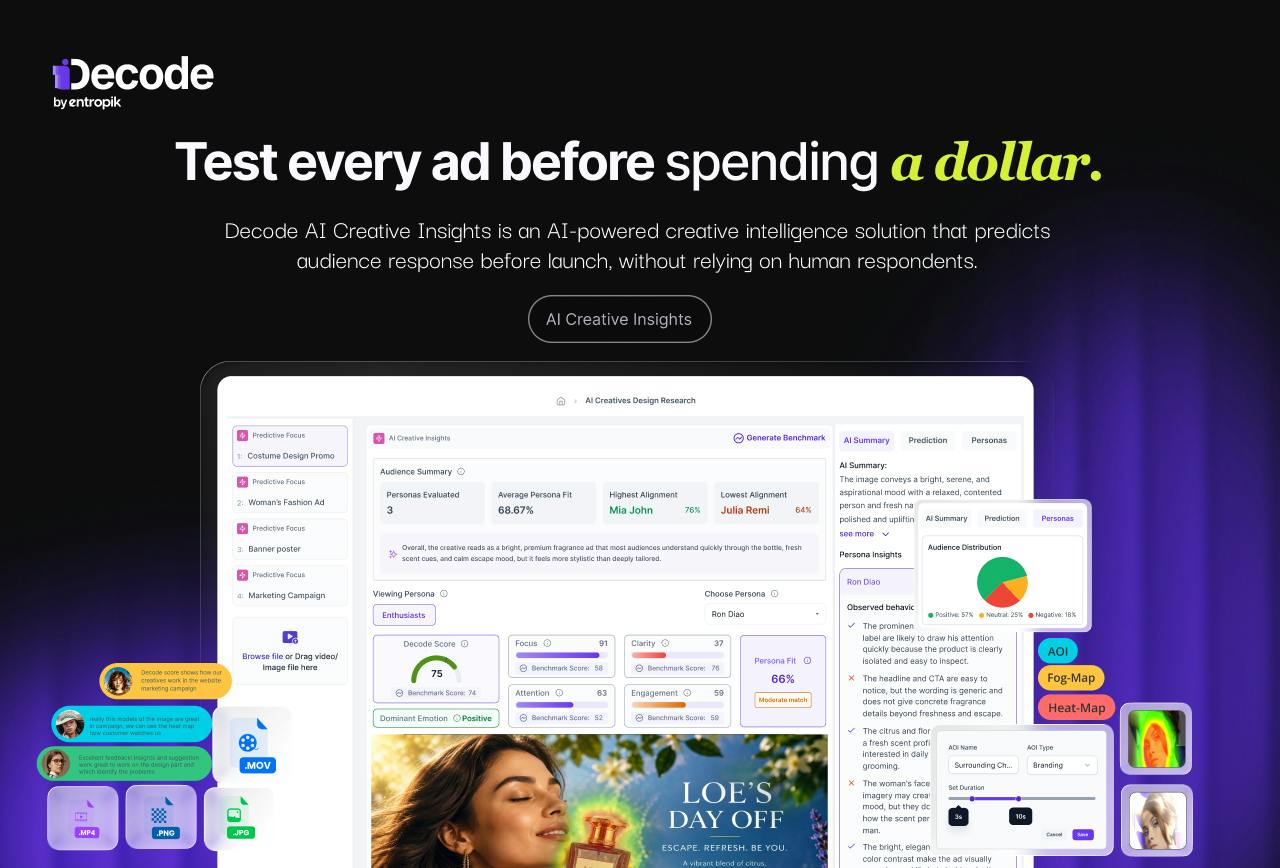
AI Creative Insights, built by Entropik (the team behind Decode), is an ad creative prediction tool that shifts performance evaluation from post-campaign review to pre-launch analysis. After uploading static, video, or OOH ad assets, users receive attention heatmaps, second-by-second emotion curves, and actionable optimization suggestions. The tool also supports category benchmarking, side-by-side variant comparison, and a standout Synthetic Audience feature that generates persona-specific predicted responses. While it can help reduce trial-and-error costs and improve ROI, its real value depends on model accuracy and is best used as a decision-support layer alongside — not instead of — real A/B testing.
AI Creative Insights: The AI Tool That Predicts Ad Performance Before You Spend
One of the biggest pain points in digital marketing is uncertainty — the budget is already spent, but the results are anyone's guess. AI Creative Insights, built by the Entropik team (the makers of Decode), aims to solve exactly that: using AI to predict which version of your ad creative will win before a single dollar of media budget is committed.
After launching on Product Hunt, the product received 95 upvotes and 6 comments, landing at #8 for the day across the Marketing, Advertising, and Artificial Intelligence categories.
Core Functionality: From Post-Campaign Review to Pre-Launch Prediction
Traditional ad performance evaluation relies on real data gathered after a campaign goes live — meaning any mistake has already cost real money. AI Creative Insights flips this model: users simply upload their ad assets — whether static display ads, banners, out-of-home (OOH) creatives, or video — and the system predicts audience reactions before anything is published.
The product offers three core analytical capabilities:
- Attention Heatmaps: Visually shows where users look first and what they focus on next, helping teams assess whether key messages are being effectively captured.
- Second-by-Second Emotion Curves: For video creatives, tracks emotional responses at a per-second level to identify which moments resonate and which cause drop-off.
- Prescriptive Suggestions: Goes beyond diagnosis — it tells you what to change and why, giving optimization efforts a concrete, evidence-based foundation.
Attention heatmaps are typically generated through one of two technical approaches: predictive models trained on eye-tracking data (which learn statistical patterns of how real users scan visual content), or computer vision-based saliency detection algorithms (which analyze features like color contrast, edge density, facial positioning, and text regions to predict which areas are most likely to capture attention). Each approach has its trade-offs: the former more closely mirrors real human behavior but depends on high-quality labeled data, while the latter is faster and more interpretable but less effective at understanding contextual semantics. In the context of ad creative evaluation, these heatmaps help designers determine whether brand logos, key selling points, or call-to-action (CTA) buttons fall within the natural visual hot zones that users gravitate toward.
Key Differentiators: Benchmarking and Synthetic Audiences
Analyzing a single asset in isolation only goes so far. What marketing teams really want to know is: how does my ad stack up against the competition? AI Creative Insights supports Category Norms benchmarking, giving creative performance a meaningful point of comparison. It also enables side-by-side variant comparison, making it easy to identify the stronger option at a glance.
The most distinctive feature is Synthetic Audience — it allows users to view predicted results through the lens of different audience personas. This means the same ad can be evaluated against how younger versus older users, or audiences from different regions or spending brackets, might respond. The result is a more granular, persona-driven view of performance that can inform smarter audience segmentation strategies.
Synthetic Audience technology deserves a closer look. Traditional user research requires recruiting real participants, organizing focus groups, or running online surveys — a process that is slow, expensive, and limited in sample size. Synthetic audiences, by contrast, are built using machine learning trained on large volumes of historical behavioral data, demographic attributes, and emotional response patterns, creating "digital proxies" for specific audience segments. When an ad is fed into the system, the AI simulates the cognitive and emotional processing paths of different personas and outputs differentiated predicted responses. The advantage lies in speed and scale — dozens of audience segments can be tested within minutes, unconstrained by recruitment logistics. The limitations are equally real: synthetic audiences are fundamentally a fit to historical patterns, and prediction accuracy may drop significantly for entirely new product categories, cultural shifts, or highly creative content driven by novel emotional triggers.
Technology Background and Team
AI Creative Insights is built by Entropik, the same team behind the Decode platform. Entropik has long focused on emotion recognition and consumer insight technology, and AI Creative Insights can be seen as an extension of those capabilities into the ad creative evaluation space. With an established foundation in behavioral and emotional analytics, the product has meaningful technical grounding for its core mission: predicting human responses.
Value and Considerations
Industry-wide, AI is permeating every stage of marketing — and creative evaluation has historically been one of the "softest" links, heavily dependent on experience and gut instinct. AI Creative Insights attempts to bring data-driven, quantifiable rigor to creative decision-making, theoretically reducing the cost of trial-and-error and improving campaign ROI.
That said, the real-world value of predictive tools like this hinges on several critical factors: how closely the prediction model correlates with actual campaign data, whether synthetic audiences can faithfully capture the complexity of real target groups, and whether the actionable suggestions hold up under real-world conditions. For marketing teams, this tool is best positioned as a decision support layer rather than a replacement — ideal for quickly filtering between creative variants and narrowing the testing field, rather than fully substituting for real A/B testing.
For advertisers, creative teams, and digital marketing professionals, pre-launch prediction tools represent a direction worth watching: compressing uncertainty as much as possible before the money is spent.
Pre-launch creative testing is not a new concept. Traditional approaches include consumer focus groups, survey-based copy testing, and small-scale live A/B tests. The core competitive edge of AI tools in this space is compressing the time cost of this process from days or even weeks down to minutes, while dramatically lowering the per-test cost — making multi-round iteration accessible even for teams with modest budgets. That said, independent validation studies examining the correlation between AI predictions and real A/B test outcomes remain scarce. Most accuracy figures published by tool vendors are based on their own backtests, which carry the risk of selection bias. For this reason, the methodologically sound approach is to position AI creative evaluation as a filtering layer that narrows the candidate pool — not as the final word on creative decisions.
Related articles

Free Unlimited Claude Code Solution: Agnes AI + CC Switch Setup Guide
No paid subscription needed — pair the free AI platform Agnes AI with the open-source tool CC Switch to provide a backend for Claude Code, enabling unlimited free calls to text, image, and video models. This guide covers the full setup, test results, and usage boundaries.

A Complete Zero-Cost Guide to Getting Started with Claude Code for Beginners in China
A beginner's guide to Claude Code for users in China: two installation methods (command line and IDE plugin), full configuration steps for replacing the official API with the free domestic LongCat model, and a hands-on demo of building a small tool with natural language, plus tips.

When the NSA Gets Involved: The AI Supply Chain Crisis Behind Open-Source CVEs and API Key Hijacking
Multiple open-source projects disclosed severe CVEs in one day, PHP flaws alarmed the FBI, and Railway and OpenCode were breached with API keys stolen. This article breaks down the vulnerability window, AI-accelerated exploitation, and the AI supply chain crisis behind the API key black market, with a developer defense checklist.