AI + Cybersecurity in Practice: From Getting Started with Agents to Using Intelligent Agents to Find Vulnerabilities

Treat AI as a tool rather than a replacement, and move from Agent building toward real-world Web vulnerability practice.
Based on a Bilibili tutorial, the article discusses what the AI wave means for cybersecurity practitioners. It first establishes that AI is a tool for people to control, not a replacement, and that without usage norms it may bring risks, so the learning path should be learning to control AI for security. AI's most direct value is simplifying repetitive penetration testing work, but users must have professional judgment because AI may give seemingly satisfying but wrong answers. Skill-wise, one needs to master MCP writing and invocation, prompts, and Agent capability boundaries. Whether to learn cybersecurity or AI first is only a difference in pace.
AI is evolving from a conversational tool into an agent that can generate images, generate videos, and help people get things done. What does this wave mean for cybersecurity practitioners? This Bilibili tutorial offers a pragmatic answer: treat AI as a tool, start by building Agents, and step by step move toward real-world Web vulnerability practice.
AI Is a Tool, Not a Replacement
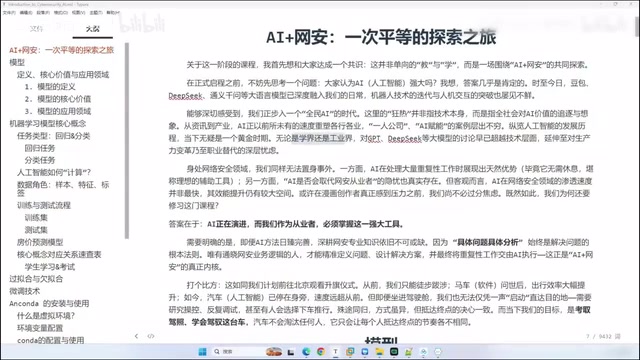
The tutorial opens with a judgment: some people see AI as an industry competitor or a replacement for human labor, but for ordinary people it is essentially a tool—developed by people, for people to use. Without anyone to steer it and without corresponding usage norms, AI may instead bring disastrous consequences.
This positioning is crucial. It determines that the learning path is not "wait for AI to do security for me," but "I learn to control AI to do security." The author calls the present a golden period of AI for everyone, with both academia and industry introducing AI, and cybersecurity is no exception.
What AI Can Do in Penetration Testing
According to this Bilibili creator's overview, AI's first value in security work is simplifying repetitive labor. Typical scenarios include: when facing a website, there are fixed testing templates, and you can have AI test according to the template; when facing a large amount of software, you need to determine whether there are problems and how to exploit them, and you can have AI invoke and execute.
The author uses the comics and film industries as an analogy: in the past, drawing a picture required a long process of sketching, tracing, and coloring; today AI has pushed costs very low, and short dramas can be presented in anime form, whether live-action, 2D, or 3D. The logic of simplifying security workflows is similar.
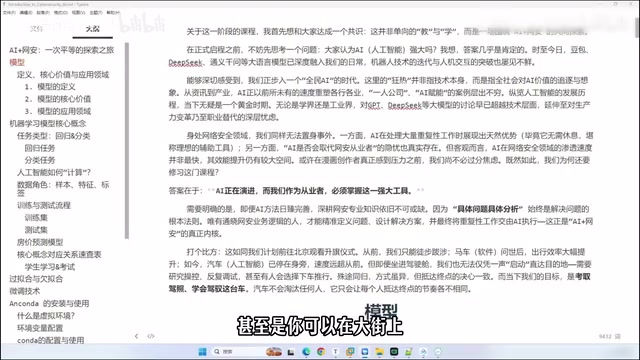
Penetration testing refers to simulating an attacker's thinking and methods, without damaging the target system, to probe and verify assets within an authorized scope in order to discover exploitable security flaws. The standard process generally includes information gathering, asset mapping, vulnerability detection, verification and exploitation, privilege escalation, and report output. A large number of these steps rely heavily on fixed templates and repetitive operations, such as checking common vulnerabilities item by item according to a checklist, batch-comparing fingerprints, and organizing scan results. This is exactly where AI can step in—it excels at batch execution and summarization according to established rules, but it is not good at judging business semantics out of thin air, so template quality and manual review determine the final effect.
The Prerequisite for Using AI Well Is Understanding Security Yourself
One viewpoint in the tutorial worth taking seriously is: AI sometimes gets "confused" and gives you an answer that looks satisfying but is actually deceiving you. Therefore users must have professional judgment—judging whether traffic is abnormal, whether a port can be exploited, whether an interface has privilege escalation—all of which require understanding business logic in order to pinpoint problems and design solutions.
In other words, AI is an amplifier, not a replacement. Your own ability is the foundation, and AI is an efficiency tool layered on top of that foundation.
From Agent to MCP: Specific Skills to Master
The author compares learning AI to learning to drive: the car is already parked beside you, far faster than walking, but you cannot "reach the destination with one click"; you have to learn how to drive, how to refuel, how to brake, and how to shift gears. Corresponding to AI, this means knowing how to write and invoke MCP, how to use prompts, how to make good use of an Agent, and where its implementation capability boundaries lie.
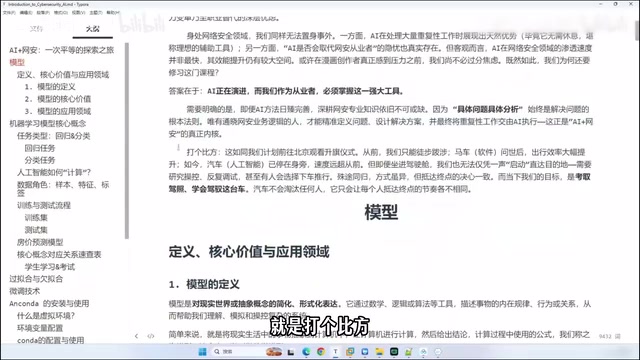
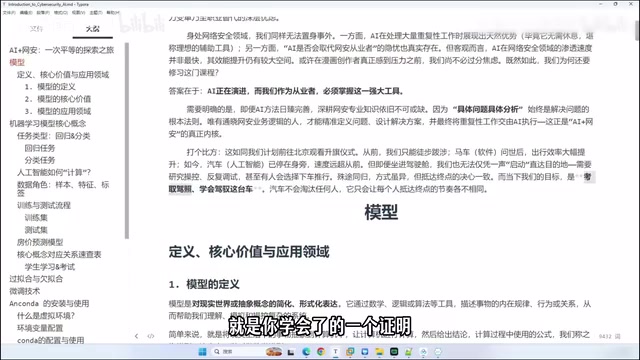
Passing the driving test is proof of learning, but before getting the license, the skill itself must first be practiced until proficient. The author emphasizes: cars will not eliminate anyone; they only make everyone reach the finish line at a different pace. Learning cybersecurity first and then AI, or learning AI first and then cybersecurity, are different paces, depending on the driver.
MCP (Model Context Protocol) is a protocol standard proposed and open-sourced by Anthropic at the end of 2024, with the goal of unifying the way large language models connect to external tools and data sources. Before MCP, making AI call a database, an API, or a local script often required writing adapter code separately for each model, creating a large amount of repetitive "glue layer." MCP abstracts these connections into standardized Server (the side providing capabilities) and Client (the model/host side), with tools, resources, and prompt templates all exposed in a unified format. For security practitioners, this means you can encapsulate your commonly used scanners, asset interfaces, and log queries into an MCP Server for Agents to call directly, without having to re-orchestrate the workflow each time. Understanding MCP's communication mechanism and permission boundaries is also a prerequisite for assessing whether an Agent will make unauthorized calls or leak sensitive data.
Agent (intelligent agent) differs from an ordinary chatbot in the key aspect of the "loop": it does not just generate a response, but continuously advances through a closed loop of "think—choose tools—execute—observe results—decide again" until the task is completed or a termination condition is triggered. What supports this process is the core capability of tool calling (function calling) and context management. Capability boundaries are usually reflected in three places: first, the scope of the toolset—an Agent can only do things for which it has been granted tools; second, the context window and memory—early information may be lost in long tasks; third, the reliability of autonomous decision-making—the more steps, the more obvious the accumulated error. Therefore, in high-risk scenarios such as penetration testing, Agents are better suited to controllable stages such as information gathering, templated detection, and result organization, while key judgments and destructive operations should still be controlled by humans.
The Pace Is Up to You
This tutorial is positioned as an introductory guide: first establish the understanding that "AI is a tool," then understand its subcomponents and usage norms, and finally move on to Agent building and real-world Web vulnerability practice. For practitioners who want to enter the AI + cybersecurity direction, this path provides an actionable starting point—not waiting for AI to mature, but starting now to learn to control it.
One-line Summary
Treat AI as a tool rather than a replacement, and move from Agent building toward real-world Web vulnerability practice.
Paragraph Summary
Based on a Bilibili tutorial, this article discusses what the AI wave means for cybersecurity practitioners. The author first establishes the cognitive premise: AI is a tool for people to control, not a replacement for human labor; without usage norms, it may instead bring risks, so the learning path should be "learn to control AI to do security." In terms of concrete value, AI's most direct role is simplifying repetitive labor such as penetration testing, for example testing websites according to templates and batch-invoking software to determine problems and exploitation methods; its cost-reduction logic is similar to the workflow compression in the comics and film industries. But the article emphasizes that AI can give answers that seem satisfying but are actually wrong, so users must have professional abilities such as judging traffic anomalies, port exploitability, and interface privilege escalation. At the skill level, it is necessary to master the writing and invocation of MCP, the use of prompts, and the capability boundaries of Agents, just like learning to drive rather than reaching the destination with one click. Finally, it points out that whether to learn cybersecurity first or AI first is only a difference in pace, depending on personal choice.
Related articles

ReelRoom: An Android Video Editor Powered by a 1M Token Context Window
ReelRoom is an Android video editor built on Gemini 4 Neon and a 1M token context window. It scans thousands of camera roll clips, categorizes them by scene, and generates publishable videos. This article breaks down its technical logic and impact on creator tools.

Sanders Talks AI: Billionaire Tax, Superintelligence Ban, and the Democracy Crisis
Bernie Sanders discusses the democracy crisis, a 5% annual billionaire tax, Medicare reform, and his support for banning superintelligence development.

Super-Hot Rock Geothermal: A New Solution to Data Centers' Energy Woes
Super-hot rock geothermal startups target data center power demand, claiming terawatt-scale delivery almost anywhere. We analyze the technology, its fit with data centers, and real-world challenges like drilling costs and regulation.